


Cheap Render or Flexible Tile: Which Facade Finish Is More Cost-Effective Over Time?
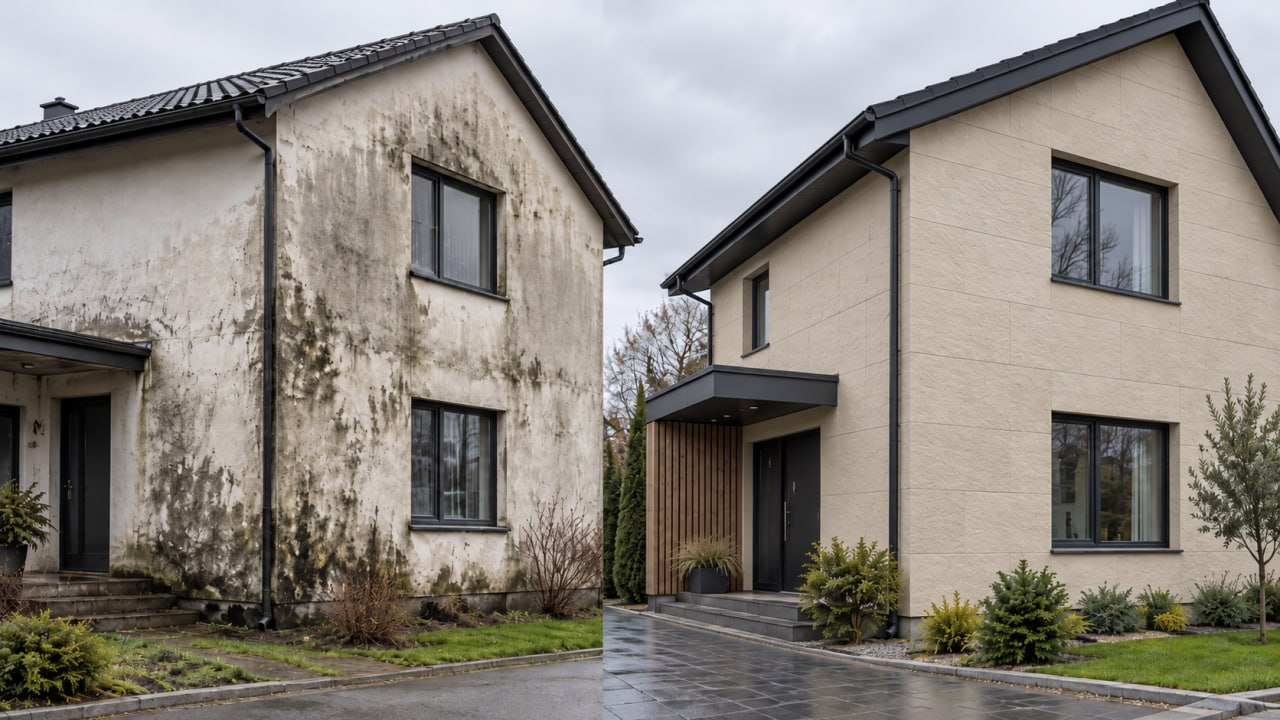
Low-cost facade render can reduce the initial cost of building or renovating a house. However, a lower upfront price does not necessarily mean that it will remain the most economical option over 10–15 years.
Over time, the facade is exposed to rain, frost, sunlight, and temperature fluctuations. The finish may require repainting, crack repairs, or other maintenance. That is why it makes more sense to compare not only the installation cost, but also the future cost of upkeep.
Why Cheap Render Does Not Always Save Money
Decorative render remains a common solution for private house facades. It is relatively affordable, offers a wide choice of colors and textures, and can be used in external insulation systems.
However, its durability depends greatly on substrate preparation, reinforcement quality, correct application, and operating conditions.
Over time, several problems may occur:
Cracks. Temperature changes, substrate movement, and reinforcement mistakes can lead to cracking.
Changes in appearance. Dirt, weather exposure, and wear of painted surfaces may make facade renewal necessary.
Local damage. Detached or damaged areas need to be repaired to prevent further deterioration.
Additional costs. Repainting, crack repair, materials, and professional labor all increase the overall cost of ownership.
This does not mean that every rendered facade will deteriorate quickly. A high-quality system can last for many years. However, when comparing budget render with more durable cladding, the possibility of future repair work should be taken into account.
How KORDEKO Flexible Tile Is Different
KORDEKO Flexible Tile (PletaFlex) is a thin mineral-polymer cladding material with textures that imitate natural stone, brick, slate, and other surfaces.
Unlike rigid cladding materials, the tile can bend. This allows it to adapt to curved areas and accommodate small substrate movements, helping reduce the risk of cracking in the cladding itself.
For long-term use, three characteristics are especially important:
Resistance to weather exposure. The material is designed for exterior use and exposure to moisture, freezing temperatures, and sunlight.
Retention of decorative appearance. Oxide pigments with UV resistance are used in production. According to the KORDEKO technical description, the material’s original appearance can be maintained for 10 to 30 years.
Simple maintenance. The surface does not require regular repainting. Ordinary dirt can be removed with periodic cleaning using water.
At the same time, flexible tile does not repair structural defects in the wall. If the substrate is deteriorating, delaminating, or has serious cracks, it must be restored before cladding is installed.
Which Is More Cost-Effective After 10–15 Years?
The difference between the materials is easier to understand by comparing several cost categories.
| Criterion | Budget Render | KORDEKO Flexible Tile |
|---|---|---|
| Initial material cost | Usually lower | Higher |
| Substrate preparation | Required | Required |
| Resistance to minor substrate movement | Depends on the system and reinforcement | Flexibility helps reduce the risk of cracking |
| Color renewal | Repainting may be required | Regular repainting is not required |
| Surface cleaning | Depends on the coating type | Can be cleaned with water |
| Local repair | Possible | Individual tiles can be replaced |
Imagine two identical houses. One has a facade finished with budget render, while the other uses flexible tile.
At the time of construction, the first option may cost less. However, if the render needs repainting and repairs over the following years, the initial savings will gradually decrease.
With the second option, the owner invests more in the cladding from the beginning in an effort to reduce future maintenance costs.
However, it would be incorrect to claim that KORDEKO will always be cheaper after a specific number of years. Such a conclusion requires actual material prices, labor costs, facade area, and estimated repair expenses.
The main difference is in the pattern of spending: render can reduce upfront costs, while more durable cladding may reduce the need for future maintenance and renewal.
Why Installation Quality Affects the Final Cost
Even an expensive material will not justify the investment if it is installed over an improperly prepared surface.
When installing KORDEKO Flexible Tile, the substrate is cleaned and checked for cracks, hollow areas, and irregularities. Where necessary, it is leveled and primed. A frost-resistant adhesive is used for exterior applications.
If the facade also requires thermal insulation, Facade Insulation should be considered together with the choice of the final finish.
The general requirements for external thermal insulation composite systems (ETICS) are set out in the European assessment documents published by EOTA.
In such a system, the insulation reduces heat loss, the reinforcement layer provides the required base, and the flexible tile forms the exterior decorative surface while protecting the system from weather exposure.
Saving money on substrate preparation, reinforcement, or adhesive while investing in more expensive final cladding is not practical. Mistakes at these stages can lead to additional costs regardless of the selected finish.
When Render Is Still a Reasonable Choice
Flexible tile is not necessarily required for every building.
Budget render may be a sensible option when initial costs are strictly limited, the facade has simple geometry, and the owner accepts the possibility of periodic maintenance.
Flexible cladding deserves more attention when the house is intended for long-term use, a natural stone or brick texture is desired, and regular facade repainting is something the owner would prefer to avoid.
The architecture of the building should also be considered. Columns, arches, rounded corners, and complex decorative elements are easier to finish with a material that can follow the shape of the surface.
See also: a facade that won’t date in 5–10 years; cladding an old facade without demolition; porcelain tile or flexible tile.
Conclusion
Cheap render is more economical in terms of initial investment, but not necessarily in terms of total long-term cost. If the coating requires several repairs or renewals, expenses over the years may increase significantly.
KORDEKO Flexible Tile requires a higher initial investment, but its properties can help reduce the need for regular facade maintenance.
The right choice therefore depends on how long the finish is expected to remain in service. If the priority is the lowest possible renovation cost today, budget render may be sufficient. If the facade is intended to serve for decades, it makes more sense to consider all future costs rather than only the purchase price of the material.
Frequently asked questions
Which is cheaper: render or flexible tile?
Does flexible tile always pay off?
When is render still a sensible choice?
Need advice on your facade?
- Get a free consultation for your project
- Find out which material suits your facade
- We'll answer all your questions and help you choose