


How flexible panels differ from porcelain tile and facade panels
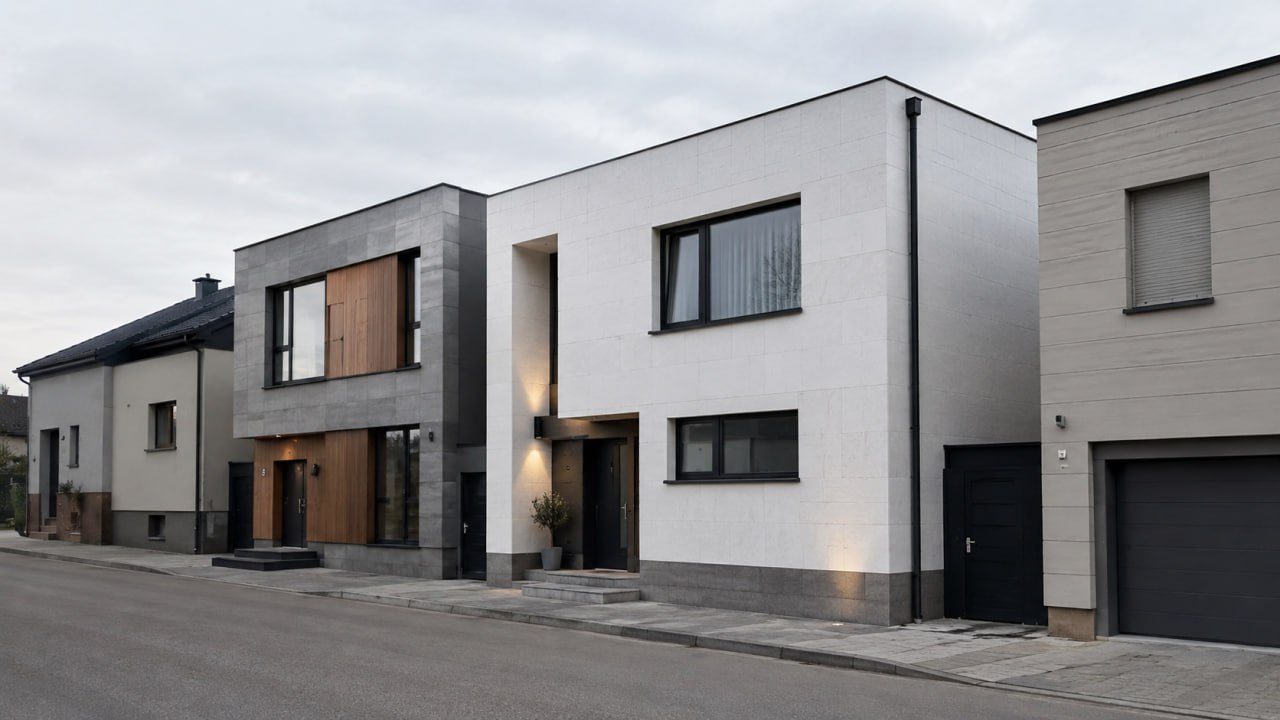
Porcelain tile, facade panels and flexible panels look like similar solutions, but they differ in weight, logistics, installation and total cost. A comparison across the facade's whole life cycle.
When choosing a facade finish, three solutions are frequently compared: porcelain tile, facade panels and flexible panels. At first glance they all serve the same purpose — to cover the walls and give the house an attractive look. In practice, though, the differences matter: weight, installation, logistics, the load on the facade, repairs and long-term costs.
If we analyse not just the material's price per square metre but the facade's entire life cycle, lightweight cladding often turns out to be the more practical and rational choice.
Why cladding weight matters for a facade
Porcelain tile is a heavy material. For a facade this means:
- a higher load on the base;
- stricter fixing requirements;
- more complicated installation over thermal insulation;
- higher costs for transport and lifting the material;
- a greater risk of problems on weak or old walls.
Facade panels can be lighter than porcelain tile, but a lot depends on the panel type, the substructure and the fixings. Sometimes, together with the frame and additional components, the final system can become quite bulky.
KORDEKO flexible panels (PletaFlex) belong to the category of lightweight facade solutions. They suit situations where it's important not to overload the structure: private houses, insulated walls, plinths, entrance zones, balconies, loggias, terraces and decorative elements.
Logistics: transport, storage and work on site
Weight affects not only the wall but every cost before installation:
- transport;
- unloading;
- storage on site;
- lifting to height;
- the risk of breakage and damage;
- more people needed for handling.
Porcelain tile requires careful transport and storage. If a tile gets damaged, it can sometimes be hard to quickly find the same shade or format again.
Facade panels also need space, careful transport and proper storage conditions, especially if the elements are long or bulky.
Flexible panels are simpler logistically: lighter, more convenient to transport, and they don't demand the same heavy site organization as massive cladding.
Installation: where the difference shows
Porcelain tile installed on a facade requires strict adherence to the technology. Depending on the system, it may need adhesive, mechanical fixing, a substructure, joints, special profiles and careful control of flatness.
Facade panels can go up faster, but they need a correct substructure, precise geometry, fixing systems and clean joints. If the lines aren't straight, the facade can instantly look cheap.
Flexible panels are especially practical for the complicated details:
- corners;
- window sills;
- plinths;
- columns;
- arches;
- the entrance zone;
- stair risers;
- the sides of staircases;
- small architectural elements.
In the places where a rigid tile must be cut and fitted painstakingly, flexible cladding makes working with shapes and details easier — provided correct flexible-panel installation is followed.
Which finish integrates better with thermal insulation
When facade insulation is carried out, you have to consider not only the exterior look but also the load on the whole system. The heavier the final finish, the higher the requirements for the base, reinforcement, fixings and technical details. The general principles of these systems are described by the European ETICS Association.
Heavy cladding may require additional solutions, strengthening and more complicated installation. And if the project is on an old house, the risk of errors can be higher.
A lightweight facade fits into an insulated system more simply: lower load, simpler details, and easier work around sills, corners and transitions. More on this approach in the article about a thin facade with exterior insulation.
Service life: the whole system matters, not just the material
Porcelain tile can itself be a very durable material, but a facade isn't made of a single layer. What matters is how it's fixed, how the joints behave, how water drains, and how the corners and junctions are made.
Facade panels can also last a long time if chosen and installed correctly. Still, the vulnerable zones often appear at the joints, the fixings, the corners and around the windows.
An important advantage of KORDEKO flexible panels is the combination of a decorative stone look with practicality for facades. It doesn't look like a temporary solution, yet it stays light and convenient for the difficult zones.
What a facade actually costs
Comparing only the material price per square metre is a mistake. It's more accurate to calculate the total cost:
- material;
- transport;
- unloading;
- base preparation;
- fixings or adhesive;
- installation;
- cutting;
- material waste;
- repairing damage;
- maintaining the facade over time.
Sometimes a material looks cheap at purchase but ends up more expensive because of complex installation, difficult logistics and a large number of additional components.
Lightweight facade cladding can win precisely on the project's total cost: lower load, simpler transport, faster installation and fewer complicated details.
Why lightweight cladding doesn't look cheap
The word "lightweight" for a facade refers to the structural weight, not the visual effect.
Flexible panels can reproduce the texture of stone and be used on large facade surfaces, the plinth, the entrance zone and architectural details. The house gets a solid, expressive look without heavy cladding and without a complicated substructure. You can see how it looks on real buildings in the gallery of completed projects.
When porcelain tile is worth choosing
Porcelain tile can be a good solution if:
- the project is engineered for heavy cladding from the start;
- there is a strong base or a suitable substructure;
- a strict look with large formats is wanted;
- the budget covers not just the material but the installation;
- the site is prepared for more complex logistics.
Still, for private houses, insulated facades and complicated details, it isn't always the most convenient option.
When facade panels are the right fit
Facade panels suit projects that want fast installation and a clear modular system. However, you need to account for:
- how the joints look;
- the quality of the fixings;
- behaviour under sun exposure;
- repairability;
- integration with the plinth, sills and corners.
A panel facade can look good, but if the layout isn't done right, the look can quickly turn too "technical" and less architectural.
When flexible panels are the most practical choice
Flexible panels are especially advantageous when you need to:
- build a lightweight facade;
- finish insulated walls;
- dress the plinth and entrance zone;
- finish corners and window sills neatly;
- reduce the load on the structure;
- get the look of stone without heavy cladding;
- simplify logistics and installation.
This solution suits private houses, renovations, facade work done in stages, and projects where long-term practicality matters.
Conclusion
If porcelain tile, facade panels and flexible panels are compared by looks alone, all the options can seem similar. In a real project, though, what matters is weight, transport, installation, joints, the load on the facade and maintenance costs.
KORDEKO flexible panels are a lightweight facade solution with the look of stone that installs conveniently over insulation, on plinths, corners, sills and complicated architectural details. This approach delivers an attractive finish without unnecessary load and without overly complicated logistics.
Frequently asked questions
Which is lighter: porcelain tile or flexible panels?
Can cladding be installed over an insulated wall?
How do you compare facade costs correctly?
Need advice on your facade?
- Get a free consultation for your project
- Find out which material suits your facade
- We'll answer all your questions and help you choose