


KORDEKO flexible facade: can you clad an old facade without full demolition?
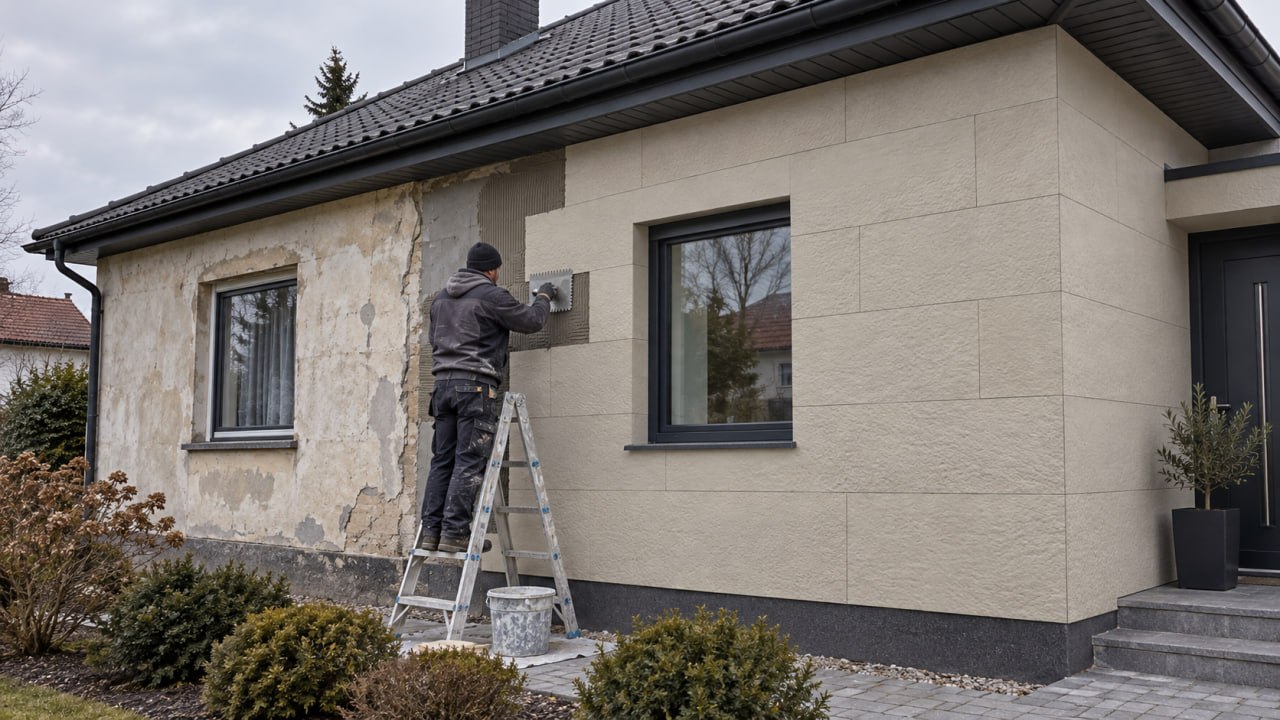
Renovating an old house does not necessarily mean completely removing the existing facade finish. In many cases, a new facade system can be installed over the existing substrate, provided that it is in suitable condition and capable of supporting the new layers.
This can be especially useful during renovation projects where the goal is to change the appearance of the house, improve insulation, and install new cladding without unnecessary demolition costs.
However, there is one important condition: the old finish should never simply be covered with a new one without first checking its condition.
When the Existing Facade Can Be Kept
The existing finish may remain as a substrate for the new facade if it is:
- strong;
- stable;
- firmly bonded;
- free from areas that easily crumble or fail;
- free from permanently damp zones;
- capable of providing reliable adhesion for the following layers.
If the old plaster is firmly attached, there are no widespread areas of delamination, and the substrate can be properly prepared, full demolition may not be necessary.
When Demolition Is Still Necessary
There are situations where the old finish should not be covered.
For example, if the facade has:
- peeling or detached plaster;
- weak areas;
- large cracks;
- unstable old coatings;
- constant moisture exposure;
- mold or other signs of long-term dampness;
- areas that cannot provide a reliable substrate.
If the existing surface layer has already lost its strength, installing new cladding over it will not make it stronger.
It will simply place the new system over an existing problem.
Why Appearance Alone Is Not Enough
An old wall may look perfectly acceptable while still containing weak areas.
Before renovation, it is important to check not only how the facade looks, but also:
- how firmly the existing coating is attached;
- whether there are hollow areas;
- whether any sections are delaminating;
- how even the surface is;
- whether there are signs of continuous water penetration.
Special attention should be paid to areas around windows, the plinth, flashings, and drainage systems.
What to Do with Minor Damage
If the existing finish is generally strong but contains a few damaged areas, there is no need to remove the entire facade.
The problem areas can be repaired locally:
- Remove the weak section;
- Clean the substrate;
- Restore the damaged surface;
- Level the necessary areas;
- Prepare the substrate for the new system;
- Install the new cladding afterward.
This approach allows the parts of the old facade that are genuinely in good condition to be preserved.
What If the House Also Needs Insulation?
In this case, the task becomes slightly different.
When carrying out Facade Insulation, the existing finish can only become part of the prepared substrate after its condition has been assessed and if it is compatible with the selected insulation system.
The general requirements for external thermal insulation composite systems (ETICS) are set out in the European assessment documents published by EOTA.
The new structure is then built up as follows:
existing wall → prepared substrate → insulation → reinforcement layer → primer → adhesive → final cladding.
How each of these layers is carried out is described in the article facade insulation step by step.
It is important that every following layer has a reliable substrate and is compatible with the layer beneath it.
Why Flexible Tile Is Convenient for Renovation
KORDEKO Flexible Tile (PletaFlex) is lightweight and can be used to renovate a facade without installing a heavy cladding system.
How much such cladding weighs compared with traditional options is covered in the article how much a flexible tile facade weighs.
This can be particularly useful when renovating older buildings where it is important to control the additional load on the structure.
The material can be used on:
- large wall surfaces;
- plinths;
- corners;
- window reveals;
- entrance areas;
- columns;
- individual architectural elements.
An Old Facade Does Not Have to Look New
This is an important point.
If the existing finish has minor visual imperfections, that does not automatically mean it must be completely removed.
The key requirement is that the substrate is:
strong + stable + properly prepared + compatible with the new system.
At the same time, major level differences, weak areas, and damaged sections must be corrected before installation begins.
Pay Special Attention to Moisture
If the old facade is regularly exposed to moisture, the cause should be identified first.
Where moisture in a wall comes from and how to protect a facade from efflorescence is covered in the article protecting a facade from moisture and efflorescence.
The following should be checked:
- drainage systems;
- flashings;
- window sills;
- connection points;
- the plinth;
- canopies;
- junctions between the facade and terraces or balconies.
Junctions around windows, sills and drains are treated separately in the article facade junctions and protection against leaks.
There is no point in covering a damp wall with new cladding before the source of water has been eliminated.
Otherwise, the problem will remain inside the structure.
How to Determine Whether Full Demolition Is Necessary
Before starting work, it can be useful to divide the facade into three general categories.
Good Substrate
Strong, stable, and without significant damage.
The existing layer may be suitable for preservation.
Locally Damaged
There are individual weak areas, but most of the coating remains strong.
Partial repair followed by preparation may be possible.
Severely Damaged
There are widespread areas of delamination, deterioration, cracking, or permanent moisture exposure.
More extensive reconstruction may be required, including complete removal of the old finish in some cases.
Why It Is Not Worth Saving Money on Inspection
Complete removal of an old facade can indeed be expensive and labor-intensive.
However, trying to preserve everything without proper inspection can lead to even higher costs later.
If a weak substrate is covered with new cladding, future repairs may involve not only the old surface but also the newly installed system above it.
The right way to save money is not to “remove nothing,” but to preserve everything that can genuinely and safely remain in place.
Mini Checklist Before Cladding an Old Facade
Before beginning work, check:
- Is the existing coating strong?
- Are there any areas of delamination?
- Are there large cracks?
- Is there any permanent moisture exposure?
- Is the substrate sufficiently even?
- Can reliable adhesion with the new system be achieved?
- Will the new cladding create excessive additional load?
- Are the windows and flashings correctly installed?
- Is the plinth in good condition?
- Is the selected installation system suitable for the existing substrate?
Conclusion
Yes, in many cases an old facade can be reclad without complete demolition. However, this does not mean that new cladding can simply be installed directly over the existing finish.
The condition of the existing substrate must first be assessed. Strong and stable areas can be preserved, local damage can be repaired, while weak or permanently damp layers should be removed and replaced.
Thanks to its low weight and ease of installation, KORDEKO flexible tile can be an effective solution for renovating older facades. However, the durability of the new finish begins not with the cladding itself, but with a properly prepared substrate.
Frequently asked questions
When can an old facade stay in place?
When is demolition unavoidable?
What if the house also needs insulation?
Need advice on your facade?
- Get a free consultation for your project
- Find out which material suits your facade
- We'll answer all your questions and help you choose