


KORDEKO flexible facade: thermal bridges that can compromise your home's insulation
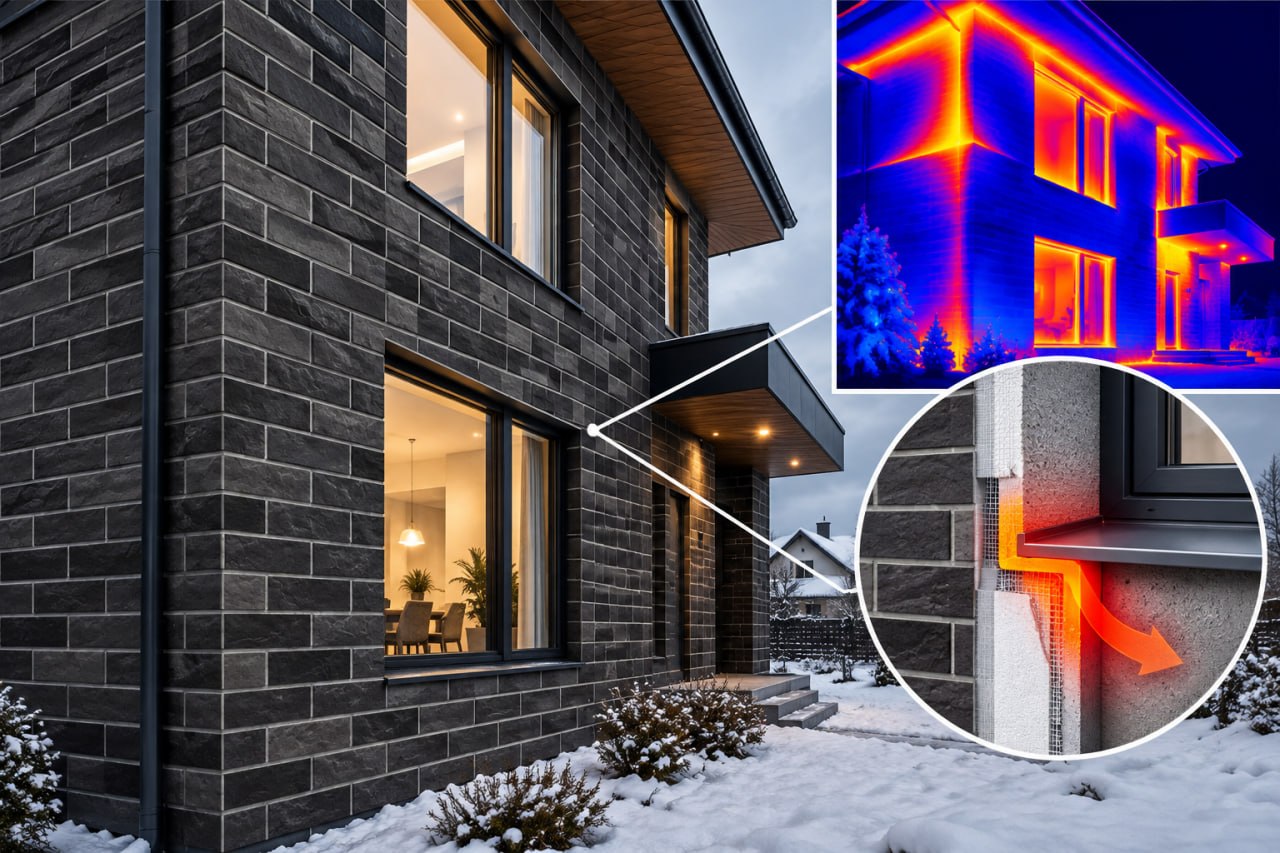
You can spend a considerable amount of money insulating your home, install high-quality insulation, and still get results that fall far short of your expectations. Sometimes the problem lies not in the insulation material itself, but in small areas through which heat continues to escape.
These areas are called thermal bridges. Although they occupy relatively little space, they can significantly affect wall surface temperatures, indoor comfort and the efficiency of the entire insulation system.
What is a thermal bridge
A thermal bridge is an area of a building's envelope through which heat passes more quickly than through the surrounding insulated areas.
Imagine a large wall completely covered with insulation. If the insulation is interrupted in one area, is too thin, or has an improperly installed joint, heat loss through that particular area will be greater. The problem is that such defects may be almost invisible from the outside.
Where thermal bridges most commonly occur
Several areas of a facade require special attention:
- building corners;
- window and door openings;
- window and door reveals;
- junctions between walls and floor slabs;
- balconies;
- the plinth;
- mechanical fasteners;
- joints between insulation boards;
- roof junctions;
- connections between different structural elements.
The more complex a house's architecture, the more junctions and details need to be executed correctly.
Why gaps between insulation boards matter
One simple but important mistake is leaving gaps between insulation boards. If the boards are installed with large gaps, the continuous thermal insulation layer is interrupted, creating areas through which heat can escape much more easily. This can result from:
- incorrect cutting;
- an uneven substrate;
- rushed installation;
- the use of damaged insulation boards;
- incorrect board layout.
The insulation should form a continuous layer with as few unnecessary interruptions as possible.
Why windows are among the most complex areas
Even a well-insulated wall can have cold spots around windows. This may be caused by incorrectly finished reveals, insufficient insulation around the window frame, or poorly executed junctions. It is especially important to check:
- how the window reveals are insulated;
- where the insulation layer ends;
- whether there are gaps around the window frame;
- whether the installation joint has been properly executed;
- how the exterior window flashing is installed;
- whether the junction is protected against water penetration.
If these details are poorly executed, a cold spot may develop right next to an otherwise well-insulated wall. How reveals, flashings and junctions are done properly is covered in a separate article.
Why building corners also need attention
At building corners two walls meet, making the insulation geometry more complicated. If insulation boards are incorrectly cut or weak areas remain between them, the corner can become a thermal bridge. This is particularly noticeable in winter, when interior corners may feel colder than other surfaces.
Insulating corners is therefore not simply a matter of covering the walls with boards. Proper interlocking of the insulation, the absence of voids, and correctly installed reinforcement are essential.
How fasteners create weak points
Some facade systems use mechanical fasteners. When these penetrate the thermal insulation layer, their design and quantity also affect the system's thermal performance. The more areas that interrupt the continuity of the insulation, the more potential points of heat loss there are.
Mechanical fasteners should therefore comply with the requirements of the specific facade system and its manufacturer.
Balconies and other projecting structures
Balcony slabs, canopies, concrete projections and other elements connecting the interior and exterior parts of a building can conduct heat directly through the structure. These areas are known as linear or structural thermal bridges. Particular attention should be paid to:
- balcony slabs;
- concrete lintels;
- reinforced concrete elements;
- staircase junctions;
- connections between extensions and the main building.
In these areas, simply insulating the adjacent wall may not be sufficient.
The plinth: a thermal bridge at the bottom of the house
If the walls are insulated but the lower part of the building is left without proper thermal insulation, heat can escape through the plinth area. This is particularly noticeable on the ground floor: the floor near exterior walls becomes colder, and the interior surfaces at the bottom of the walls may have lower temperatures.
The plinth should therefore be designed together with the rest of the facade rather than added at the very end as a purely decorative element. Why the plinth ages faster than the rest of the facade, and what to clad it with, is the subject of a separate article.
Why the final finish cannot correct poor insulation
The finishing material covers the facade, but it does not replace thermal insulation or eliminate thermal bridges within the structure.
KORDEKO flexible tile (PletaFlex) can be used as the final cladding of an insulated facade. It allows large wall surfaces, corners, reveals, the plinth and other architectural features to be finished neatly. However, if the insulation underneath has been installed incorrectly, contains voids or has poorly executed junctions, the cladding itself will not eliminate heat loss, just as it cannot rescue insulation that lets water in.
How insulation should function as a complete system
When Facade insulation is carried out, it is important to ensure the continuity of the entire system: wall → insulation → reinforcement layer → primer → adhesive → final cladding. Windows, corners, the plinth, balconies, the roof, flashings and other complex junctions must also be inspected separately.
The main objective is not simply to install insulation over a large surface, but to avoid leaving weak points wherever the structure changes shape or connects to other elements. The continuity of the thermal envelope is also what the EU requirements for energy-efficient buildings are built on.
How to detect thermal bridges
If a house has already been insulated but the results are unsatisfactory, several methods can be used to investigate. One of the most revealing is a thermal imaging inspection. It makes it possible to identify areas with lower surface temperatures and locate places that require further investigation. It is particularly useful to inspect:
- corners;
- windows;
- the plinth;
- balconies;
- structural joints;
- areas around fasteners;
- the upper part of the facade.
Such inspections should be carried out when there is a suitable temperature difference between indoors and outdoors, so that the thermal images provide useful information.
How to prevent thermal bridges during installation
Before starting work, the following should be checked:
- The flatness and condition of the substrate.
- The correct layout of the insulation boards.
- The absence of large gaps.
- Proper treatment of corners.
- Insulation of window and door reveals.
- Junctions with the plinth.
- Balcony junctions and projecting structural elements.
- Fasteners and their positioning.
- Roof junctions.
- Flashings and moisture protection.
The earlier a mistake is discovered, the less expensive it is to correct.
Conclusion
Expensive insulation does not guarantee good results if thermal bridges remain within the system. Sometimes the problem is caused by just a few centimetres of incorrectly installed insulation, a gap near a window, an uninsulated plinth or a poorly designed structural junction.
The efficiency of a facade therefore depends on more than the thickness of the insulation. The continuity of the entire thermal insulation system and the quality of every complex detail are equally important.
KORDEKO flexible tile can serve as the final cladding of such a system, but its overall efficiency begins much earlier — with proper insulation, reinforcement, correctly executed junctions and the elimination of thermal bridges.
Frequently asked questions
What is a thermal bridge?
Where do thermal bridges appear most often?
How do I find thermal bridges in a house that is already insulated?
Need advice on your facade?
- ·Get a free consultation for your project
- ·Find out which material suits your facade
- ·We'll answer all your questions and help you choose