


Window sills, drip sills and canopies: façade junctions that do not leak
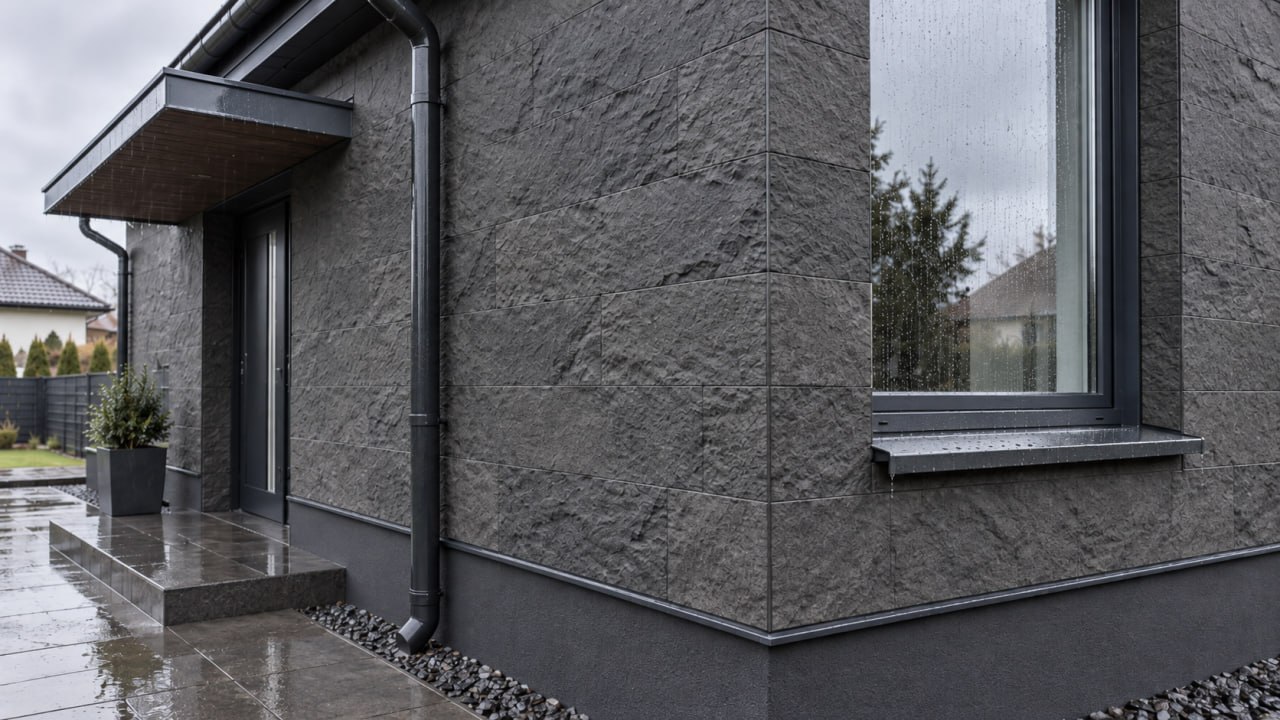
A beautiful façade can be spoiled by one small mistake: a badly made junction. Water rarely damages a façade through the middle of a flat wall. It usually finds the weak points instead: window sills, drip sills, canopies, joints around windows, transitions to the plinth and the corners.
When those details are done wrong, damp patches, run marks, efflorescence, delamination and dirty streaks appear over time. That is why a good façade starts not only with the choice of material, but with properly protecting every place where water can collect or work its way in.
Why are junctions the most vulnerable part of a façade?
On a flat wall, water usually runs straight down. Around window sills, drip sills, canopies and decorative elements, though, it can linger, get into gaps and travel behind the finish.
Problems most often appear where:
- the drip sill has no fall;
- there is no drip edge;
- the sealant was applied carelessly;
- the window sill is too short;
- water from the canopy runs down the wall;
- the junction is a plain butt joint with no protection;
- the tile has been cut into a strip that is too thin;
- drainage away from the plinth was never planned.
The result is a façade that may be new but already looks tired after a single season.
Drip sills: a small detail that protects a large wall
A drip sill should do more than cover the bottom of the window. Its job is to lead water away from the façade. If water runs down the wall, the drip sill is not working.
A correct drip sill needs:
- a fall towards the outside;
- enough projection from the wall;
- a drip edge;
- neatly finished side ends;
- a sealed junction with the window and the reveals.
If the drip sill is short or almost horizontal, water will sit on it, creep back and leave marks below the window.
Window sills: where water shows up most often
An exterior window sill takes rain, snow, dust and dirt all the time. That is why it must never send water back towards the façade.
Typical mistakes:
- the sill is fitted without a fall;
- its edges are not protected;
- water runs off onto the reveal;
- the joint next to the window is poorly sealed;
- there is no drip edge underneath;
- a weak, open joint is left under the sill.
Even a small gap beside a window can eventually cause run marks, damp patches and damage to the substrate.
Canopies: protecting the entrance, or a source of run marks?
A canopy should protect the entrance, not create new problems. If water is not led off it properly, rain runs along its edges, reaches the wall and stains the finish around the door.
When a canopy is installed, think through:
- where the water goes;
- whether the front edge has a drip edge;
- whether water runs down the side walls;
- whether the junction with the façade is protected;
- whether moisture gets behind the finish;
- how the canopy works with the cladding and the entrance.
This matters most above the entrance, because that part of the façade is seen every day and any run mark spoils it at once.
Sealing: to protect, not to cover up
Sealant should never be used to hide poor installation. Its job is to close a correct detail that was prepared in advance.
Good sealing needs:
- a clean substrate;
- a dry surface;
- the right joint width;
- a compatible sealant;
- careful application;
- protection from standing water.
Simply running sealant over a dirty or wet joint will not solve anything. In time the joint can come away, crack or start letting water in. Façade sealants are construction products, and their requirements are set at European level by the Construction Products Regulation.
What is a drip edge, and why is it needed?
A drip edge breaks the flow of water so that it does not cling to the lower edge and run down the façade. It can be a special drip sill profile, an edge, a trim or a properly formed projection.
Without one, water often goes where it should not: under the window, onto the reveal, down the wall, into the joint, onto the plinth and behind the final finish.
A drip edge is therefore not a decorative extra but a working part of the façade's protection.
How flexible tile meets drip sills and window sills
The final cladding has to meet drip sills, window sills and canopies neatly. Random gaps, weak edges and thin strips at the junctions are not acceptable.
KORDEKO flexible tile (PletaFlex) suits façades with complex details: it can be used on walls, the plinth, reveals, the entrance area, corners and next to decorative elements. The result, though, depends on how well those details are prepared.
It is especially important to plan the layout around windows and the entrance in advance, so the tile never meets a drip sill as small random offcuts. That is why installing flexible tile starts with the details, not the large surfaces.
On an insulated façade, junctions must be designed in advance
When façade insulation is installed, every detail matters even more. The system includes the insulation, the reinforcing layer, mesh, adhesive, primer and the final cladding. If water reaches a weak point, the problem can affect not just the outer layer but the whole system.
Pay particular attention to:
- window reveals;
- the bottom line of the drip sill;
- the top of the plinth;
- the entrance area;
- canopy fixing points;
- joints with cornices;
- areas under downpipes.
A correct junction is not just neat on the surface; it is protected inside.
Typical mistakes on site
- The façade goes up first and the drip sills are thought about later. Tiles then have to be cut, reworked and joints closed however they can be.
- The drip sill is fitted without enough projection. Water falls straight onto the wall or plinth.
- No drip edge is made. Water is drawn under the edge and runs down the façade.
- Sealant is applied to an unprepared surface. The joint quickly stops being watertight.
- The side ends of the drip sill are left unprotected. Water gets into the reveals and leaves stains.
- The tile is cut into a thin strip next to the window. That area looks weak and gets damaged sooner.
A short checklist for leak-free junctions
Before the façade is finished, check that:
- every drip sill falls towards the outside;
- the drip edge breaks the flow of water;
- the drip sill projects far enough;
- the side ends are protected;
- junctions with windows and reveals are sealed;
- the canopy does not shed water onto the façade;
- the tile meets every detail neatly, with no random thin strips;
- the substrate is dry, sound and primed;
- water drains away from the plinth, not towards the wall;
- every joint was planned before the final finish went on.
Conclusion
Façade leaks most often start not because of the cladding itself, but because of weak junctions. Window sills, drip sills, canopies, drip edges and sealing have to work as one system that leads water away from the wall.
KORDEKO flexible tile helps make a façade neat and practical, but it has to be installed together with correct details. Then the walls stay dry, the plinth gets less dirty and the façade keeps its clean, finished look for longer.
Frequently asked questions
Why do run marks appear under windows even on a new façade?
What is a drip edge, and why is it needed?
Can sealant fix a badly made junction?
Need advice on your facade?
- ·Get a free consultation for your project
- ·Find out which material suits your facade
- ·We'll answer all your questions and help you choose