


Safe Facade Cladding for a Home: Which Material Characteristics Really Matter
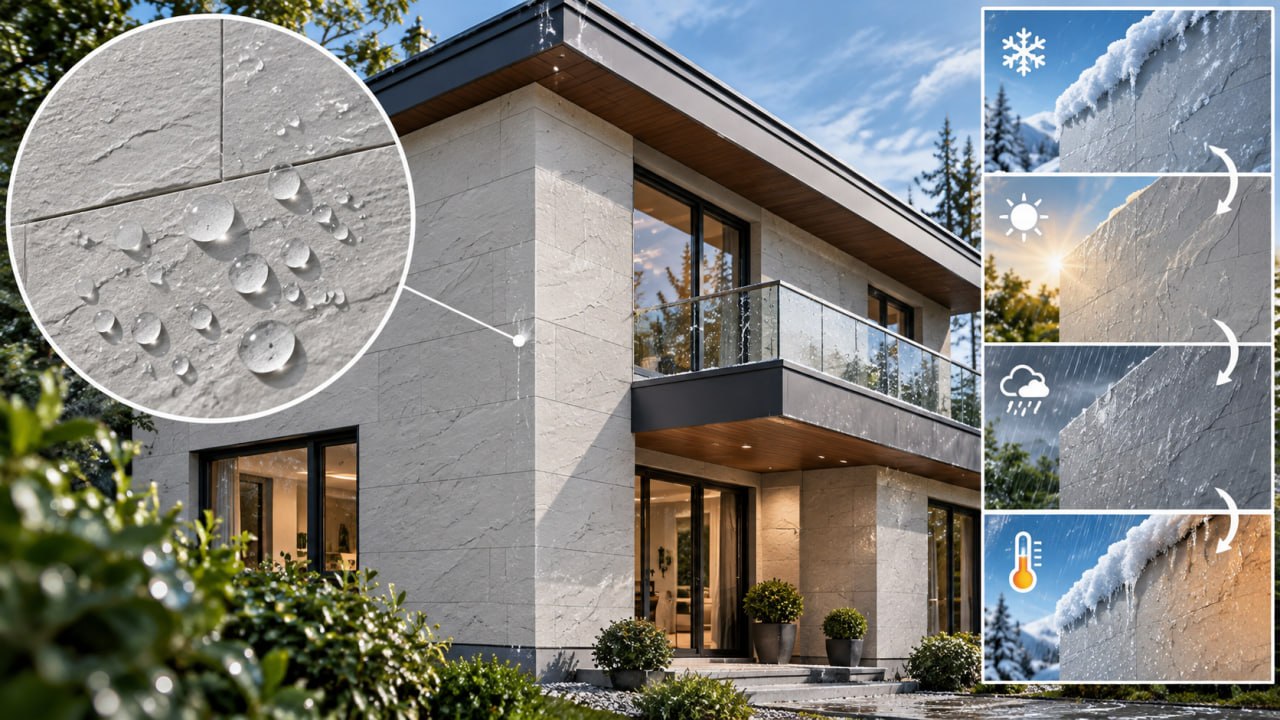
When choosing facade cladding, it is not enough to consider only its appearance and cost. The material is exposed every day to rain, frost, sunlight, and temperature fluctuations. Its properties affect not only the durability of the finish, but also the safe operation of the building.
That is why, before purchasing facade cladding, it is important to consider the material composition, fire performance, moisture resistance, weight, and compatibility with the facade structure.
Environmental Safety and Material Composition
Facade safety begins with understanding what the material is made of.
KORDEKO Flexible Tile (PletaFlex) is produced on a mineral-polymer base. Its composition includes white cement, quartz sand or marble powder, acrylic dispersion, and inorganic oxide pigments. Additional strength is provided by a reinforcing non-woven membrane.
According to the manufacturer’s technical description, the material is stated to be safe for human health and the environment.
However, environmental safety cannot be assessed only by the presence of natural components. Specific sanitary and environmental characteristics should be confirmed by the relevant product documentation and test reports.
Facade Fire Safety
When choosing cladding, its reaction to fire must also be considered, especially for multi-storey buildings or facades with external thermal insulation.
The general requirements for external thermal insulation composite systems (ETICS) are set out in the European assessment documents published by EOTA.
Fire safety depends not only on the decorative tile itself, but also on the insulation, adhesives, reinforcement materials, and the design of the entire facade system.
KORDEKO documentation refers to fire reaction testing carried out in the Czech Republic. However, the specific reaction-to-fire classification should be checked in the relevant test report to determine where and how the material can be used.
Fire barriers and other structural fire-safety measures required by applicable building regulations should also be taken into account.
Moisture Resistance and Resistance to Climatic Loads
Exterior cladding is constantly exposed to weather. If moisture penetrates damaged areas of the facade, freezing can contribute to deterioration of the finishing layers.
For residential buildings, several characteristics are especially important:
- Moisture resistance — the ability of the finish to retain its properties when exposed to water.
- Frost resistance — resistance to sub-zero temperatures and repeated freeze-thaw cycles.
- Flexibility — the ability to accommodate small deformations without cracking.
- UV resistance — the ability to preserve decorative properties under sunlight exposure.
According to the KORDEKO technical description, the flexible tile has these characteristics. However, even weather-resistant cladding cannot replace proper drainage or correctly sealed facade junctions.
Why Cladding Weight Affects Structural Safety
Heavy facade finishes create additional loads on walls and fixing elements.
For example, according to the KORDEKO technical description, flexible tile weighs approximately 4 kg/m², while some types of natural stone may weigh around 20–35 kg/m².
Low weight is particularly useful when renovating older buildings or finishing insulated facades.
However, the total weight of the complete system must still be considered, including adhesive and additional layers. A lightweight cladding material does not eliminate the need to check the strength and condition of the substrate.
Material Compatibility and Correct Installation
Even cladding with good technical characteristics can become unreliable if it is installed incorrectly.
Facade Insulation requires compatibility between all components: thermal insulation, adhesive, reinforcement layer, primer, and decorative finish.
Before installing flexible tile, the walls must be checked for strength, loose areas should be removed, and the surface should be properly prepared.
A frost-resistant adhesive is used for exterior applications. The required installation temperature conditions must also be respected.
Reinforcement mistakes, incorrect fixing of the insulation, and improper substrate preparation can lead to cracks and delamination regardless of the quality of the cladding itself.
See also: what flexible tile is made of: composition and safety; heavy or lightweight cladding: why weight matters; heat, frost and temperature swings on a facade.
Conclusion
Safe facade cladding should be suitable for the building’s operating conditions, meet relevant fire-safety requirements, and be compatible with the substrate and facade system.
When selecting a material, it is important to consider not only environmental characteristics, but also moisture resistance, frost resistance, weight, mechanical properties, and the availability of supporting technical documentation.
KORDEKO Flexible Tile combines low weight, flexibility, and resistance to atmospheric exposure. However, the reliability and safety of the finished facade depend on the entire system and the quality of installation, not only on the properties of the decorative finish.
Frequently asked questions
What is KORDEKO flexible tile made of?
What fire classification does flexible tile have?
Why does cladding weight matter for safety?
Need advice on your facade?
- Get a free consultation for your project
- Find out which material suits your facade
- We'll answer all your questions and help you choose