


Eco-Friendly Facade Finishing: KORDEKO Flexible Tile Composition and Safety for Residential Homes
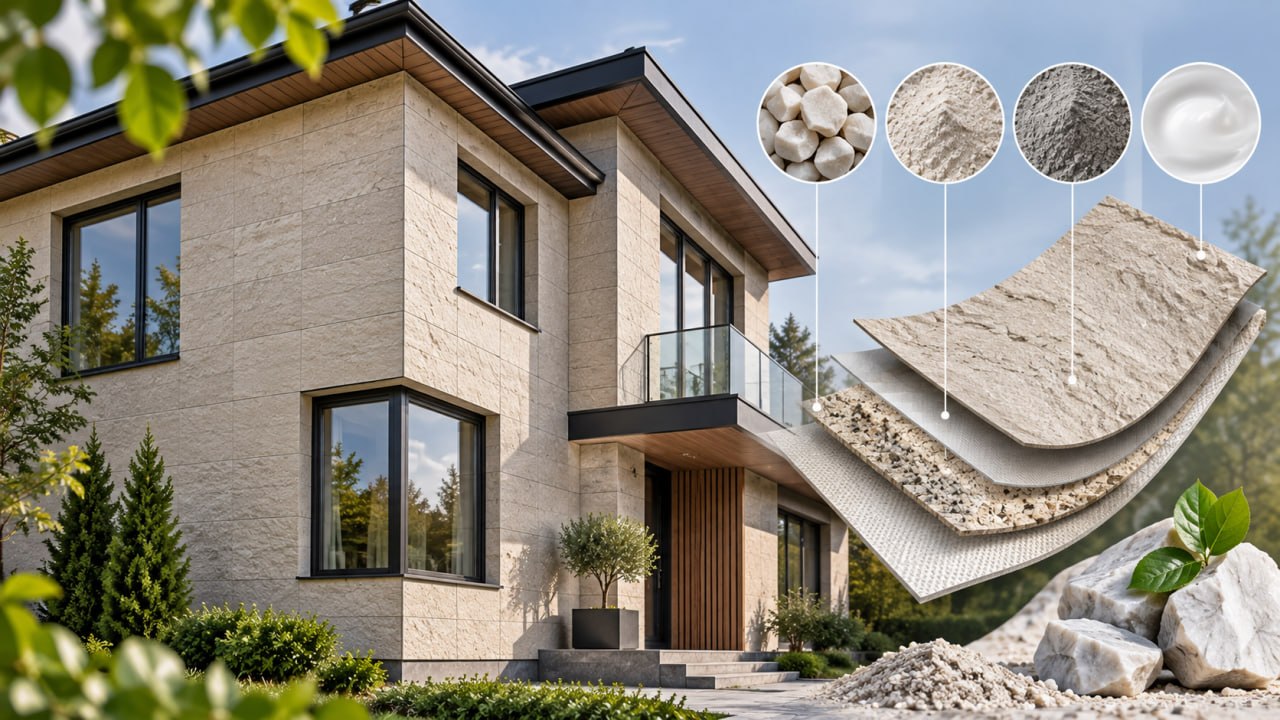
When choosing facade cladding, more and more attention is being paid not only to appearance and durability, but also to the composition of the material. This is especially important for private homes, where the safety of building materials and living comfort matter.
KORDEKO Flexible Tile contains natural mineral components and a polymer binder. Below, we explain what the material is made of, the role of each component, and what is known about its safety.
What KORDEKO Flexible Tile Is Made Of
KORDEKO Flexible Tile (PletaFlex) is a mineral-polymer cladding material manufactured using PletaFlex technology. Unlike conventional rigid tiles, it can bend while maintaining the integrity of its decorative surface.
The composition includes the following components:
- White cement — a binding component that forms a strong mineral base.
- Quartz sand or marble powder — natural mineral fillers that create volume and a stone-like texture.
- Acrylic dispersion — a polymer binder that provides flexibility and moisture resistance.
- Oxide pigments — inorganic colorants resistant to ultraviolet exposure.
- Reinforcing non-woven membrane — strengthens the tile and helps it bond with the adhesive.
- Thickener and water — used to achieve the required consistency during production.
Therefore, KORDEKO cannot be described as completely natural stone without additional components. The material combines mineral raw materials with polymer components that are necessary to provide flexibility.
Is Flexible Tile Safe for Residential Homes?
According to the KORDEKO technical description, the material is stated to be safe for human health and the environment and free from harmful organic compounds.
At the same time, it is important to distinguish between the composition of a product and documented safety performance. The use of natural minerals alone does not prove the complete absence of any potentially harmful emissions.
According to the manufacturer’s documentation, technical confirmations and test reports are available for the products. ISO 9001 quality management and ISO 14001 environmental management systems are also indicated.
However, ISO 14001 certifies the company’s environmental management system and does not, by itself, confirm the absence of harmful emissions from a specific tile product.
For projects with specific sanitary or environmental requirements, the relevant test reports and product declarations should be reviewed.
Why Material Composition Matters for a Facade
The environmental characteristics of cladding should be considered together with its performance properties.
The mineral-polymer structure of KORDEKO combines a textured surface with flexibility. The tile is resistant to weather exposure, moisture, and temperature changes, and it does not require regular repainting to maintain its decorative appearance.
At the same time, Facade Insulation remains a separate construction task. Flexible tile can be used as the final finish of a thermal insulation system, but the main thermal protection is provided by properly selected insulation and a correctly designed exterior wall system.
The general requirements for external thermal insulation composite systems (ETICS) are set out in the European assessment documents published by EOTA.
When selecting the entire facade system, it is important to consider not only the safety of the cladding itself, but also the characteristics of the adhesive, primer, insulation, and reinforcement materials.
See also: how much a flexible tile facade weighs; porcelain tile or flexible tile: the light facade.
Conclusion
KORDEKO Flexible Tile is made from a combination of mineral and polymer components. Natural fillers form the texture, the acrylic binder provides flexibility, and the reinforcing membrane strengthens the product.
The manufacturer states that the material is suitable for residential buildings and can be used for both exterior and interior finishing. However, specific environmental and sanitary performance should be confirmed by the relevant product documentation.
For a residential home, it is important to choose not only suitable cladding, but also a properly designed facade system.
Frequently asked questions
What is KORDEKO flexible tile made of?
Is flexible tile safe for a residential home?
What does an ISO 14001 certificate confirm?
Need advice on your facade?
- Get a free consultation for your project
- Find out which material suits your facade
- We'll answer all your questions and help you choose