


Heat, Frost, and Temperature Fluctuations: How KORDEKO Flexible Tile Protects the Facade
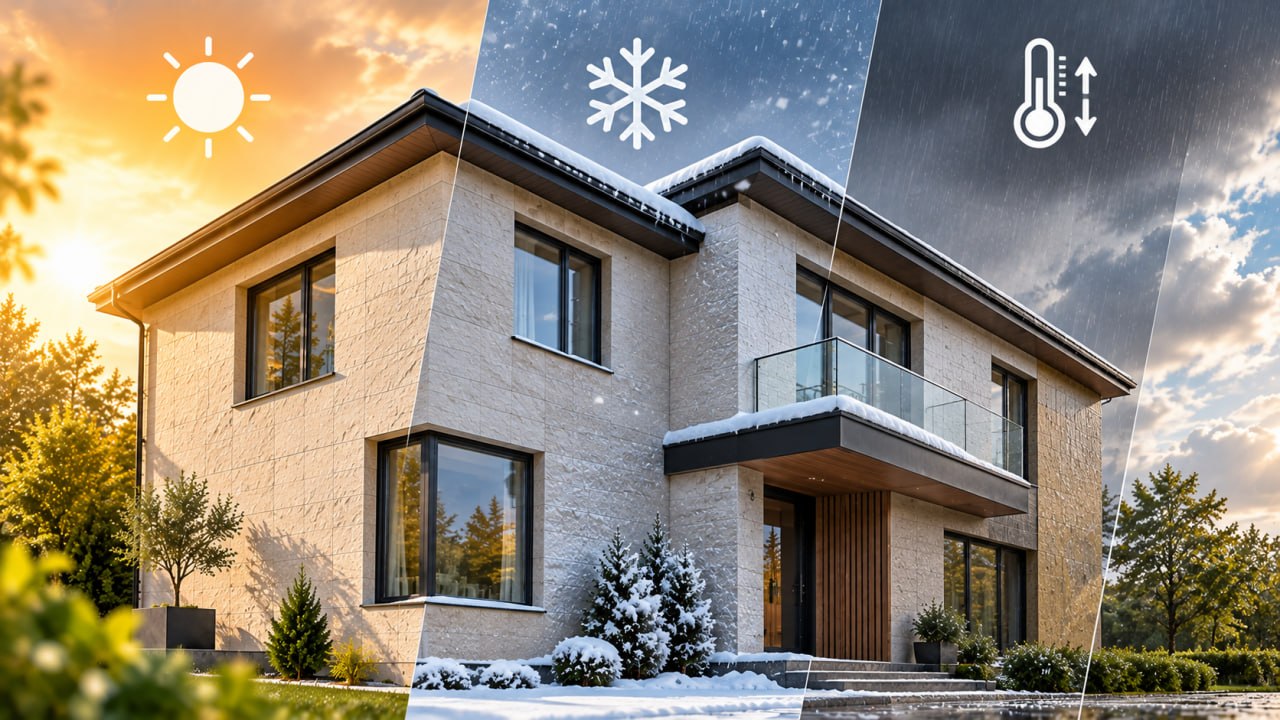
In summer, the facade heats up under direct sunlight. In winter, it is exposed to freezing temperatures, while spring and autumn bring sudden temperature fluctuations. These conditions gradually affect the cladding, adhesive bonds, and wall substrate.
As a result, cracks, delamination, and other types of damage may appear on the surface. To preserve both strength and appearance, facade cladding must be designed to withstand the climatic loads typical of the region.
How Temperature Affects Facade Cladding
Building materials react to heating and cooling by changing in size. They expand as the temperature rises and contract as it falls.
The effects of thermal movement are especially noticeable at joints between different materials and where architectural elements connect.
Three factors create the greatest risk:
- Extreme heat. Heating of the facade creates thermal stress in the cladding and adhesive layers.
- Frost and moisture. Water that penetrates damaged areas expands when it freezes and can contribute to further deterioration.
- Sudden temperature fluctuations. Repeated expansion and contraction increase stress on joints and the cladding surface.
Areas with cracks, poorly executed joints, and installation defects are particularly vulnerable.
How KORDEKO Flexible Tile Handles Climatic Loads
KORDEKO Flexible Tile (PletaFlex) is produced on a mineral-polymer base using acrylic dispersion and a reinforcing non-woven membrane.
The acrylic binder gives the material flexibility, allowing the tile to bend without damaging the decorative layer. This helps the cladding adapt to small changes in the shape of the substrate.
According to the manufacturer’s technical description, KORDEKO has several properties that are important for exterior applications:
- Frost resistance. The material is designed for use at sub-zero temperatures and repeated freeze-thaw cycles.
- Moisture resistance. The acrylic binder helps protect the finish against moisture penetration.
- UV resistance. Oxide pigments help preserve color under exposure to sunlight.
- Flexibility. The tile can accommodate small deformations without cracking the cladding itself.
However, weather resistance does not mean that the material can withstand any temperature conditions without limitation. The performance of the entire facade system must be considered for each specific application.
Why Insulation Helps Protect the Facade from Temperature Fluctuations
Exterior thermal insulation reduces the effect of seasonal temperature changes on the load-bearing wall and helps maintain a more stable temperature within the structure.
Facade Insulation using expanded polystyrene or mineral wool requires correctly selected insulation thickness, proper reinforcement, and compatible finishing materials.
The general requirements for external thermal insulation composite systems (ETICS) are set out in the European assessment documents published by EOTA.
KORDEKO Flexible Tile can be used as the final finish of such a system. Thanks to its low weight and flexibility, it is suitable for installation over a properly prepared reinforced layer.
However, protection against thermal deformation does not depend on the tile alone. Incorrectly installed insulation, gaps between boards, and reinforcement mistakes can lead to cracking regardless of the selected finish.
How to Install Cladding Correctly in Hot and Cold Weather
Even a weather-resistant material can suffer premature damage if installation conditions are not respected.
When installing KORDEKO Flexible Tile, several rules should be followed:
- Use a frost-resistant adhesive designed for exterior applications.
- Do not install in freezing conditions or at temperatures outside the adhesive manufacturer’s permitted range.
- In hot weather, protect the working surface from excessively rapid drying of the adhesive.
- Clean, level, and prime the substrate before installation.
- Apply the adhesive evenly and press the tile firmly against the surface.
Special attention should be paid to building corners, window reveals, the plinth, and roof junctions. Poor moisture protection in these areas can accelerate deterioration of the facade system.
See also: can flexible tile be installed in a heatwave; why facades crack and how to avoid it; a dark facade in the sun: heating and fading.
Conclusion
Heat, frost, and sudden temperature fluctuations create constant stress on a facade. The durability of the cladding depends on both the material’s ability to withstand climatic exposure and the quality of installation.
KORDEKO Flexible Tile combines flexibility, moisture resistance, frost resistance, and UV color stability. These properties make it suitable for exterior finishing in variable climates.
However, facade durability depends on the entire system: a properly prepared substrate, compatible materials, reliable insulation, and correct installation technology.
Frequently asked questions
Does KORDEKO flexible tile withstand frost?
Why do facades crack with temperature swings?
Can flexible tile be installed in winter or in a heatwave?
Need advice on your facade?
- Get a free consultation for your project
- Find out which material suits your facade
- We'll answer all your questions and help you choose