


Heavy or Lightweight Facade Cladding: Why Material Weight Affects a Building’s Durability
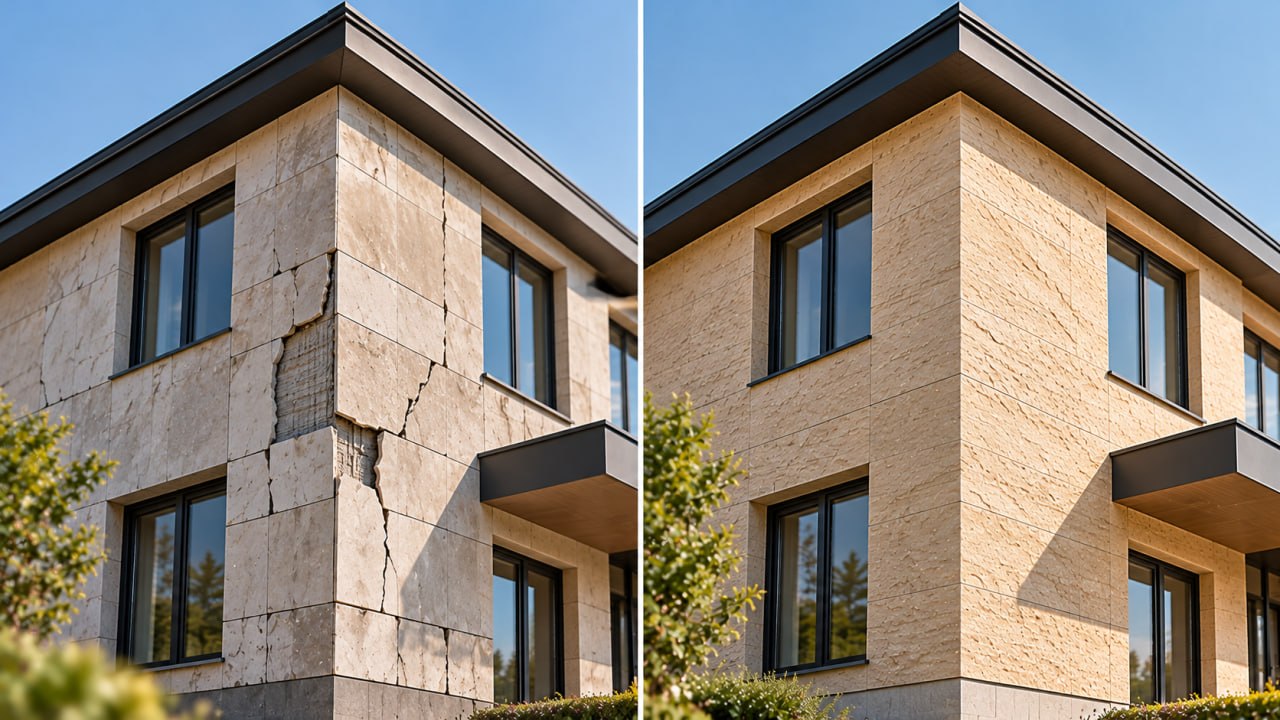
When choosing facade cladding, people usually compare appearance, cost, and resistance to weather conditions. However, the weight of the cladding material is just as important.
Natural stone, porcelain stoneware, and flexible tile place very different loads on exterior walls. This factor is especially important when renovating older buildings, insulating facades, and finishing lightweight structures.
Why Facade Cladding Weight Matters
Any exterior cladding adds extra load to the building. The heavier the material, the greater the requirements for the substrate, fixings, and facade structure.
When heavy cladding is used, it is important to consider not only the weight of the tiles themselves, but also the weight of the adhesive, fixing elements, and other system components.
The effect of weight is especially important in three situations:
- Renovation of older buildings. Additional load may require an assessment of the walls and load-bearing structure.
- Insulated facades. The weight of the cladding must be compatible with the capacity of the thermal insulation system.
- Complex architectural elements. Columns, arches, and projecting details require properly designed fixing solutions.
Heavy cladding is not necessarily a poor choice. If the structure is designed for the required load, natural stone or porcelain stoneware can be successfully used for exterior finishing.
How Much Do Different Facade Materials Weigh?
According to the KORDEKO technical description, the weight of facade materials can vary significantly.
| Material | Approximate Weight |
|---|---|
| KORDEKO Flexible Tile | 4 kg/m² |
| Porcelain Stoneware | 15–20 kg/m² |
| Natural Stone | 20–35 kg/m² |
These figures refer to the materials listed in the technical description and do not include the total weight of the complete facade system.
For example, cladding an area of 100 m² would require approximately 400 kg of KORDEKO Flexible Tile or around 2,000–3,500 kg of natural stone from the categories indicated above.
The difference is substantial, especially when renovating an existing building or installing cladding over thermal insulation.
What Are the Advantages of Lightweight KORDEKO Flexible Tile?
KORDEKO Flexible Tile (PletaFlex) is a thin mineral-polymer material with a reinforcing non-woven membrane.
Its low weight reduces the additional load on the facade compared with traditional heavy cladding.
This provides several practical advantages.
First, the material is convenient for renovating older facades. Provided that the existing substrate is strong, stable, and properly prepared, flexible tile can be installed over suitable existing surfaces without complete demolition.
Second, the lower weight makes transportation, unloading, and handling easier during construction work.
Third, the flexibility of the tile makes it possible to clad curved surfaces, arches, and columns without the complex cutting and processing required for rigid stone materials.
However, low weight does not eliminate the need to inspect the substrate or select the correct adhesive.
Why Lightweight Cladding Is Convenient for Insulated Facades
Facade Insulation involves a multi-layer system that includes thermal insulation, fixings, a reinforcement layer, and a decorative finish.
The general requirements for external thermal insulation composite systems (ETICS) are set out in the European assessment documents published by EOTA.
Not every thermal insulation system is designed to support heavy cladding. That is why the weight of the final finish becomes an important selection criterion.
KORDEKO Flexible Tile is compatible with the external thermal insulation systems designed for its use. It is installed over a properly prepared reinforced layer using a suitable adhesive.
However, the permitted load is determined by the performance of the complete system, not by the weight of the tile alone.
See also: how much a flexible tile facade weighs; porcelain tile or flexible tile: the light facade; cladding an old facade without demolition.
Conclusion
The weight of facade cladding affects the load on the walls, fixing requirements, ease of installation, and whether the material can be used over thermal insulation.
Heavy natural stone is suitable for structures designed to support the corresponding load. Lightweight KORDEKO Flexible Tile provides a stone-textured decorative surface at a significantly lower weight.
Its advantages are especially noticeable when renovating buildings, cladding insulated facades, and finishing complex architectural elements.
Frequently asked questions
How much does KORDEKO flexible tile weigh?
When does cladding weight matter most?
Does low weight mean the substrate need not be checked?
Need advice on your facade?
- Get a free consultation for your project
- Find out which material suits your facade
- We'll answer all your questions and help you choose