


KORDEKO flexible stone: how much a facade weighs after cladding, and why it matters
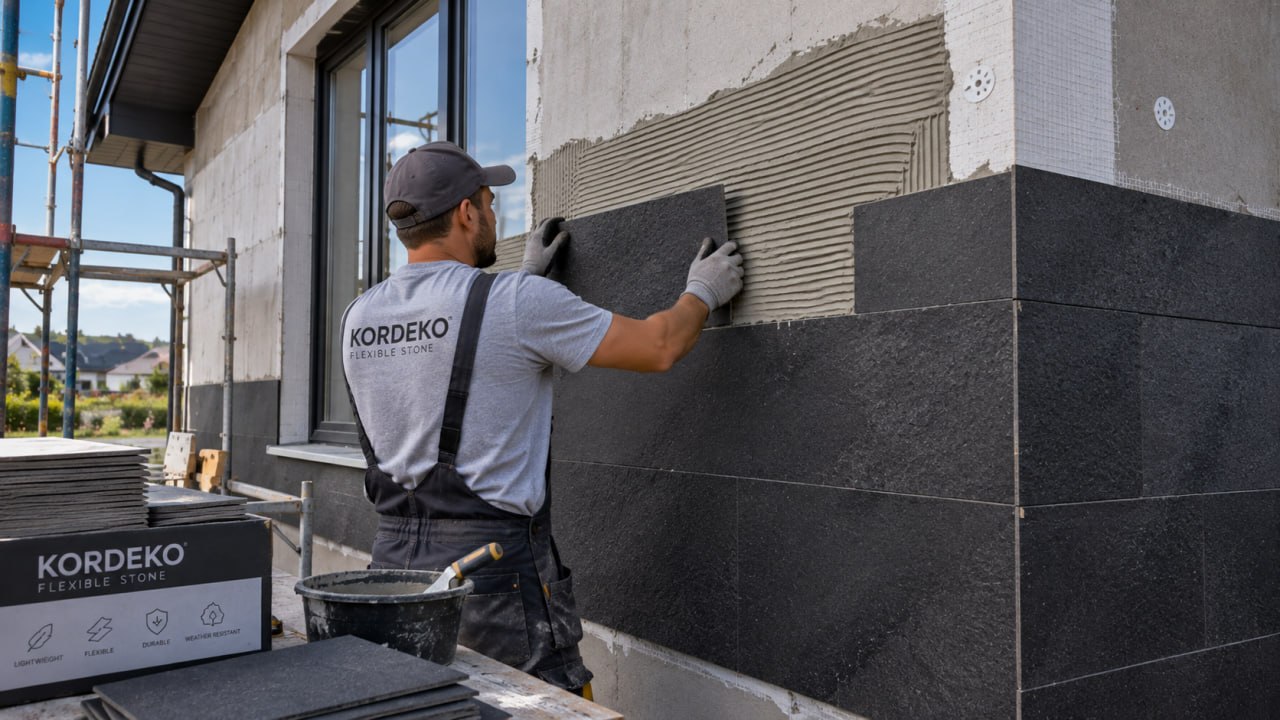
When choosing facade cladding, people usually look at the colour, the texture and the price per square metre. But there is one more parameter that is directly tied to the structure of the house — the weight of the material.
The heavier the cladding, the greater the load it puts on the substrate, the insulated facade system, the fixings and the logistics. That is why, for large houses, renovations and insulated facades, the weight of the finish matters in particular.
How much flexible tile weighs
KORDEKO flexible tile (PletaFlex) belongs to the light cladding materials. Depending on the specific product and finish, its mass is roughly 3–4 kg/m².
To get a sense of scale, take a facade of 200 m²:
- at 3 kg/m² — about 600 kg of material;
- at 4 kg/m² — about 800 kg of material.
That is the weight of the tile itself, without adhesive, substrate preparation and the other elements of the facade system.
So when calculating the full load you have to count not just the cladding, but the whole facade build-up.
Why cladding weight matters
Imagine two facades of the same area. One is finished with a heavy material, the other with light flexible tile.
The area is the same in both cases, but the load on the structure can differ substantially.
Weight affects:
- the requirements for the substrate;
- the load on the insulated system;
- transporting the material;
- lifting it to height;
- ease of installation;
- work on old buildings;
- finishing complex architectural elements.
This matters especially in renovation, when the walls already have a certain load-bearing reserve and you do not want to add unnecessary load. A direct comparison of light and heavy cladding is in our article on porcelain tile versus flexible tile on a facade.
Big facade — big difference
On a small area, a difference of a few kilograms per square metre can seem insignificant. But at 300, 500 or 1,000 m² the numbers quickly become substantial.
For example, at 500 m²:
- 3 kg/m² × 500 m² = 1,500 kg
- 4 kg/m² × 500 m² = 2,000 kg
So the cladding alone will weigh roughly 1.5–2 tonnes.
That is exactly why weight has to be considered before purchasing and installation begin, especially on large commercial and residential projects.
Light cladding is more convenient on an insulated facade
When Facade insulation is carried out, the final finish is installed over the prepared system. Here it is important not to create unnecessary extra load.
Light cladding keeps the structure more rational and makes it easier to work with:
- large facade planes;
- the plinth;
- reveals;
- corners;
- columns;
- entrance areas;
- architectural elements.
At the same time, the low weight of the finish does not cancel the requirements for substrate quality, reinforcement, primer and adhesive. If the work is spread over time, see also how facade insulation in stages is organised.
Why this matters especially for old houses
In a renovation you cannot automatically assume that the existing wall will carry any new cladding.
An old building can have:
- weakened render;
- a damaged substrate;
- old layers of finish;
- limited load-bearing capacity;
- insulation already installed;
- complex architectural elements.
Adding heavy cladding without assessing the structure is not the best approach.
A light material can simplify the task considerably in such a situation, but the condition of the substrate still has to be checked before installation.
Weight affects installation too
A heavy slab has to be held, lifted and fixed with its mass in mind. At height this becomes especially noticeable.
Light flexible tile is simpler to work with:
- it is easier to carry;
- simpler to lift to upper floors;
- easier to cut;
- more convenient to fit in difficult areas;
- less strain on the installers;
- simpler to work with over large areas.
This is particularly relevant when the facade has many windows, corners, reveals and decorative elements — see how flexible tile installation is done.
Light does not mean weak
Low weight is often mistakenly seen as a drawback. But the mass of a material and its performance are different characteristics.
KORDEKO flexible tile combines low weight with the facade properties needed for outdoor use:
- flexibility;
- moisture resistance;
- frost resistance;
- UV resistance;
- resistance to temperature swings;
- a stone texture;
- ease of handling and installation.
It is exactly this combination that makes light cladding an interesting alternative to heavier materials.
What goes into the real weight of a facade
It is important not to make one mistake: 3–4 kg/m² is not the weight of the whole facade system.
The complete build-up can include:
- The wall.
- The insulation.
- The adhesive layer.
- The reinforcing layer.
- The facade mesh.
- The primer.
- The flexible tile.
- Additional elements and profiles.
So at the design stage the load of the whole system has to be calculated, not just the final cladding — the same principle by which the EU Construction Products Regulation treats facade systems as an assembly.
Why it matters for logistics
Weight affects more than the walls of the house. It is directly tied to transport and the organisation of the work.
The heavier the material:
- the greater the total weight of the delivery;
- the higher the demands on transport;
- the harder manual unloading becomes;
- the greater the load when lifting;
- the more labour it takes to move it around the site.
For large deliveries, a difference of a few kilograms per square metre turns into tonnes.
What to consider before choosing cladding
Before ordering a facade material it is worth finding out:
- the mass of the material per m²;
- the area of the facade;
- the weight of the whole system;
- the condition of the substrate;
- the thickness and type of insulation;
- the installation method;
- the manufacturer's requirements;
- the transport and lifting conditions.
That way you understand in advance not only the cost of the facade, but its real load on the building.
Conclusion
The weight of facade cladding is not a secondary characteristic. On a large project, a difference of a few kilograms per square metre turns into hundreds of kilograms or even tonnes.
KORDEKO flexible tile weighs roughly 3–4 kg/m², which places it among the light facade claddings. That simplifies transport and installation and allows the material to be used on large areas, insulated facades and renovation projects.
But it is important to remember: what has to be calculated is not just the weight of the tile, but the load of the whole facade system, including the insulation, the adhesive, the reinforcement and the substrate.
Frequently asked questions
How much does KORDEKO flexible tile weigh?
Is 3–4 kg/m² the weight of the whole facade?
Does a light material mean a weak one?
Need advice on your facade?
- ·Get a free consultation for your project
- ·Find out which material suits your facade
- ·We'll answer all your questions and help you choose