


Why Mold and Fungi Appear on Facades and How KORDEKO Flexible Tile Helps Protect Walls
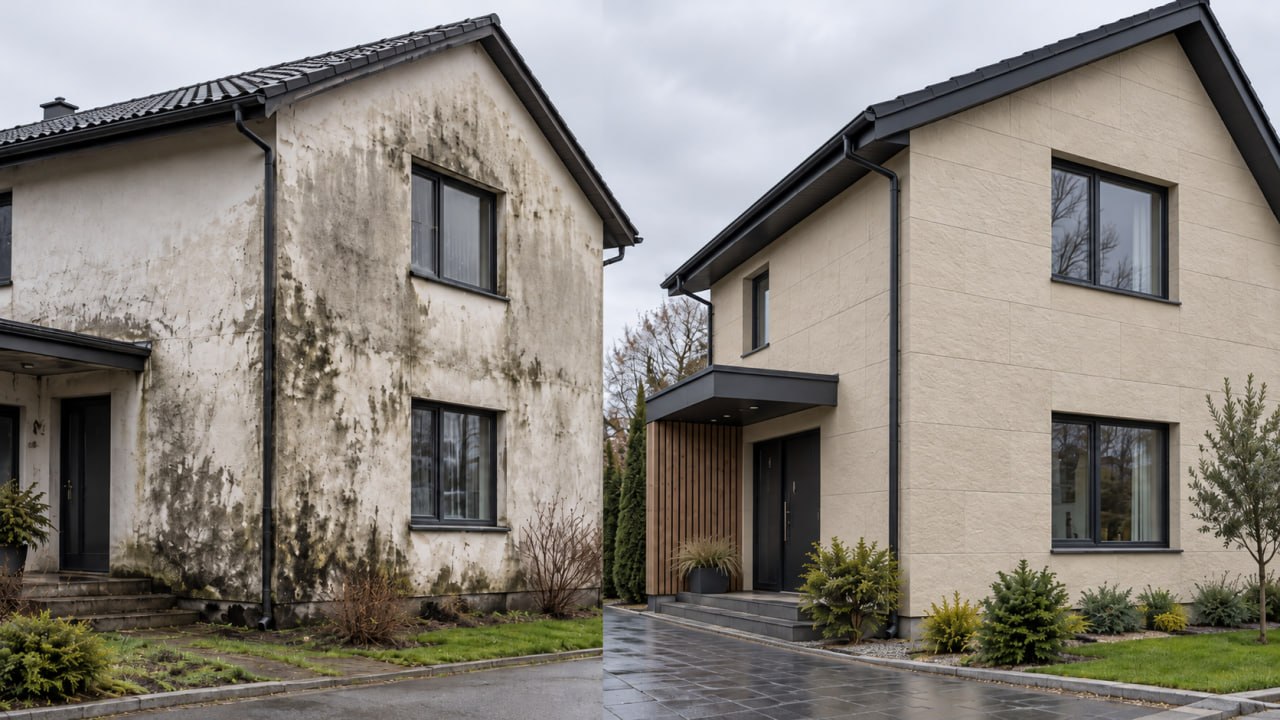
Dark stains, green deposits, and traces of mold on a facade are not only an aesthetic problem. Their appearance often indicates excessive surface moisture or issues within the exterior finishing system.
Such contamination is especially noticeable on shaded walls, near drainage systems, and in areas where the facade remains wet for long periods. To prevent the problem from returning after cleaning, it is important to understand where the moisture comes from and how the finish can be protected.
Main Causes of Mold and Fungal Growth on Facades
Mold needs moisture to develop. If a surface becomes wet regularly and does not have enough time to dry, favorable conditions for microbial growth are created.
The most common causes include:
- Constant moisture. Rain, condensation, and water from faulty drainage systems keep the surface damp.
- Insufficient sunlight. North-facing and shaded walls dry more slowly after rainfall.
- Insulation mistakes. Incorrect insulation thickness and incompatible layers can contribute to moisture accumulation within the structure.
- Poorly executed junctions. Water can penetrate beneath the cladding through damaged connections near the roof, window sills, and flashings.
- Damage to the finish. Cracks and areas of delamination create additional paths for moisture penetration.
Simply removing the visible deposits does not always solve the problem. If the source of moisture remains, mold may return.
How Facade Cladding Affects Mold Development
Different finishing materials interact with moisture in different ways. Important factors include water resistance, the condition of joints, correct installation, and the wall’s ability to dry.
For example, damaged plaster may allow water to penetrate into the underlying layers. Repeated wetting can increase the risk of further surface deterioration.
KORDEKO Flexible Tile (PletaFlex) is produced on a mineral-polymer base using acrylic dispersion, which provides the material with moisture resistance.
According to the KORDEKO technical description, the cladding is resistant to atmospheric exposure, including rain, frost, and temperature fluctuations. It is also vapor permeable.
These properties make flexible stone suitable for exterior applications where the surface is regularly exposed to moisture. However, moisture resistance does not mean that mold can never develop on a dirty or permanently damp facade.
Why Proper Insulation Helps Reduce Dampness
One of the functions of exterior thermal insulation is to protect walls from temperature fluctuations and reduce the likelihood of condensation accumulating within the structure.
Facade Insulation requires the correct selection of insulation thickness and compatibility between all system layers. If installation technology is not followed, moisture can become trapped inside the system.
The general requirements for external thermal insulation composite systems (ETICS) are set out in the European assessment documents published by EOTA.
Particular attention should be paid to reveals, the plinth, roof junctions, and window sills. Installation mistakes in these areas can allow water to penetrate the facade.
KORDEKO Flexible Tile can be used as the final finish in exterior insulation systems. It covers the reinforcement layer and creates a moisture-resistant decorative surface, but it does not replace waterproofing or properly executed junctions.
What to Do If Mold Has Already Appeared on the Facade
Before renewing the cladding, the cause of excessive moisture should be eliminated.
It is recommended to:
- Check drainage systems, flashings, and junctions for leaks.
- Inspect the plaster for cracks, hollow areas, or delamination.
- Eliminate sources of moisture and remove biological contamination using an appropriate method.
- Check the condition of the insulation and reinforcement layer if the facade is insulated.
- Once the damage has been corrected, prepare a dry and stable substrate for the new finish.
- Flexible tile should not be installed directly over mold or over a weak, damp coating.
See also: protecting a facade from moisture and efflorescence; what happens to an insulated facade when water gets in; junctions, sills and drains.
Conclusion
The main reason mold and fungi appear on facades is prolonged moisture exposure. The problem can be made worse by insulation defects, damaged cladding, and poorly executed junctions.
Thanks to its moisture resistance and resistance to atmospheric exposure, KORDEKO Flexible Tile is suitable for protecting and decorating exterior walls. However, the durability of the result depends on proper facade construction and the elimination of moisture sources.
Frequently asked questions
Why does mold appear on a facade?
Can flexible tile be glued over mold?
How does flexible tile help against fungus?
Need advice on your facade?
- Get a free consultation for your project
- Find out which material suits your facade
- We'll answer all your questions and help you choose