


How to Renovate an Old and Uneven Facade Without Completely Removing the Existing Finish
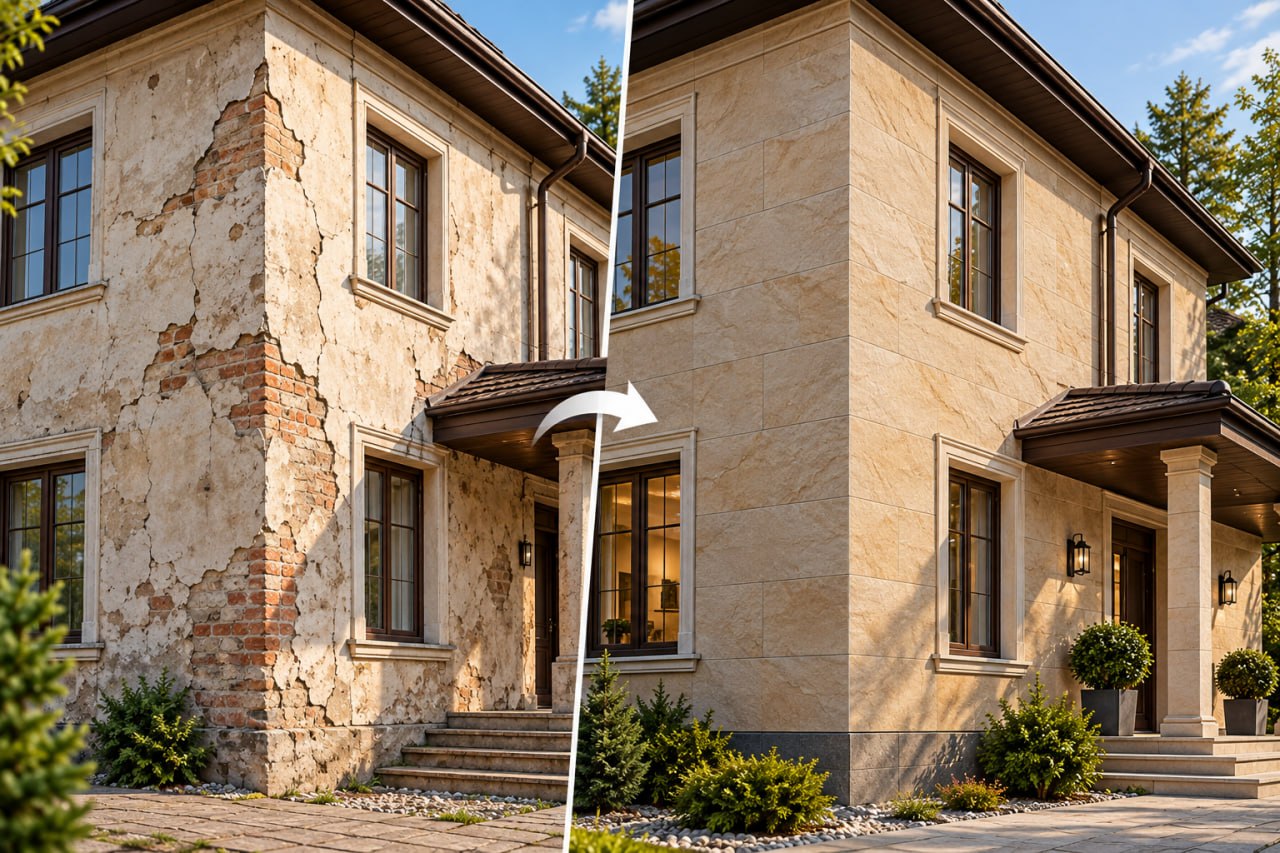
Cracks and uneven plaster do not always mean the whole facade has to come down. We explain when the old layer can stay, how to tap-test it, how to level and prime the walls, why the thin, light KORDEKO flexible tile suits this kind of work, and when demolition cannot be avoided.
Old plaster, small cracks, and surface irregularities do not always mean that the entire facade must be removed. In some cases, it is enough to repair damaged areas, prepare the substrate, and install new cladding over the existing finish.
This approach can reduce the amount of construction work, lower waste volumes, and reduce renovation costs. However, it is not suitable for every building. The main requirement is that the existing substrate must be strong and stable.
When the Existing Finish Can Be Kept
Before renovating the facade, the condition of the existing finish should be assessed. Even if the plaster looks unattractive, it may still be strong enough to serve as a base for further finishing.
The old layer can potentially be retained if:
- The plaster is firmly bonded to the wall and does not crumble.
- There are no significant areas of delamination or hollow sections.
- Damage can be repaired locally.
- The substrate is stable enough to support the new cladding.
The condition of the facade can be checked through visual inspection and by tapping suspicious areas.
If the old plaster is peeling, crumbling, or seriously damaged, it should be removed from the affected areas. New cladding should never be installed over an unstable substrate.
How to Level a Facade Before Installing New Cladding
One common mistake is trying to hide major irregularities directly with the cladding material.
Even flexible tile, which can follow the shape of a surface, requires a properly prepared substrate.
Preparation usually includes several stages:
- Cleaning. Remove dust, dirt, weak areas, and any loose or peeling finish.
- Surface inspection. Identify cracks, hollow areas, and uneven sections.
- Repair and leveling. Repair damaged areas and level irregular sections using a suitable compound.
- Priming. Apply a primer appropriate for the type of substrate.
- Cladding installation. Once the preparation layers have dried sufficiently, installation of the tile can begin.
The better the substrate is prepared, the lower the risk of delamination and other defects.
Why Flexible Tile Is Suitable for Renovating Older Facades
KORDEKO Flexible Tile (PletaFlex) is a thin mineral-polymer material reinforced with a non-woven membrane.
According to the manufacturer’s technical description, the tile thickness is approximately 2.5–5 mm and its weight is around 4 kg/m².
Thanks to its low weight, the material adds significantly less load to the walls than heavy stone cladding.
Its flexibility makes it suitable for columns, arches, and rounded corners, while its low thickness makes it possible to renovate a facade without substantially increasing the thickness of the decorative layer.
Provided that the substrate is strong and stable, KORDEKO can be installed over suitable existing plaster, reducing the need for complete removal.
However, flexible tile is not intended to correct major surface irregularities on its own. Such defects must be repaired before installation.
Can You Renovate and Insulate an Old Facade at the Same Time?
If the building requires not only cosmetic renovation but also improved thermal performance, a complete facade upgrade may be worth considering.
Facade Insulation involves preparing the wall, installing thermal insulation boards, reinforcing them with fiberglass mesh, and applying the final finish.
The general requirements for external thermal insulation composite systems (ETICS) are set out in the European assessment documents published by EOTA.
KORDEKO Flexible Tile is compatible with the exterior insulation systems designed for its use and can create decorative surfaces that imitate natural stone, slate, brick, or wood.
However, the condition of the existing finish must be assessed before the insulation is installed. Weak or unstable layers can compromise the entire new system.
When Demolition Cannot Be Avoided
Keeping the old finish is not always practical.
Damaged layers must be removed when the plaster is extensively delaminating, the substrate is losing strength, or serious structural cracks are present.
Areas with continuous moisture penetration should also never simply be covered with new cladding. The source of the moisture must first be identified and corrected.
See also: can an old facade be clad without demolition: how to decide; why facades crack and how flexible tile helps avoid it; heavy or lightweight cladding: why weight matters.
Conclusion
It is possible to renovate an old facade without completely removing the existing finish if the current coating remains strong, stable, and suitable for further finishing.
Thanks to its low weight, flexibility, and small thickness, KORDEKO Flexible Tile is well suited to this type of renovation. It allows the appearance of a building to be transformed without using heavy cladding.
However, savings should come from avoiding unnecessary demolition, not from reducing the quality of substrate preparation. The condition of the substrate is what ultimately determines the reliability of the new facade.
Frequently asked questions
Can flexible tile be glued straight onto old plaster?
Will flexible tile hide an uneven wall?
When does the old finish have to come off after all?
Need advice on your facade?
- Get a free consultation for your project
- Find out which material suits your facade
- We'll answer all your questions and help you choose