


Flexible stone vs porcelain stoneware: what happens to a facade after 10 years of use?
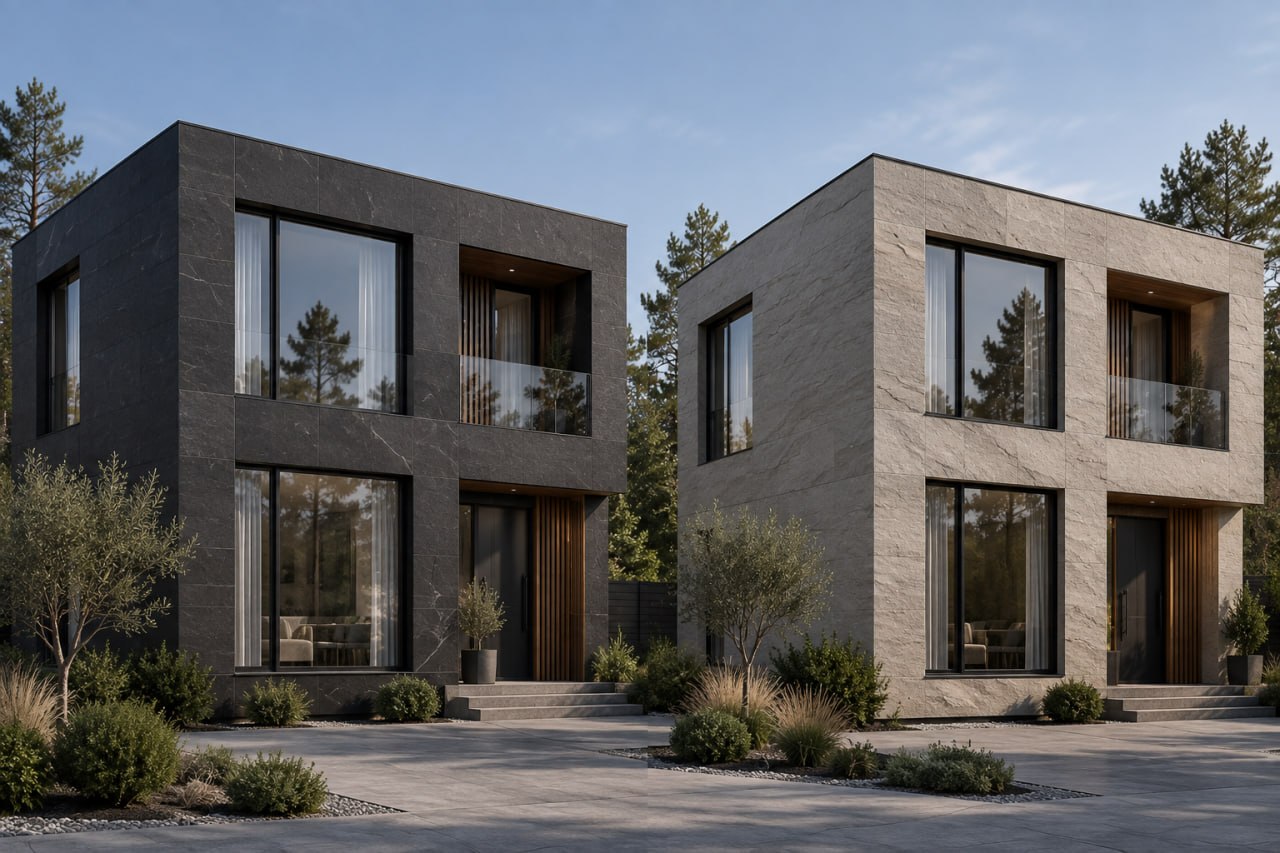
When choosing facade cladding, people rarely think only about the first year. A much more important question is how the facade will look and perform after several years of exposure to hundreds of heating and cooling cycles, rain, frost, sunlight, dirt and everyday wear.
Flexible stone and porcelain stoneware serve the same purpose: they create a durable decorative surface. However, they achieve this in completely different ways. As a result, after years of use they differ not only in appearance but also in their requirements for the substrate, installation, repairs and individual facade details. The basic comparison is in our article on porcelain tile versus flexible tile on a facade; this one is about what happens over time.
Why the first year reveals very little
A newly installed facade almost always looks good. The material is new, the colour is uniform, the joints are neat, and the surface is clean. The main differences become apparent later. The facade is continuously exposed to:
- heating from sunlight;
- cooling at night;
- frost and thawing;
- rain and snow;
- wind;
- dirt and pollution;
- mechanical impacts;
- movement at joints and connection points.
That is why evaluating cladding solely by its appearance immediately after installation is not enough.
What happens to porcelain stoneware
Porcelain stoneware is a hard and heavy material. Its performance on a facade depends not only on the slabs themselves but also on the fixing system. For a large facade, several factors must be considered:
- the weight of the slabs;
- fasteners;
- the supporting substructure;
- the condition of the substrate;
- thermal expansion and contraction;
- the quality of the joints;
- details around windows and corners.
If the system is properly designed and installed, porcelain stoneware can retain its original appearance for a long time. However, its rigidity also creates certain structural requirements. The material does not have the flexibility needed to accommodate small movements of the substrate.
What happens to flexible stone
Flexible stone works differently. It is a thin, lightweight cladding material with a mineral texture and a polymer-based binder.
KORDEKO flexible tile (PletaFlex) combines the appearance of natural stone with flexibility and low weight. This makes it suitable not only for large flat surfaces but also for corners, window reveals, plinths, columns and other complex architectural elements. When installed on a properly prepared substrate and in accordance with installation requirements, flexible tile is less susceptible to brittle cracking than rigid cladding.
Why, after 10 years, the main question is not just the material
It would be misleading to compare facades by claiming that one material will look brand new after 10 years while the other will inevitably deteriorate. The condition of a facade depends on several factors:
- the quality of the material itself;
- substrate preparation;
- installation technology;
- the quality of the adhesive or fixing system;
- reinforcement;
- proper corner detailing;
- window connections;
- flashings and drip edges;
- drainage;
- climate;
- maintenance.
The same cladding installed on two different houses may look completely different after several years because of differences in installation and operating conditions.
Where porcelain stoneware requires special attention
Porcelain stoneware has an important advantage: its surface is extremely hard. However, this does not mean that the entire facade is automatically protected against damage. Areas requiring particular attention include:
- fixing points;
- slab corners;
- cut edges;
- joints;
- connection points;
- areas around windows;
- areas exposed to mechanical impacts.
Damage to an individual slab usually requires a localized repair involving replacement of the damaged element. At considerable heights, this may require additional installation work.
Where flexible stone is more convenient
Flexibility is especially useful when a facade has complex geometry. For example:
- external corners;
- window and door reveals;
- columns;
- arches;
- curved architectural elements;
- plinths;
- entrance areas;
- decorative facade bands.
Instead of working with heavy, rigid slabs, installers can use a lightweight material that is easier to cut and adapt to the shape of the surface.
Why weight matters from the installation stage
The difference between the two materials becomes particularly noticeable on large projects. KORDEKO flexible tile weighs approximately 3–4 kg/m². This significantly simplifies transportation, lifting and installation. Porcelain stoneware is considerably heavier, so its application requires an appropriate fixing system and structural load calculations.
On a small surface, this difference may seem insignificant. On a facade covering hundreds of square metres, the total weight becomes a major consideration; we did the arithmetic in our article on how much a flexible-tile facade weighs.
What happens to the colour
After several years of use, a material's resistance to sunlight becomes increasingly apparent. The most demanding areas may include:
- south-facing walls;
- west-facing facades;
- large, exposed surfaces;
- dark-coloured finishes;
- areas without protective overhangs.
UV resistance depends on the material's composition, pigments, manufacturing technology and protective layer. KORDEKO is designed for exterior use and colour retention under sunlight exposure. Therefore, when selecting facade cladding, it is important to evaluate not only the appearance of a sample today but also its resistance to prolonged environmental exposure.
Why water may matter more than the cladding after 10 years
If water continuously penetrates behind the facade system, problems may arise regardless of whether porcelain stoneware or flexible stone is used. Particularly problematic are:
- incorrectly installed flashings;
- missing drip edges;
- leaking drainage systems;
- poorly executed connection points;
- exposed edges;
- installation mistakes around windows;
- constant moisture at the plinth.
The durability of a facade therefore begins not with choosing attractive cladding, but with the proper design and installation of the entire system. How flashings, drip edges and junctions should be done is covered in a separate article.
What happens to the insulation beneath the cladding
When Facade insulation is carried out, the final cladding is only one component of the overall structure. If water penetrates the system through damaged joints or connection points, the insulation and other layers may become wet. This affects not only the facade's appearance but also the thermal performance of the building envelope.
Therefore, after 10 years, a well-performing facade is more than cladding without visible damage. It is a system in which the substrate, insulation, reinforcement layers, connection points and water protection remain intact. Facade kits are assessed as a system by the European technical assessment bodies united in EOTA, too.
What about repairs after several years
This is where the differences between the materials become particularly interesting. With porcelain stoneware, localized repairs usually involve replacing the damaged slab and restoring its fixing system. Flexible tile allows individual sections to be replaced or restored without dismantling large areas of cladding. This is especially convenient when damage is limited to a small area.
For either material, it is important to keep some spare products with the same texture and shade. It is therefore advisable to include a small reserve in the initial order.
What will the facade look like after 10 years
If the installation has been performed correctly, the substrate properly prepared, connection points protected against water, and the material suits the operating conditions, both flexible stone and porcelain stoneware can maintain their functionality and appearance for many years. However, their installation and maintenance requirements are different.
Porcelain stoneware is rigid, heavy cladding that requires an appropriate fixing system. KORDEKO flexible stone is lightweight, flexible cladding with a mineral texture that is easier to adapt to complex architectural shapes and to use on insulated facades. The decision is therefore not simply between two surfaces with a similar appearance, but between two different approaches to facade construction.
What to consider when comparing materials
Before choosing a material, it is useful to compare the following characteristics:
| Parameter | KORDEKO flexible stone | Porcelain stoneware |
|---|---|---|
| Weight | Low | Significantly higher |
| Flexibility | Yes | No |
| Complex shapes | Easy to adapt | Require special solutions |
| Corners and reveals | Easy to cut and finish | Require precise cutting |
| Installation | Adhesive-based | Depends on the facade system |
| Stone texture | Yes | Yes |
| System requirements | Substrate, adhesive, reinforcement | Fixings, substructure and structural calculations |
| Local repairs | Individual sections can be replaced | Individual slabs can be replaced |
| UV resistance | Depends on the specific material | Depends on the specific product |
| Durability | Depends on the material and installation | Depends on the material and facade system |
What 10 years of use will really reveal
After ten years, a facade is no longer evaluated on an advertising sample, but on its actual condition:
- has the colour been preserved;
- are there any cracks or areas of delamination;
- what condition are the corners in;
- have the connection points deteriorated;
- are there any persistent water stains;
- has the original geometry been maintained;
- how easy is it to maintain individual sections;
- how much have repairs cost over the entire period.
That is why choosing facade cladding should involve more than comparing today's price per square metre.
Conclusion
Flexible stone and porcelain stoneware are different facade solutions, each with its own construction requirements, installation technology and substrate specifications. Porcelain stoneware provides hard, heavy stone-like cladding. KORDEKO flexible stone offers a mineral stone texture at a significantly lower weight, with the added ability to accommodate complex facade geometry.
Ultimately, the condition of a facade after 10 years is determined by more than the cladding material alone. The result depends on material quality, installation technology, substrate preparation, water protection, insulation and the correct execution of every connection point.
Frequently asked questions
Which lasts longer on a facade, flexible stone or porcelain stoneware?
Where is flexible stone more convenient than porcelain stoneware?
How is a facade repaired after several years?
Need advice on your facade?
- ·Get a free consultation for your project
- ·Find out which material suits your facade
- ·We'll answer all your questions and help you choose