


How Long Does a House Facade Last: What Determines the Durability of Cladding and Flexible Stone
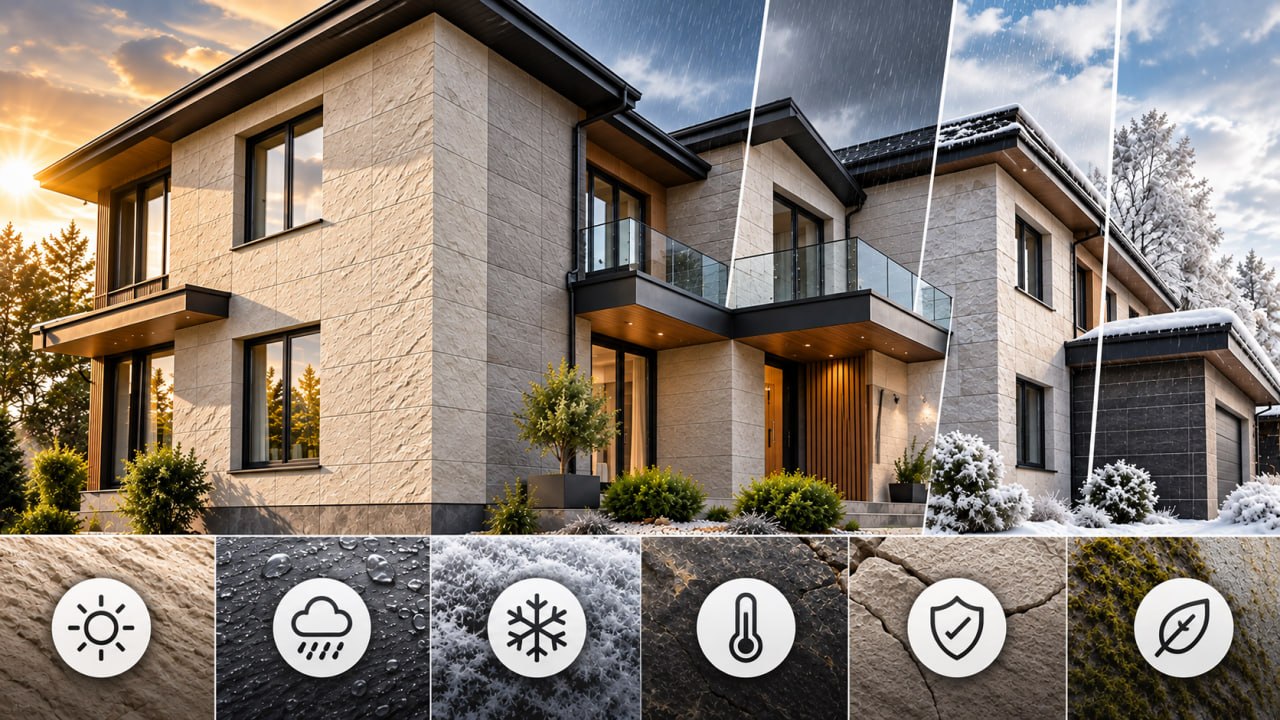
A facade may still look neat after decades or require repairs after only a few years. The difference depends not only on the cost of the cladding, but also on the quality of the substrate, weather conditions, installation quality, and proper maintenance.
When choosing a finishing material, it is important to understand that the service life of the cladding itself and the durability of the entire facade system are not the same thing.
How Long Different Facade Materials Can Last
Render, porcelain stoneware, natural stone, and flexible tile differ in composition, weight, and maintenance requirements.
Decorative render is relatively affordable, but over time it may require crack repairs or repainting. In KORDEKO comparison materials, some rendered finishes are indicated as requiring repainting approximately every 3–5 years.
Porcelain stoneware is moisture-resistant, but its durability also depends on the fixing system, the condition of the joints, and the quality of the substrate. Natural stone can last for a long time, but it requires a suitable structural system capable of supporting heavy cladding.
For KORDEKO flexible stone, the technical description states that the original appearance can be maintained for 10–30 years. This refers to the retention of decorative properties and does not mean that every facade will have the same service life regardless of operating conditions.
What Affects the Durability of Facade Cladding
Even a high-quality material may lose its appearance prematurely if construction technology is not followed correctly.
Five factors are especially important:
- Condition of the substrate. Cracks, hollow areas, and peeling plaster reduce the reliability of the cladding attachment.
- Moisture and frost. Water that penetrates the structure can contribute to deterioration of finishing layers when it freezes.
- Thermal deformation. Repeated heating and cooling create stress, especially in rigid finishes.
- Installation quality. Incorrect adhesive, missing primer, and reinforcement mistakes increase the risk of damage.
- Maintenance. Timely repair of leaks, cleaning, and correction of local defects can help prevent more serious damage.
That is why facade cladding should not be selected only according to a stated service life.
Why KORDEKO Flexible Stone Is Designed for Long-Term Use
KORDEKO Flexible Tile (PletaFlex) is produced on a mineral-polymer base using an acrylic binder and a reinforcing non-woven membrane.
Its flexibility helps accommodate small surface deformations without cracking the tile itself. This is especially useful on facades with complex architectural features.
The material is also moisture-resistant and resistant to temperature fluctuations and ultraviolet exposure. Oxide pigments used during production help preserve the color under sunlight.
Another advantage is the relatively low weight of the cladding, approximately 4 kg/m². This reduces the load on the facade compared with heavy stone cladding.
However, even durable flexible tile cannot compensate for serious wall damage or incorrect installation.
Why Insulation and Installation Affect Facade Service Life
Facade Insulation should be installed as a complete system in which the insulation, reinforcing compound, mesh, primer, and final cladding are compatible with one another.
The general requirements for external thermal insulation composite systems (ETICS) are set out in the European assessment documents published by EOTA.
Incorrect fixing of the insulation, gaps between insulation boards, or missing reinforcement around windows can lead to cracks and delamination regardless of the decorative finish used.
Before installing KORDEKO Flexible Tile, the substrate should be cleaned, checked for strength, leveled if necessary, and primed. A frost-resistant adhesive is used for exterior applications.
During use, the facade should be inspected periodically, especially around the plinth, reveals, window sills, and roof junctions. Water can penetrate the facade system through damaged connection points.
See also: a facade that won’t date in 5–10 years; render or flexible tile: which pays off over the years; protecting a facade from moisture and efflorescence.
Conclusion
Facade durability is determined not by one material alone, but by the quality of the entire system. A strong substrate, correct reinforcement, compatible materials, and protection against moisture are just as important as the performance characteristics of the cladding.
KORDEKO states that its material can retain its original appearance for 10–30 years. Flexibility, weather resistance, and the absence of a need for regular repainting make it suitable for long-term use.
However, the main principle remains the same: even high-quality cladding will last longer if the facade is properly installed from the beginning and maintained in a timely manner.
Frequently asked questions
How long does a flexible tile facade last?
What shortens the service life of facade cladding?
Why is flexible tile designed for long service?
Need advice on your facade?
- Get a free consultation for your project
- Find out which material suits your facade
- We'll answer all your questions and help you choose