


A dark KORDEKO flexible-tile facade in the sun: beautiful or a problem?
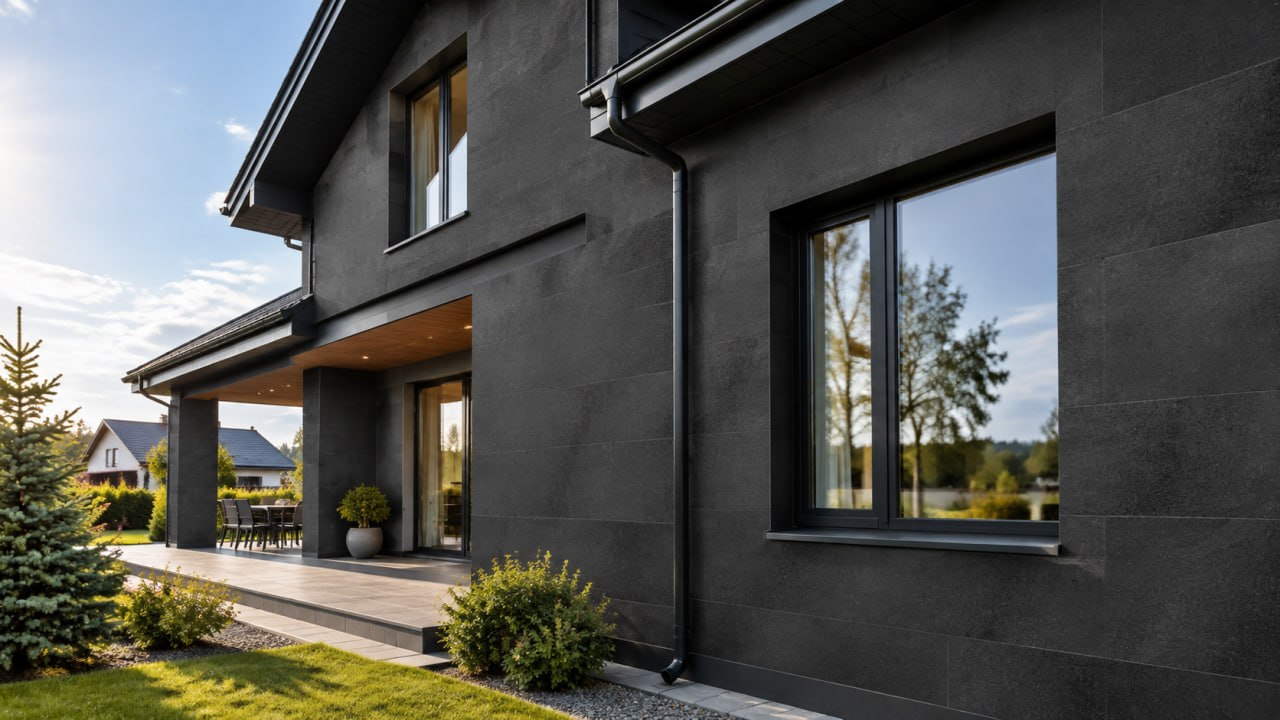
Dark facades have become one of the most popular choices in modern architecture. Graphite, anthracite, deep grey, dark stone and other saturated shades make a house more expressive, underline the shape of the building and create the feel of premium design.
But many owners ask: how will such a facade behave under the sun? Will it get too hot? Will the colour fade? Will problems appear after a few years?
The answer depends not only on the colour, but on the quality of the material, the production technology and the correctness of the whole facade system.
Why dark facades are so popular
Dark shades give architecture several advantages:
- they underline the geometry of the house;
- they go well with large windows;
- they create a modern, minimalist style;
- they combine with wood, metal and glass;
- they make the light elements of the facade more expressive.
Combinations that look particularly striking:
- graphite facade + wood;
- dark stone + light render;
- anthracite + black window frames;
- deep grey + natural materials.
But when choosing a dark colour it is important to consider not just the look, but daily use as well.
The main issue with dark facades — surface heating
Dark surfaces absorb more solar radiation than light ones. So on a sunny day a dark wall can heat up more.
This is especially noticeable on:
- south-facing facades;
- large open walls;
- houses without canopies or trees;
- sites with strong sun exposure.
Extra heating puts additional load on the facade system:
- the material expands and contracts with temperature swings;
- joints and junctions work harder;
- the demands on installation quality are higher;
- colour stability matters more.
That is exactly why choosing the right material matters so much for a dark facade. The behaviour of facade systems under heat and moisture is assessed at European level by EOTA, the organisation for the technical assessment of construction products.
Does dark flexible tile fade?
One of the main mistakes is to choose a facade only by the sample in the showroom. It is important to understand how the material will look after several years in the sun.
The colour of a facade depends on:
- the quality of the pigments;
- the production technology;
- the protective layer;
- the material's resistance to ultraviolet;
- the conditions of use.
KORDEKO flexible tile (PletaFlex) is designed for outdoor use and keeps the facade's appearance under sun, rain and temperature swings. How the colour behaves over time is shown in our article on the lasting colour of flexible stone.
For dark shades it is particularly important that the colour is stable; otherwise the facade can lose depth and look uneven.
Why texture matters for a dark facade
A smooth dark surface shows more flaws:
- dust;
- streaks after rain;
- small scratches;
- unevenness of the substrate.
A stone texture works differently. The relief creates a play of light and shadow, so the surface looks more natural.
KORDEKO flexible stone with a natural-material texture helps make a dark facade more practical visually:
- minor dirt is less noticeable;
- the surface looks deeper;
- the colour reads more naturally;
- the facade does not look like a flat painted wall.
Where dark shades work best
The whole house does not always have to be dark. A more harmonious option is often to use colour accents.
For example:
- dark plinth + light facade;
- a graphite entrance area;
- an accent wall;
- dark architectural elements;
- columns or the zones around windows;
- a combination with a wood texture.
The house gets a modern look, but the facade stays visually light. How to match the facade shade to the roof, the windows and the fence is explained in our guide to choosing the facade colour.
How to protect a dark facade from problems
For a dark finish to work well, a few things have to be considered.
1. Correct substrate preparation
On a dark facade these are especially noticeable:
- differences in flatness;
- uneven joints;
- waves;
- poor cutting.
So the substrate has to be prepared to a high standard.
2. Quality insulation
When Facade insulation is carried out, the whole system has to be assembled correctly:
- insulation;
- reinforcing layer;
- mesh;
- primer;
- adhesive;
- final cladding.
Mistakes inside the system can show up more strongly on dark facades, because the temperature swings are higher and visible.
3. Good junctions around windows and details
Particular attention goes to:
- reveals;
- corners;
- the plinth;
- junctions;
- cornices;
- drip flashings.
That is where the first problems most often appear if the installation was done incorrectly.
How to combine dark flexible tile with other materials
A dark facade shows best in combination.
Dark stone + wood
Creates a warm, modern style. Wood softens the graphic look of a dark facade.
Anthracite + light render
Lets you pick out architectural elements and makes the house visually more interesting. An example from the collection is R09 Volcanic Anthracite, an anthracite-black tone for modern facades and entrance areas.
Graphite + metal
Suits modern houses with large windows and minimalist architecture.
Dark plinth + light walls
A practical solution: the lower part shows less dirt, and the house stays light.
Should you be afraid of a dark facade?
No — if you choose the right material and follow the technology. Problems come not from the dark colour itself, but from the wrong coating, weak substrate preparation or installation mistakes.
Modern facade materials allow deep shades, as long as they are designed for sun and outdoor use.
Mini-checklist before choosing a dark facade
Before ordering, check:
- Is the material UV-resistant?
- Is it suitable for outdoor work?
- How does the texture look on a large area?
- Will dust and water be too visible?
- Was the insulation done correctly?
- Are the corners, reveals and plinth protected?
- Does the colour go with the windows, the roof and the plot?
- Has the water drainage been planned?
Conclusion
A dark facade is not necessarily a problem. It is a design decision that requires more careful attention to material and installation.
KORDEKO flexible tile makes it possible to create modern dark facades with a stone texture that look expressive and keep a neat appearance in use.
The main thing is to choose not just a beautiful shade, but a complete facade system designed for sun, moisture and temperature swings.
Frequently asked questions
Does a dark flexible-tile facade fade?
Does a dark facade get too hot in the sun?
The whole house dark, or just accents?
Need advice on your facade?
- ·Get a free consultation for your project
- ·Find out which material suits your facade
- ·We'll answer all your questions and help you choose