


Why Mix Facade Tiles from Different Packages and How to Do It Correctly?
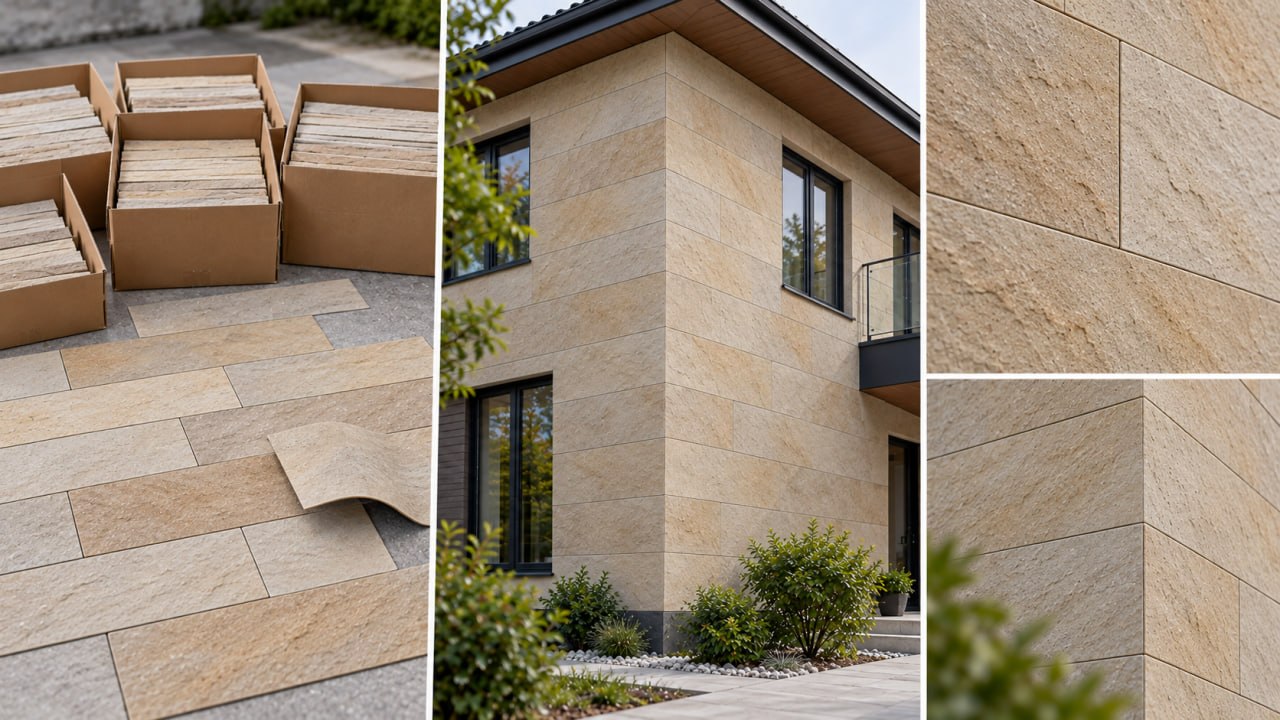
You bought flexible tile in one colour and lighter and darker patches appeared on the wall. It is not a defect: a material that imitates natural stone allows slight shade variation. We explain why tiles of one model differ, what happens when you install box after box, and give four mixing steps that produce a natural pattern without bands or patches.
You buy flexible tile in one color, begin cladding the facade, and after installing several rows notice that some areas look slightly different in shade. Even though the model name and product code are identical on every package, lighter and darker areas may appear on the wall.
This does not always indicate a manufacturing defect. Decorative materials designed to reproduce the appearance of natural stone may have slight variations in shade and mineral distribution. To make these differences look natural, tiles should be mixed from different packages before installation begins.
Why Can Tiles from the Same Model Vary Slightly in Shade?
Facade cladding with a natural-stone texture does not necessarily need to look completely uniform. Real stone often contains color transitions, inclusions, and variations in surface pattern.
KORDEKO Flexible Tile is produced on a mineral-polymer base using quartz sand or marble powder and oxide pigments. Depending on the collection, its surface can reproduce the appearance of stone, slate, brick, or other materials.
The KORDEKO technical description allows for minor natural shade variations that give the cladding a more lively and authentic appearance.
However, there is an important difference between natural variation and clearly visible color patches.
When tiles with slight differences are distributed across the entire facade, the overall result looks harmonious. But if one package is used completely before moving to the second and then the third, noticeable transitions may appear between different sections of the wall.
That is why alternating tiles from several packages is recommended.
What Happens If You Install Tiles Package by Package?
Imagine a facade clad with a natural gray stone texture.
One package may contain slightly lighter elements, while another may contain somewhat darker ones. When viewed separately, these differences may be barely noticeable.
However, if the entire contents of the first box are installed first, followed by the second, the finished facade may develop horizontal or vertical areas with different color intensity.
Such transitions are especially visible on large uninterrupted walls where there are no architectural elements to distract from the surface.
By mixing tiles, these differences are distributed more evenly across the facade. Instead of several distinct color zones, the surface develops a more natural combination of shades typical of stone.
At the same time, mixing should not be used to hide clearly mismatched products. If tiles differ significantly in color or texture from the approved sample, the product should be checked for conformity before installation begins.
How to Mix Flexible Tiles from Different Packages Correctly
KORDEKO installation instructions recommend mixing tiles from different packages to create a more natural-looking surface.
In practice, the process can be organized as follows.
1. Open Several Packages Before Installation
Do not begin installation using only one box.
Prepare tiles from several packages of the same selected model and color. This allows you to identify possible variations in advance and distribute the elements more evenly across the area being clad.
The exact number of boxes opened at the same time depends on the project size and how the installation is organized.
2. Lay Out the Tiles and Assess the Overall Pattern
Before applying adhesive, it is useful to place several tiles next to each other on a clean surface.
Pay attention to color intensity, the distribution of mineral inclusions, and variations in relief.
For collections with a pronounced stone texture, this preliminary layout helps prevent accidental clustering of similar-looking elements.
It is best to evaluate the shades in natural daylight, because artificial lighting can alter color perception.
3. Alternate Tiles During Installation
During installation, take tiles alternately from different packages rather than using one box at a time.
For example, you can take several tiles from the first package, then from the second and third, distributing them across the surface.
There is no need to follow a strict repeating sequence. The main objective is to avoid visible grouping of similar shades.
For natural-stone textures, slight irregularity in the pattern often looks more authentic than a mechanical alternation of light and dark elements.
4. Check the Result as Installation Progresses
After installing several rows, step back from the wall and look at the cladding from a distance.
When viewed up close, attention is focused on individual tiles. From several meters away, the overall composition becomes easier to assess.
If one area appears significantly darker than the surrounding sections, adjust the distribution of tiles before continuing.
This type of visual check is especially useful on large facades and wide wall areas without window openings.
For Which Textures Is Mixing Especially Important?
KORDEKO Flexible Tile (PletaFlex) is available in different reliefs and color combinations. The importance of mixing depends on the character of the selected texture.
For wild-stone textures, natural color changes and mineral inclusions are part of the decorative effect. Proper distribution helps create a continuous surface without obvious clusters.
With slate textures, shade transitions and relief are often more noticeable. A preliminary layout makes it easier to evaluate how neighboring tiles work together.
For brick-look cladding, distribution is also important, especially when the selected series includes several shades.
However, different product codes or colors should not be mixed unless such a combination is part of the design. The recommendation primarily applies to tiles of the same selected model taken from different packages.
What Other Mistakes Can Affect the Appearance of the Cladding?
Even correctly mixed tiles will not produce a clean result if installation technology is not followed.
In particular, the appearance can be affected by:
- Incorrect adhesive color. For light KORDEKO shades, white-cement-based adhesive is recommended; for darker shades, gray-cement-based adhesive is recommended.
- An uneven substrate. Surface irregularities can reduce the quality of tile contact.
- Insufficient pressing. After placement, the material should be firmly pressed with a flat float to remove trapped air.
- Adhesive residue left on the surface. Excess adhesive should be removed with a sponge during installation.
- No preliminary pattern check. On a large wall, poor shade distribution is much harder to correct after installation than during the initial layout stage.
If the cladding is installed over a thermal insulation system, Facade Insulation also requires proper preparation of the reinforcement layer and priming before the decorative finish is applied.
The general requirements for external thermal insulation composite systems (ETICS) are set out in the European assessment documents published by EOTA.
Mixing therefore helps create visual harmony, while correct substrate preparation and installation technology are responsible for the reliability of the cladding.
Can Tiles Be Mixed After Installation Has Already Started?
Yes. If the facade has not yet been completed, you can begin alternating tiles from different packages on the remaining area.
However, the pattern that has already been created must be taken into account. If a large part of the wall has been clad predominantly with one shade, changing the installation sequence may not fully eliminate the visible transition.
That is why the most practical approach is to open several packages in advance and evaluate how the elements work together before bonding them to the wall.
This is a simple organizational step that requires no special equipment but gives much better control over the final appearance of the facade.
See also: why the showroom sample and the finished facade look different; a 4 mm or 6 mm adhesive layer under flexible tile; how to combine stone, brick, slate and wood on a facade.
Conclusion
Mixing flexible tiles from different packages helps distribute natural shade variations evenly and creates a more cohesive facade without noticeable color bands or patches.
The process is simple: inspect the material in advance, lay out several elements, and alternate tiles from different boxes during installation.
This preparation is especially useful for natural stone, slate, and brick textures, where small color variations form part of the character of the surface.
The key is to evaluate not only each individual tile, but also how all the elements will look together on the finished wall.
Frequently asked questions
Why do tiles of the same model differ in shade?
How many packages should be opened before installation?
Can mixing start when part of the wall is already laid?
Need advice on your facade?
- Get a free consultation for your project
- Find out which material suits your facade
- We'll answer all your questions and help you choose