


KORDEKO flexible tile: 4 mm or 6 mm, how the wrong adhesive layer affects cladding durability
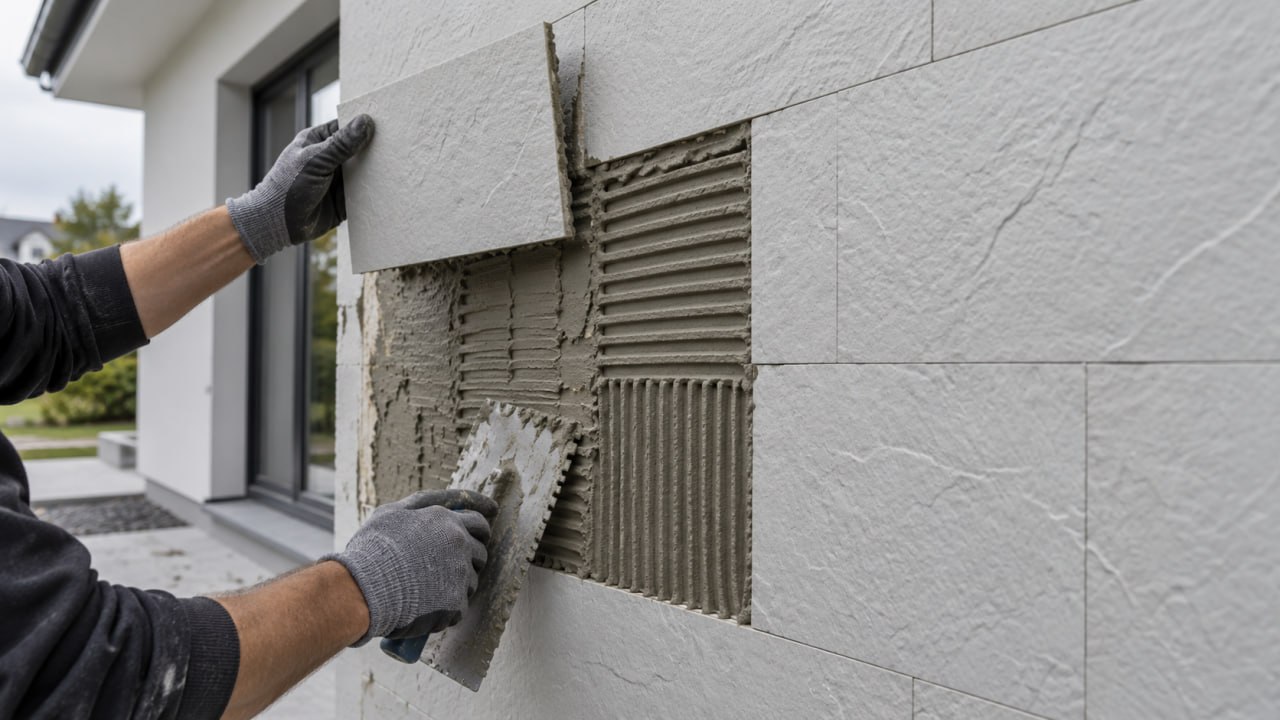
When installing flexible tile, it may seem that the adhesive is simply an intermediate layer between the wall and the cladding. In reality, the thickness and uniformity of the adhesive layer directly affect the quality of contact with the substrate, the appearance of the facade and the durability of the entire cladding system.
Depending on the installation conditions, an adhesive layer of 4 mm or 6 mm may be used. Problems arise when the installer chooses the thickness "by eye", applies too little adhesive or, on the contrary, tries to compensate for an uneven substrate with an excessively thick layer. So the real question is not only 4 mm or 6 mm, but whether the adhesive layer has been selected and applied correctly.
Why a specific adhesive layer is needed
The adhesive must provide full and reliable contact between the substrate and the flexible tile. When applied correctly, it:
- distributes evenly beneath the cladding;
- provides the required adhesion;
- covers the working surface properly;
- helps prevent voids;
- allows the tile to sit correctly on the substrate.
If there is too little adhesive, some areas may not achieve full contact. If there is too much, another problem appears: an excessive adhesive layer complicates installation and should not be used as a substitute for levelling the substrate.
What happens if the layer is too thin
An insufficient amount of adhesive can result in incomplete contact between the tile and the substrate. Some areas beneath the cladding do not receive enough adhesive. As a result:
- the actual bonded surface area is reduced;
- voids may form beneath the tile;
- the edges of individual elements are less securely fixed;
- the risk of cladding damage during use increases.
Special care is required on exterior facades, where the material is constantly exposed to rain, sunlight, frost and temperature fluctuations.
What if the layer is too thick?
More adhesive does not mean greater reliability. If the substrate has significant irregularities, there may be a temptation to apply more adhesive and use it to "level" the surface. However, the adhesive layer should not replace proper substrate preparation. An excessively thick layer can:
- make it more difficult to align the tile;
- increase material consumption;
- change the position of individual elements;
- create different thicknesses beneath different areas;
- make it harder to achieve a flat finished surface.
If the substrate has significant variations, it should first be properly prepared and levelled before the cladding is installed.
4 mm or 6 mm?
The choice of thickness depends on the specific installation technology, the substrate and the application conditions. 4 mm may be used where that working layer is specified and the substrate has already been properly prepared. 6 mm is used where the installation technology for the specific area or material requires a thicker layer.
The main rule is not to choose the thickness on the idea that "more means stronger". The adhesive thickness should follow the KORDEKO installation technology and the actual conditions of the surface.
Why uniformity matters more than the number itself
Imagine a wall where the adhesive layer is around 4 mm in one area, 7 mm in another and almost absent somewhere else. Even if the average thickness seems acceptable, this cannot be considered a high-quality installation. An uneven adhesive layer can lead to:
- inconsistent contact;
- surface level differences;
- local voids;
- uneven fixation of individual elements;
- visible surface defects.
The installer's task is therefore not simply to apply a certain amount of adhesive, but to achieve a uniform working layer across the entire cladding area.
Adhesive should not compensate for an uneven wall
This is one of the most common installation mistakes. If the substrate has significant level differences, the installer may try to correct them by increasing the amount of adhesive. This increases consumption and makes installation quality less predictable.
The correct sequence is different: substrate preparation → priming → adhesive application → flexible tile installation. The flatter and more stable the substrate, the easier it is to achieve the correct adhesive layer. Each of these stages is described on our flexible tile installation service page.
What happens if voids are left behind
Voids beneath the cladding are one of the most undesirable installation defects. On a facade the material is constantly exposed to temperature changes: the surface heats up in sunlight, cools down at night and in winter goes through repeated freeze-thaw cycles. If some areas of the tile do not have full contact with the substrate, the loads are distributed unevenly.
That is why it is especially important to avoid voids around:
- tile edges;
- corners;
- reveals;
- the plinth;
- areas around windows;
- external facade corners.
These are also the details that let water in when done carelessly; see our article on facade junctions without leaks.
Why problems with the adhesive may not appear immediately
A problem with the adhesive layer may not become visible immediately after installation. A newly finished facade may look perfect. But normal operating conditions then begin:
- summer heating;
- night-time cooling;
- rain;
- frost;
- thawing;
- wind;
- mechanical impact.
Repeated cycles gradually reveal weak areas in the installation. That is why facade durability cannot be judged only by how good it looks on the day the project is completed. Why a correctly installed flexible facade stays free of cracks for years is covered in a separate article.
Installation technology is especially important on insulated facades
When facade insulation is carried out, the final cladding is installed over a prepared facade system. The adhesive cannot be considered separately from the other layers: the European assessment documents for external thermal insulation systems (EOTA) treat such a system as one whole. The substrate must be:
- strong;
- even;
- properly reinforced;
- correctly prepared;
- primed according to the installation technology.
Only after that should flexible tile be installed. If problems in the underlying layers are simply covered by increasing the adhesive thickness, the actual cause of the defect remains unresolved.
Why flexible tile still requires precise installation
KORDEKO flexible tile (PletaFlex) is lightweight and flexible, which makes it convenient for facades, plinths, corners, reveals and other complex areas. However, the flexibility of the material does not remove the requirements for proper substrate preparation and adhesive application. On the contrary, accurate bonding is especially important where the cladding follows the geometry of the substrate.
The installer should therefore control not only the amount of adhesive, but also:
- the condition of the substrate;
- uniformity of application;
- full contact of the material;
- absence of voids;
- the quality of edges and joints.
How to check installation quality
Before cladding a large area, it is useful to make a small test section. This allows you to check:
- whether the selected adhesive is suitable;
- how it works with the specific substrate;
- what adhesive thickness the installation technology requires;
- how evenly the adhesive can be applied;
- how well the tile sits on the surface;
- whether any voids remain;
- how the joints look.
It is much easier to correct a problem on a small test area than after the entire facade has been completed.
Typical installer mistakes
Applying adhesive "by eye"
Without controlling the thickness, it is easy to create an uneven layer.
Making the layer thicker to hide irregularities
Adhesive should not replace proper substrate preparation.
Using too little adhesive
An insufficient amount may result in incomplete contact.
Failing to check tile edges
Edges and corners require particularly careful bonding.
Skipping a test area
It is easier to identify an installation problem before starting the entire facade.
Mini checklist before installation
Before starting work, make sure that:
- the substrate is even and strong;
- the surface has been properly prepared;
- a suitable adhesive has been selected;
- the required adhesive thickness has been determined;
- the correct application method is being followed;
- the adhesive layer is uniform;
- there are no voids beneath the tile;
- edges and corners are properly bonded;
- adhesive is not being used to correct major substrate irregularities.
Conclusion
When installing flexible tile, the goal is not to use the thickest possible adhesive layer, but to create the correct and uniform working layer required by the installation technology. A layer that is too thin can result in insufficient contact, while an excessively thick layer increases material consumption and creates levelling problems. That is why 4 mm or 6 mm should not be chosen arbitrarily: the correct value depends on the specific detail, the substrate and the installation requirements.
KORDEKO flexible tile is designed for facade applications, but its durability depends on more than the material itself. A properly prepared substrate, suitable adhesive, uniform application and compliance with the installation technology are essential for a reliable result.
Frequently asked questions
What adhesive layer does flexible tile need, 4 mm or 6 mm?
Can a thick adhesive layer level an uneven wall?
Why are voids under flexible tile a problem?
Need advice on your facade?
- ·Get a free consultation for your project
- ·Find out which material suits your facade
- ·We'll answer all your questions and help you choose