


KORDEKO flexible tile: why a showroom sample and a finished facade can look different
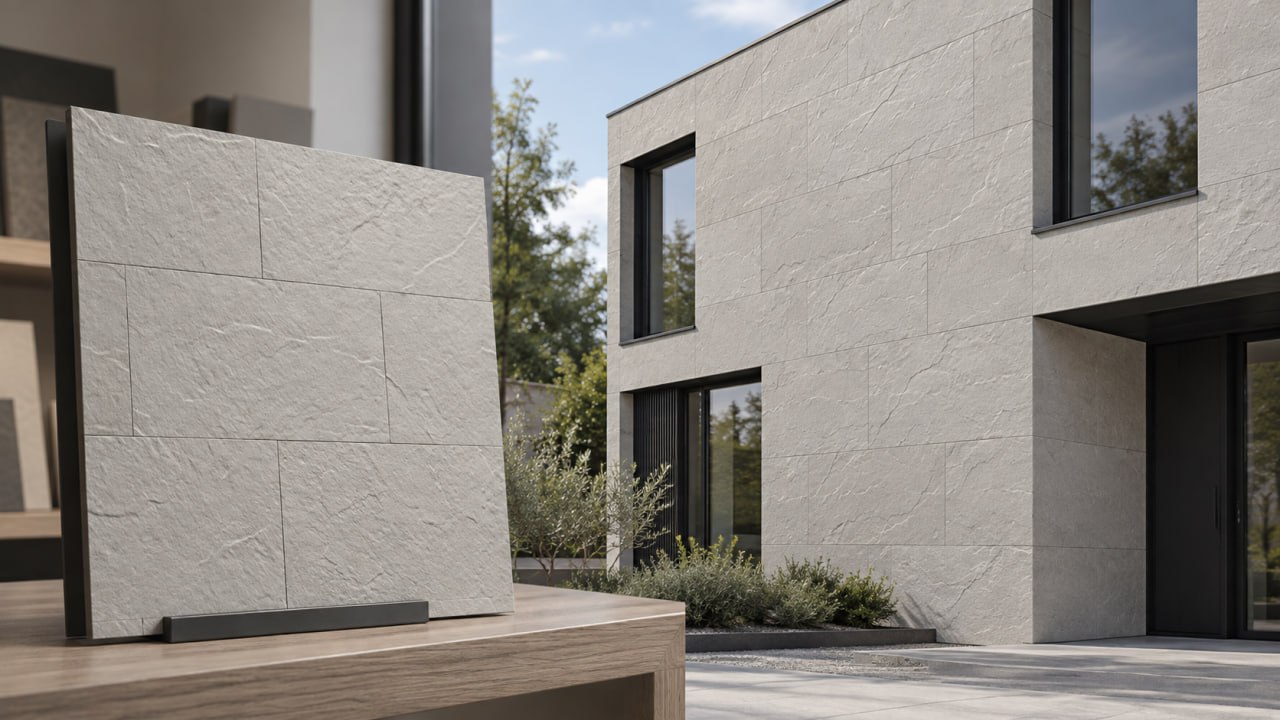
When choosing facade cladding, many people base their decision on a small sample displayed in a showroom. It may look perfect: an attractive shade, expressive texture and neat surface relief. However, once the same material is installed on a house, it can sometimes look completely different.
This does not necessarily mean that the material itself has changed. What changes is the scale, lighting, viewing distance, surrounding colours and the number of repeated elements. That is why a showroom sample and a finished facade should be treated as two different visual scenarios.
Why a small sample and a large wall are perceived differently
When looking at a sample, a person sees only a small fragment of the material. Attention is focused on its texture, colour and details.
On a facade, the situation is different. The material may cover tens or even hundreds of square metres and begins to be perceived as one continuous surface. On a large area, the following may become more noticeable:
- the overall shade;
- repetition of the pattern;
- direction of the layout;
- size of individual elements;
- contrast between neighbouring areas;
- transitions between different textures.
What seemed like a strong accent on a small sample may become a calm background when applied to an entire wall. The opposite can also happen: a small contrast visible on the sample may become much more noticeable when repeated across a large surface.
How showroom lighting differs from outdoor light
In a showroom, samples are usually viewed under artificial or controlled lighting. On a facade, the material is exposed to natural light, which changes throughout the day: the surface may look one way in the morning, another way at midday and completely different under cloudy skies. This is why the International Commission on Illumination (CIE) describes daylight with several standard illuminants rather than one single "white" light.
Direct sunlight has an especially strong effect on surface relief: raised areas receive more light while recessed areas remain in shadow, making the texture appear more pronounced. That is why both colour and texture should be evaluated not only under indoor lighting, but also outdoors.
How viewing distance changes the perception of texture
In a showroom, the sample is viewed from close range and every small detail can be examined. On a facade, the material is usually viewed from several metres away: small details merge into an overall pattern, while individual elements become less noticeable.
That is why it is important to imagine how the material will look not only from arm's length, but also:
- from the opposite side of the property;
- from the road;
- from the entrance;
- from several metres away;
- at second-floor level.
Why facade colour depends on more than the tile itself
The same shade can look different depending on the materials around it. For example, light stone next to white plaster may appear darker. Next to a dark plinth, the same stone may appear lighter.
Its appearance is influenced by:
- roof colour;
- window frames;
- doors;
- the plinth;
- fencing;
- walkways;
- neighbouring walls;
- surrounding greenery.
That is why facade colours should be selected in the context of the entire house rather than separately from its architecture. How to match a shade to the roof, windows and fence is covered in our article on choosing a facade colour.
How texture changes on large surfaces
On a small sample, you may see only individual stone elements. Once the texture is repeated across an entire wall, a clear visual rhythm appears. On the finished facade, the following become more noticeable:
- horizontal lines;
- vertical transitions;
- repetition of stone elements;
- direction of the pattern;
- joint width;
- variation between shades.
That is why it is important to understand in advance not only how one element looks, but how the entire layout will appear. You can see a texture and its laying format on a whole house at once in our 3D facade constructor.
How combining several textures changes the perception of each one
If only one material is used on a house, its colour and texture are perceived fairly unambiguously. But once brick, stone, slate, wood texture or plaster appear next to it, each material begins to visually influence the others.
That is why KORDEKO flexible tile (PletaFlex) should not be selected on the basis of an individual sample alone. When designing a facade, it is important to evaluate how a specific texture will work together with the other materials of the building; how to distribute several textures without visual chaos is the subject of a separate article.
Why a test area is more useful than a photograph
A photograph can help visualise the overall result, but it cannot reproduce everything accurately. Its appearance is influenced by the camera, the lens, lighting conditions, image processing, viewing distance and the device screen.
A small real-life test area on the house provides much more useful information. It allows you to evaluate:
- the true colour;
- surface relief;
- element size;
- how the material reacts to sunlight;
- how it works with the windows;
- the scale of the texture;
- the quality of the joints.
That is why it is useful to create a test section before cladding a large surface.
Light and dark materials look especially different
Light shades can make a facade appear visually lighter and more spacious. Dark shades, on the other hand, emphasise volume and architectural geometry. However, on a large surface a dark material may look much more intense than it does on a small sample.
Light materials can also appear different: sunlight increases their brightness, while shadows in the relief make the texture look more contrasting. That is why it is better to compare several options side by side before making a final decision.
What happens after installation
Once installed, the material is no longer an isolated sample. It becomes part of the building's architecture, and its appearance is now influenced by the shape of the house, the windows, roof, plinth, lighting, surrounding landscape and neighbouring materials.
That is why the same material can look completely different on two different houses: on one building it may serve as a calm background, while on another it may become the main visual accent. You can see this clearly in our completed projects.
How to choose a facade material correctly
To make the final result match your expectations as closely as possible, follow a simple process:
- Compare several samples. Do not limit yourself to just one shade.
- Take the samples outdoors. Evaluate them in natural daylight.
- View them from different distances. Not only up close, but also from 5 to 10 metres away.
- Hold them against the facade. Compare the material with the windows, roof, plinth and doors.
- Create a test area. This is especially useful when a large surface is going to be clad.
- Evaluate the entire facade as a whole. Consider not only an individual stone element, but the overall composition.
What if the facade is insulated?
When facade insulation is part of the project, a test area is especially useful. It allows you to evaluate not only the appearance of the cladding, but also the entire system: the substrate, reinforcement layer, primer, adhesive, corners and junctions.
This makes it possible to identify potential problems before hundreds of square metres have been installed, when corrections would be much more difficult.
Conclusion
The difference between a showroom sample and a finished facade is usually not caused by a change in the material itself, but by a change in the conditions under which it is perceived. On a large wall the scale and rhythm of the texture change, natural light creates different shadows, and the colour begins to interact with the windows, roof, plinth and surrounding landscape.
That is why KORDEKO flexible tile should not be chosen on the basis of a small showroom sample alone. A real test area on the facade lets you understand in advance how the material will actually look on your own house.
Frequently asked questions
Why does a facade look different after installation than the sample in the showroom?
How should a facade tile sample be evaluated?
Why is a test area needed when there are photos of finished projects?
Need advice on your facade?
- ·Get a free consultation for your project
- ·Find out which material suits your facade
- ·We'll answer all your questions and help you choose