


Facade Renovation Without an Angle Grinder and Dust: Can You Update a House with Almost No Construction Waste?
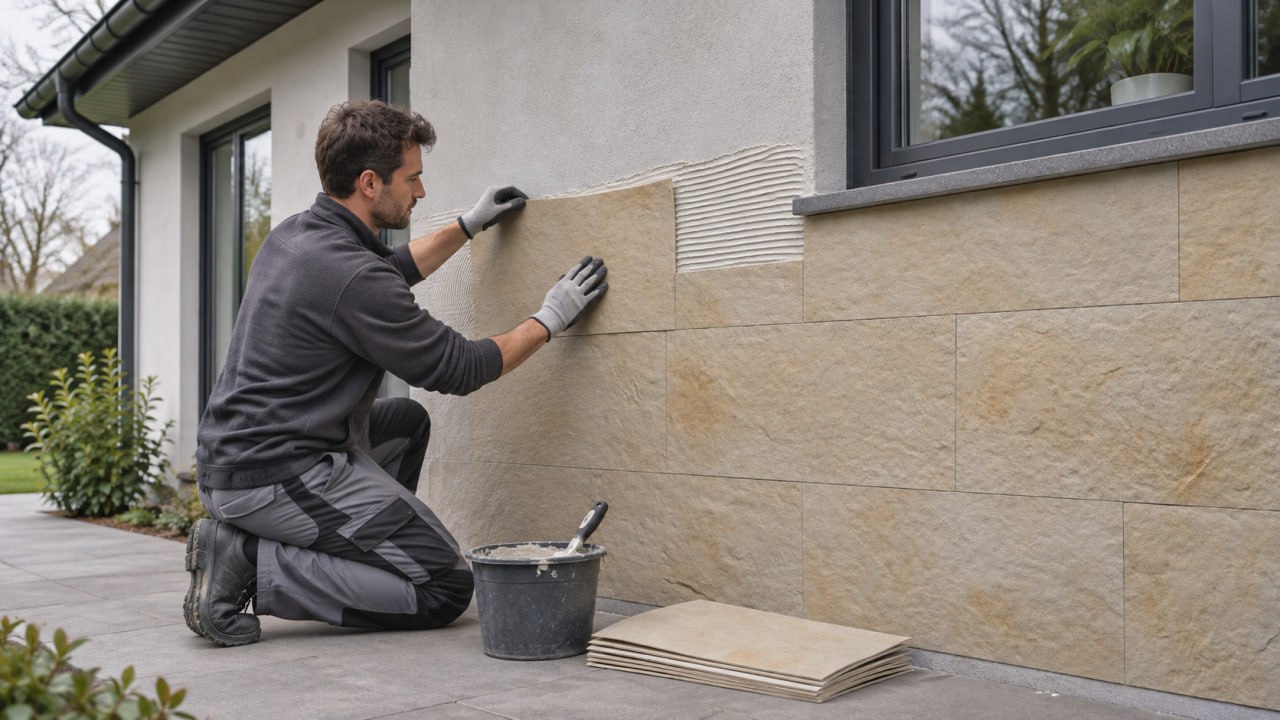
Grinder noise, clouds of dust and bags of debris are the usual picture of a facade renovation. Flexible tile is cut with a utility knife and, on a sound substrate, installed over old plaster. We look at where the dust really disappears and where preparation and insulation still cannot be avoided.
Facade renovation is often associated with the noise of an angle grinder, clouds of construction dust, and bags of debris. The biggest inconvenience usually comes from removing old cladding and cutting natural stone or porcelain stoneware.
However, modern finishing materials can make some facade work significantly cleaner. Flexible tile, for example, can be cut with a standard utility knife and, under certain conditions, installed over an existing finish. But how “clean” can such a renovation really be?
Why Does Traditional Cladding Create So Much Dust?
The amount of construction dust depends on the material being used and the way it is processed.
Natural stone and porcelain stoneware are rigid materials. Cutting them often requires specialized equipment. During dry cutting, fine particles are released and settle on scaffolding, windows, paths, and surrounding surfaces.
A large amount of cutting is often required around windows, doors, corners, and decorative architectural elements.
Another major source of waste is demolition of the existing finish. If old plaster or tile has to be removed completely before renovation, the volume of debris increases significantly.
However, not every facade requires full demolition. In some cases, the existing finish can remain if it is strong enough and suitable for further finishing.
How Does Flexible Tile Make It Possible to Work Without an Angle Grinder?
KORDEKO Flexible Tile (PletaFlex) is a thin mineral-polymer cladding material reinforced with a non-woven membrane.
Unlike natural stone and porcelain stoneware, it does not require an angle grinder for ordinary cutting.
The tile can be cut with a utility knife or scissors. This is especially convenient when fitting elements around windows, corners, and other architectural details.
This processing method offers several practical advantages:
- No mineral dust typical of dry stone cutting is generated.
- Cutting produces less noise.
- No equipment for cutting massive stone slabs is required.
- Lightweight offcuts are easier to collect and remove from the work area.
The flexibility of the material also helps when cladding columns, arches, and rounded corners. Instead of making numerous cuts, the tile can follow the shape of a properly prepared surface.
However, construction dust cannot be eliminated completely. It may still be generated during wall preparation, removal of damaged plaster, and other related work.
Can a Facade Be Renovated Without Removing the Existing Finish?
One way to reduce construction waste is to keep the existing finish.
According to the KORDEKO technical description, flexible tile can be installed over stable existing coatings, including properly prepared plaster.
However, the condition of the wall must first be checked.
If the existing finish is firmly bonded, does not crumble, and has no significant damage, keeping it can reduce the amount of demolition work.
If cracks, voids, or delaminated areas are found, they must be repaired.
New cladding should never be bonded over weak plaster simply to avoid creating construction waste. Such a solution may eventually cause the new finish to detach as well.
Renovation without full demolition is therefore possible, but only after confirming that the existing substrate is suitable.
How Does Installation Work with Minimal Waste?
When flexible tile is used, much of the work can be carried out with standard hand tools.
The main stages include:
- Substrate preparation. Remove dust, dirt, and weak areas.
- Leveling. Correct surface irregularities where necessary.
- Priming. Apply a primer suitable for the substrate type.
- Tile installation. Use a suitable adhesive and notched trowel.
- Element fitting. Cut tiles with a utility knife or scissors.
- Surface cleaning. Remove excess adhesive with a sponge.
For exterior work, KORDEKO specifies the use of a frost-resistant adhesive. After placement, the tile should be pressed firmly with a flat float to remove trapped air.
As a result, the main waste typically consists of tile offcuts, packaging, and leftover construction compounds.
However, keeping the worksite cleaner should never come at the expense of proper substrate preparation.
What If the Facade Also Needs Insulation?
If the renovation also includes improving the building’s thermal performance, the scope of work increases.
Facade Insulation involves installing thermal insulation boards, fixing them, reinforcing the surface with fiberglass mesh, priming, and applying the final finish.
The general requirements for external thermal insulation systems (ETICS) are set out in the European assessment documents published by EOTA.
These stages inevitably generate additional waste from insulation cutting, packaging, and construction compounds.
KORDEKO Flexible Tile can be used as the final cladding on a properly prepared thermal insulation system. Its easy processing can help reduce dust specifically during the decorative finishing stage.
It is therefore important to distinguish between updating an existing stable facade and carrying out a complete reconstruction with insulation. In the second case, construction waste cannot be eliminated completely.
When Is Renovation Without an Angle Grinder Really Possible?
The most favorable situation is a facade with strong existing plaster that only needs a new decorative finish.
If the substrate does not require extensive repair, flexible tile can be installed without cutting stone and without completely removing the old finish.
However, if the walls are seriously damaged, the existing coating must be removed, or the facade structure itself needs to be changed, additional construction work will still be necessary.
That is why promising a completely dust-free renovation would be unrealistic. A more practical goal is to reduce the number of dusty operations, noise levels, and the amount of construction waste.
See also: an old facade without demolition; why tile must not go on a dusty wall; fast facade installation without heavy equipment.
Conclusion
It is possible to renovate a facade in a relatively “clean” way if the existing substrate is in good condition and the selected cladding does not require complex processing.
KORDEKO Flexible Tile can be cut without an angle grinder, helping reduce dust and, in some cases, allowing the existing finish to remain without full demolition.
However, the result depends on the condition of the walls and the amount of preparation required. Even the most convenient cladding material does not eliminate the need to remove weak areas, apply primer, and follow the correct installation technology.
The main advantage of this type of renovation is therefore not the complete absence of construction waste, but the ability to significantly reduce the amount of dirty and noisy work.
Frequently asked questions
Can flexible tile be cut without an angle grinder?
Does old plaster have to be removed before cladding?
Will such a renovation be completely dust-free?
Need advice on your facade?
- Get a free consultation for your project
- Find out which material suits your facade
- We'll answer all your questions and help you choose