


Fast Facade Installation Without Compromising Quality: How Modern Materials Reduce Work Time
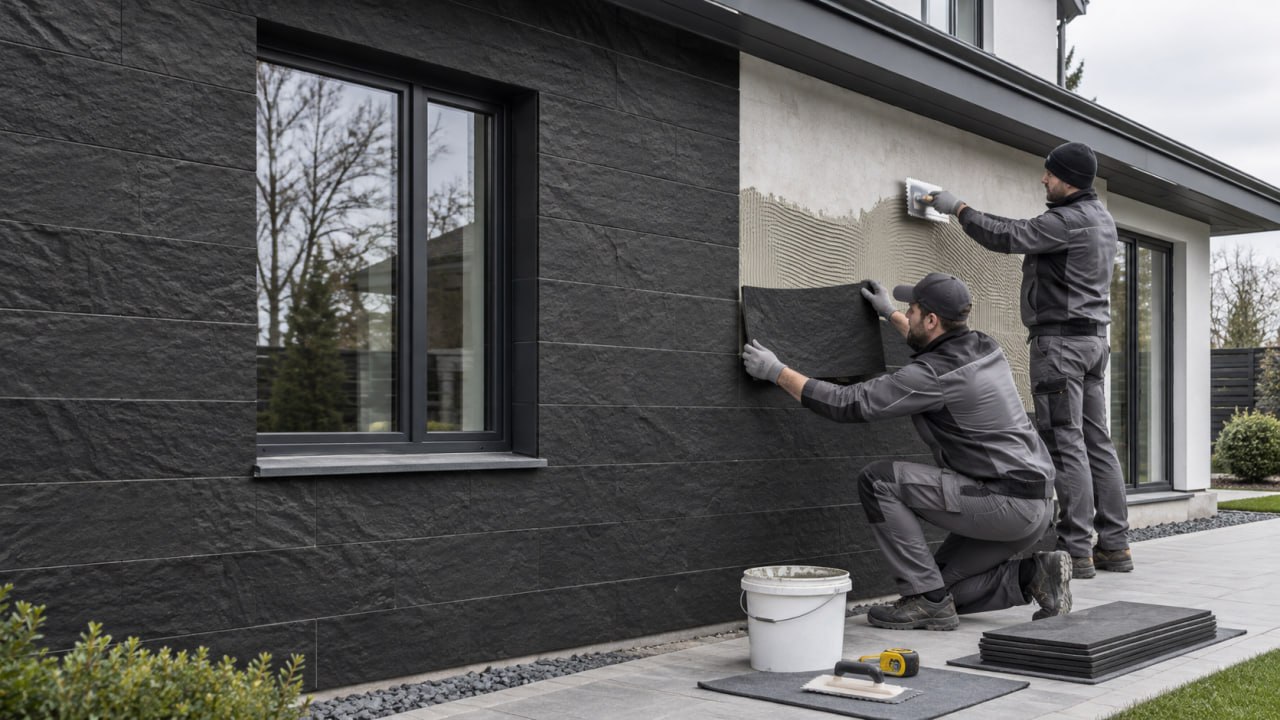
If one crew takes weeks and another finishes faster, are the builders cutting corners? We look at where time goes with heavy cladding, how KORDEKO flexible tile at about 4 kg/m² speeds things up — weight, knife cutting, complex shapes, up to 25 m² a day per installer — and which stages must never be rushed.
A facade completed quickly can sometimes raise doubts. If one crew takes several weeks while another finishes much faster, it is natural to wonder whether quality is being sacrificed.
However, installation speed depends not only on the skill of the workers. The properties of the cladding material, its weight, fixing method, and the number of required operations also play a major role. Modern facade solutions can reduce installation time without violating the required technology.
Why Does Traditional Cladding Take More Time?
When natural stone or heavy ceramic tile is used, a significant amount of working time is spent on preparation and supporting operations.
The material must be delivered, unloaded, lifted to the required height, and adjusted to the geometry of the facade. Heavy elements are more difficult to move and install, especially around windows, corners, and architectural projections.
Depending on the fixing system, additional structures, specialized tools, and several installers may be required.
That is why the duration of the work depends not only on the cladding area, but also on the complexity of the installation technology itself.
How Do Modern Materials Speed Up Facade Finishing?
One of the main advantages of certain modern cladding materials is the reduction in labor-intensive operations.
KORDEKO Flexible Tile (PletaFlex) is a thin mineral-polymer material that combines the appearance of natural stone with low weight and flexibility.
These properties can reduce installation time in several ways.
Lower Weight Means Easier Handling
KORDEKO Flexible Tile weighs approximately 4 kg/m². This makes the material easier to transport, unload, and move around the construction site than massive stone cladding.
On large facades, the difference becomes especially noticeable because installers repeatedly need to lift and position new elements.
Simple Cutting Without Complex Equipment
Natural stone and porcelain stoneware require suitable cutting equipment.
Flexible tile can be cut with a utility knife or scissors. This simplifies fitting around windows, doors, and corners and can also reduce dust during processing.
Easier Installation on Complex Shapes
Columns, arches, and curved walls often increase the time required for cladding work.
Rigid tile must usually be divided into separate pieces to follow a curved surface.
Flexible cladding can adapt to a properly prepared curved substrate. This reduces the amount of cutting required and simplifies the finishing of architectural elements.
How Much Faster Can Flexible Tile Be Installed?
According to the KORDEKO technical description, one installer can lay up to 25 m² of flexible tile per day.
This is an approximate productivity figure under suitable conditions and should not be treated as a guaranteed result for every project.
Actual installation speed depends on several factors:
- the condition and flatness of the substrate;
- the selected tile format;
- the number of windows, corners, and architectural details;
- the complexity of the layout;
- worksite organization.
For example, cladding a large flat wall usually requires fewer cuts and additional operations than finishing a facade with many small sections.
For this reason, the installation speed of different materials should only be compared under similar project conditions.
Which Stages Should Never Be Rushed, Even with Flexible Tile?
Ease of installation does not eliminate the need to follow the required technology.
Before bonding KORDEKO Flexible Tile, the substrate must be cleaned of dust and dirt and checked for cracks, voids, and weak areas. Where necessary, the surface should be leveled and primed.
A frost-resistant adhesive is used for exterior cladding. According to the manufacturer’s instructions, it is applied with a 4 mm notched trowel for smooth tile and a 6 mm notched trowel for textured tile.
After installation, the tile must be pressed firmly with a flat float to remove trapped air and ensure proper contact.
It is also essential to respect the adhesive curing time and the required installation temperatures.
If primer is skipped, the substrate is poorly prepared, or the adhesive manufacturer’s recommendations are ignored in an attempt to work faster, the advantages of the material cannot compensate for these mistakes.
Fast installation is only an advantage when unnecessary operations are reduced—not when essential technological stages are omitted.
How Does Installation Speed Affect Facade Cost?
The duration of the work is directly related to labor costs and the organization of the construction site.
The less time required for processing, handling, and installing the material, the lower certain installation costs may be.
However, the total project cost also depends on wall preparation.
For example, Facade Insulation includes thermal insulation installation, fixing, reinforcement, priming, and final cladding. Every layer must be installed correctly, and required curing periods cannot simply be shortened.
The general requirements for external thermal insulation composite systems (ETICS) are set out in the European assessment documents published by EOTA.
This means that fast installation of the decorative tile does not mean the entire insulated facade can be completed within the same timeframe.
When comparing contractor quotations, it is important to clarify what the stated installation time actually includes: only the cladding stage or the complete facade system.
See also: fast facade installation without complex equipment; how much a flexible tile facade weighs; a 4 mm or 6 mm adhesive layer under flexible tile.
Conclusion
High installation speed does not necessarily mean low quality. In many cases, it is achieved through material properties that make the cladding easier to transport, process, and install.
KORDEKO Flexible Tile can reduce the number of labor-intensive operations during facade cladding, especially on areas with complex geometry.
However, faster work should never come at the expense of substrate preparation, correct adhesive application, or proper curing conditions.
The main indicator of quality is not the number of days spent on the project, but compliance with installation technology and the reliability of the completed facade system.
Frequently asked questions
How fast can KORDEKO flexible tile be installed?
Why is flexible tile faster to install than stone?
Which stages must not be rushed to save time?
Need advice on your facade?
- Get a free consultation for your project
- Find out which material suits your facade
- We'll answer all your questions and help you choose