


Energy-Efficient Facade: How KORDEKO Flexible Tile Helps Reduce Heat Loss in a Home
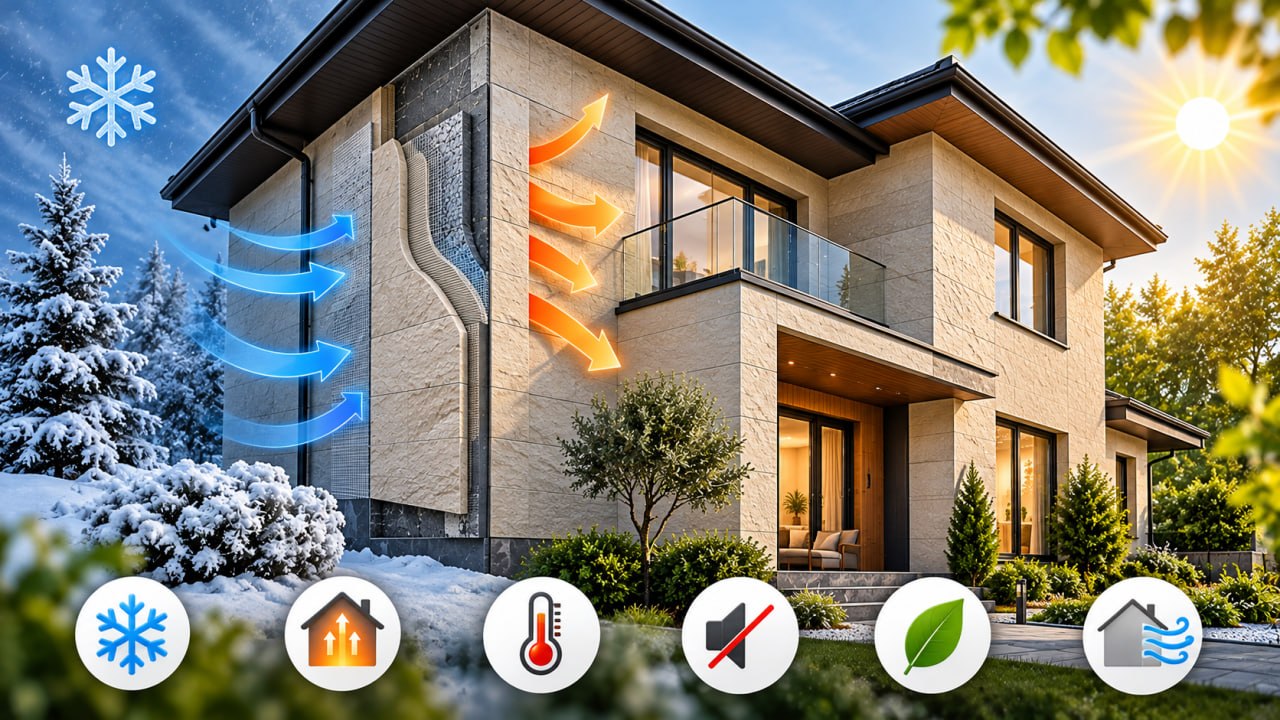
Even with a properly functioning heating system, a house can lose heat quickly. One possible reason is insufficient thermal insulation of the exterior walls. Heat escapes through them, increasing heating costs.
Decorative finishing alone cannot solve this problem. However, properly selected facade cladding can complement the thermal insulation system, protect it from external influences, and help preserve the building’s energy efficiency.
Why a House Loses Heat Through the Facade
According to KORDEKO materials on facade insulation, exterior walls may account for approximately 25–40% of a home’s total heat loss. The actual figure depends on the building structure, the condition of the windows, the roof, and other elements.
The general requirements for external thermal insulation composite systems (ETICS) are set out in the European assessment documents published by EOTA.
The main causes of heat loss include:
- Insufficient thermal insulation. The walls do not retain heat effectively during the cold season.
- Thermal bridges. Uninsulated areas around windows, balconies, and floor slabs can allow heat to escape.
- Installation mistakes. Gaps between insulation boards reduce the efficiency of the thermal insulation system.
- Excessive moisture. When certain types of insulation become wet, their thermal performance may decrease.
That is why facade energy efficiency depends primarily on the correct wall structure and the quality of the insulation system.
Can Flexible Tile Reduce Heat Loss?
KORDEKO Flexible Tile (PletaFlex) is a thin mineral-polymer material used for both exterior and interior cladding.
The manufacturer’s comparison documentation states that the material has additional heat-saving properties. However, the comparison provided with 3 cm thick expanded polystyrene is not sufficient for an independent thermal performance calculation.
For this reason, flexible tile should not be considered a full replacement for facade insulation.
Its primary purpose is to provide a decorative and protective finish. Thanks to its low weight of approximately 4 kg/m², flexible stone can be used in compatible external thermal insulation systems without significantly increasing the load on the facade.
How an Insulated Facade with KORDEKO Cladding Works
Facade Insulation involves the creation of a multi-layer system in which each material performs its own function.
A typical system includes a load-bearing wall, adhesive, thermal insulation boards made from expanded polystyrene or mineral wool, mechanical fixings, a reinforced layer with fiberglass mesh, primer, and the final finish.
In this system, the insulation is responsible for reducing heat loss, while KORDEKO Flexible Tile forms the exterior cladding.
Its moisture resistance and resistance to atmospheric exposure help protect the facade surface from rain and temperature fluctuations.
At the same time, the efficiency of the entire system depends on the thickness of the insulation, installation quality, and properly executed junctions.
Which Mistakes Reduce Facade Energy Efficiency?
Even high-quality insulation will not provide the expected results if installation mistakes are made.
It is especially important to avoid the following problems:
- Gaps between thermal insulation boards.
- Uninsulated window reveals and other thermal bridges.
- Incorrect placement of the reinforcement mesh.
- Insufficient moisture protection around the plinth and junctions.
- The use of incompatible materials within the same system.
Before installing the cladding, the substrate should be strong, clean, and properly prepared. Damage to an insulated facade can affect not only its appearance, but also the performance of the thermal insulation system.
See also: facade insulation step by step; the house is insulated but the walls are cold: why; what happens to an insulated facade when water gets in.
Conclusion
Facade cladding can complement an energy-efficient building envelope, but the main reduction in heat loss is achieved through properly designed and installed insulation.
KORDEKO Flexible Tile is suitable as a final finish for compatible thermal insulation systems thanks to its low weight, flexibility, and resistance to weather conditions.
The most practical approach is to design the insulation and cladding together as one complete facade system. This makes it possible to address thermal protection, durability, and the building’s appearance at the same time.
Frequently asked questions
Does flexible tile reduce heat loss by itself?
How much heat does a house lose through its walls?
Which mistakes reduce the energy efficiency of an insulated facade?
Need advice on your facade?
- Get a free consultation for your project
- Find out which material suits your facade
- We'll answer all your questions and help you choose