


Mineral Wool or Expanded Polystyrene: Which Insulation Is Better Under Flexible Tile?
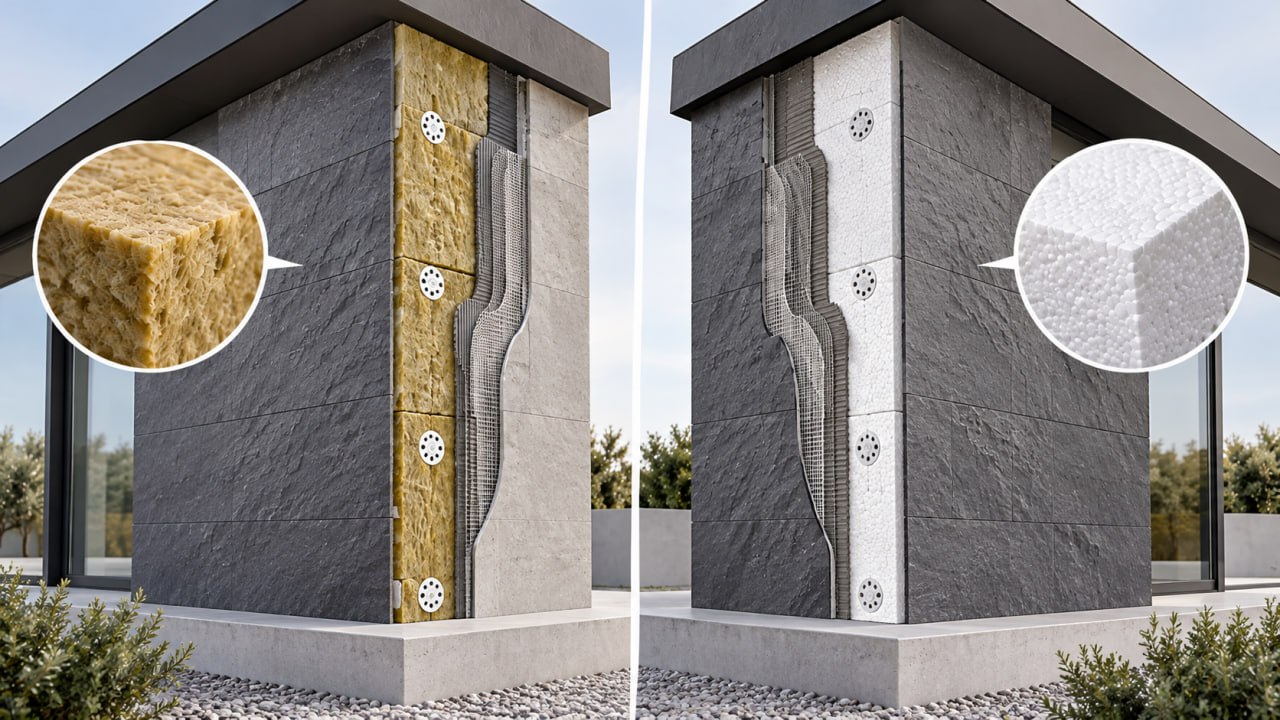
Mineral wool and expanded polystyrene are both used for exterior wall insulation, but they differ in cost, vapor permeability, fire performance, and installation requirements. Both materials can be used beneath facade cladding, but the right choice depends on the wall structure, building height, and operating conditions.
Choosing the wrong insulation can lead to moisture accumulation, cracking, and reduced thermal performance. That is why, when designing a facade, it is important to consider not only the price of the insulation, but also how the entire system will work together.
Expanded Polystyrene: An Affordable Option for Private Homes
Expanded polystyrene (EPS), often referred to as foam insulation, is widely used in external facade insulation systems. Its main advantages are low weight, affordable cost, and ease of installation.
The general requirements for external thermal insulation composite systems (ETICS) are set out in the European assessment documents published by EOTA.
EPS boards are easy to cut to size and install on a properly prepared substrate. This makes the material a practical solution for private homes and low-rise buildings.
The main advantages of expanded polystyrene include:
- Affordable cost. It is usually less expensive than mineral wool.
- Low weight. It does not add significant additional load to the walls.
- Good thermal insulation performance. It helps reduce heat loss through exterior building structures.
- Easy installation. The boards are easy to cut and install.
However, expanded polystyrene also has limitations. It is a combustible material, so the insulation system must comply with applicable fire safety requirements. EPS also has lower vapor permeability than mineral wool.
If the wall structure requires effective outward movement of moisture vapor, the use of expanded polystyrene should be justified based on the characteristics of all facade layers.
Mineral Wool: When Vapor Permeability Is Especially Important
Mineral wool, particularly stone or basalt wool, is also widely used for exterior wall insulation.
Its main difference from expanded polystyrene is its high vapor permeability. This makes it suitable for facade systems where outward moisture movement through the wall structure is important.
Mineral wool offers several advantages:
- High vapor permeability. Suitable for wall systems where moisture movement toward the exterior must be considered.
- Non-combustibility. Stone wool of the appropriate classification is used on buildings with stricter fire safety requirements.
- Sound insulation properties. It can also help reduce the transmission of outdoor noise.
- Compatibility with different facade systems. It is used in both rendered and ventilated facade systems.
The main disadvantages are higher cost and more demanding installation requirements.
Mineral wool must be protected from excessive moisture. If water penetrates the insulation, its thermal performance may decrease. For this reason, particular attention must be paid to the reinforcement layer, exterior finish, and the sealing of junctions.
Comparison of Mineral Wool and Expanded Polystyrene
| Criterion | Expanded Polystyrene (EPS) | Mineral Wool |
|---|---|---|
| Cost | Usually lower | Usually higher |
| Thermal insulation | Good | Good |
| Vapor permeability | Lower | Higher |
| Fire performance | Combustible material | Stone wool may achieve A1–A2 classification |
| Sound insulation | Not its main advantage | Good performance |
| Installation | Relatively simple | More demanding |
| Moisture protection | Required | Especially important |
| Typical applications | Private homes, low-rise buildings | Private homes, high-rise buildings, projects with higher requirements |
It would therefore be incorrect to say that one material is better than the other in every situation. Expanded polystyrene often has an advantage in terms of cost, while mineral wool performs better in terms of vapor permeability and fire characteristics.
Which Insulation Can Be Used Under KORDEKO Flexible Tile?
Both types of insulation can be used in external thermal insulation systems finished with flexible tile.
KORDEKO Flexible Tile (PletaFlex) is a lightweight mineral-polymer cladding material installed over a properly prepared and reinforced substrate.
Unlike heavy natural stone, this type of cladding does not create a significant additional load on the thermal insulation system. Its flexibility also makes it suitable for corners, reveals, columns, and other architectural elements.
A typical insulated facade system includes:
- A load-bearing wall made of brick, concrete, or aerated concrete.
- Adhesive for fixing the insulation.
- Expanded polystyrene boards or facade-grade mineral wool.
- Facade anchors selected for the substrate and system.
- A reinforced layer with fiberglass mesh.
- Primer beneath the final finish.
- KORDEKO Flexible Tile.
The thermal performance of the facade depends primarily on the correctly selected insulation material and its thickness, rather than on the decorative cladding.
The compatibility of all system components is especially important: adhesive, insulation, reinforcing compound, primer, and final finish.
Why Correct Installation Matters More Than Saving on Insulation
Even high-quality mineral wool or expanded polystyrene will not provide the expected result if installation mistakes are made.
The most common problems are caused by incorrect fixing of the boards, inadequate reinforcement, and poorly treated joints.
It is especially important to avoid the following mistakes:
- Gaps between insulation boards. These can create thermal bridges and localized cold areas.
- Insufficient fixing. An incorrect number or type of anchors increases the risk of detachment.
- Reinforcement mistakes. Incorrect positioning of the fiberglass mesh or missing reinforcement at window corners can lead to cracking.
- Poor moisture protection. Leaks around window sills, the roof, and the plinth can allow moisture into the system.
- Incompatible materials. Unsuitable adhesives or primers can reduce the reliability of the facade system.
That is why Facade Insulation should be designed as one complete system rather than as a collection of separately purchased materials.
What Should You Choose for a New or an Older House?
For a typical private house with brick or concrete walls, expanded polystyrene is often an economically reasonable solution. It allows exterior insulation to be installed without significantly increasing the overall project budget.
Mineral wool deserves particular consideration for older buildings, wall systems with higher vapor permeability requirements, and projects where stricter fire safety requirements must be met.
When renovating an old facade, the condition of the walls, existing moisture, and the characteristics of the current structure should be assessed before installation. Insulation should not be installed over a damaged substrate before the cause of deterioration has been corrected.
In both cases, insulation thickness should be selected according to the climate, wall material, and required level of energy efficiency. The same insulation thickness will not provide the same result for every building.
See also: choosing insulation and cladding for the climate; the thermal bridges that ruin insulation; facade insulation step by step.
Conclusion
Expanded polystyrene is attractive mainly because of its affordable price, low weight, and ease of installation. For many private homes, it can be a practical choice.
Mineral wool usually costs more, but it offers higher vapor permeability and advantages in terms of fire safety and sound insulation.
Both materials can be used beneath KORDEKO Flexible Tile, provided that the facade system is properly designed and the substrate is prepared according to the required technology.
The key is not to choose the insulation separately from the cladding, but to consider the entire wall structure as one system. The combined performance of the insulation, reinforcement layer, and exterior finish determines the reliability and durability of the facade.
Frequently asked questions
Which is better under flexible tile: mineral wool or EPS?
Can KORDEKO flexible tile be glued straight onto the insulation?
When is mineral wool mandatory?
Need advice on your facade?
- Get a free consultation for your project
- Find out which material suits your facade
- We'll answer all your questions and help you choose