


Can One Installer Clad an Entire House? Facade Installation Possibilities and Limitations
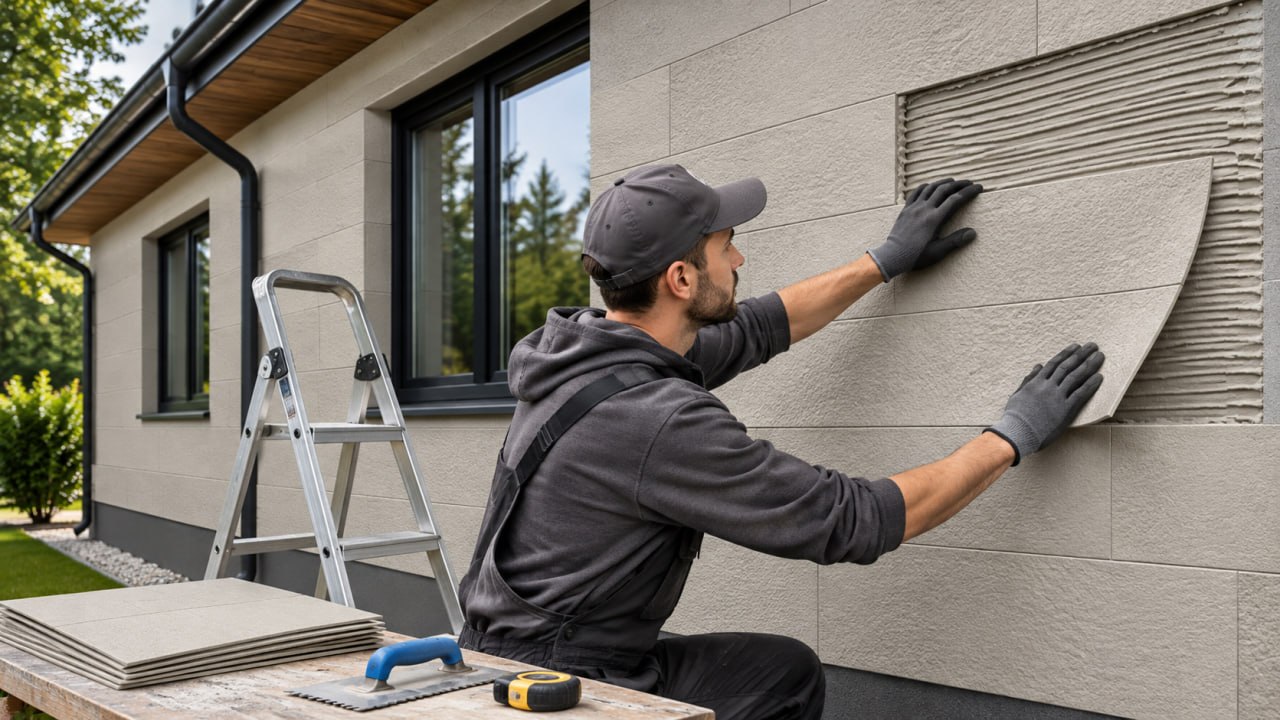
Cladding a house usually means a crew. But KORDEKO flexible tile at about 4 kg/m² is cut with a knife and laid with ordinary tools, so one qualified installer can do a large part of the work alone. We run the 200 m² ÷ 25 m² a day sum, name the conditions where it makes sense, and the limit — height, safety, adhesive working time — beyond which a second person is needed.
Cladding an entire house is usually associated with a construction crew. Several specialists prepare the walls, move materials, cut the cladding, and install the tiles. But is a full team always necessary?
Modern lightweight cladding materials allow one installer to carry out a significant part of the facade work independently. However, whether one person can work efficiently depends not only on the weight of the tile, but also on building height, architectural complexity, and safety requirements.
Why Does Traditional Cladding Often Require a Crew?
Natural stone and heavy ceramic tile make installation more demanding because of their weight and processing requirements.
The materials need to be unloaded, moved around the construction site, lifted to the required height, and installed on a prepared substrate. Cutting rigid materials may also require specialized equipment.
If the facade includes many windows, corners, projections, or columns, the amount of labor increases.
On such projects, several workers can divide the tasks: one prepares the material, another applies the adhesive, and a third installs the cladding.
However, the need for a crew is not determined only by the type of cladding. Even a lightweight material may require several specialists on a tall or architecturally complex building.
How Does Flexible Tile Make It Possible for One Installer to Work Alone?
KORDEKO Flexible Tile (PletaFlex) is a thin mineral-polymer cladding material with the appearance of natural stone, brick, or slate.
According to the technical description, it weighs approximately 4 kg/m². This is significantly less than traditional heavy stone cladding.
Its low weight makes individual elements easier to carry and install. Flexible tile can also be cut with a utility knife or scissors, without requiring complex stone-processing equipment.
Standard installation tools are used, including a notched trowel, hand trowel, flat float, tape measure, and sponge.
The flexibility of the material also simplifies cladding of arches, columns, and rounded corners, where rigid tile would require numerous cuts.
Thanks to these characteristics, a qualified installer can carry out tile installation independently on a properly prepared substrate.
How Many Square Meters Can One Person Install?
KORDEKO technical documentation gives an approximate productivity of up to 25 m² of flexible tile per day for one installer.
For a house with 200 m² of cladding area, a simple calculation would be:
200 m² ÷ 25 m² = 8 working days.
However, this represents only the estimated time for the tile installation itself at the stated productivity.
It does not include substrate preparation, scaffolding installation, priming, required curing periods, or other related work.
Actual installation speed depends on tile format, layout complexity, wall condition, and the number of architectural elements.
It would therefore be incorrect to promise that one person can fully complete every 200 m² house in eight days.
When Does Working Alone Make Sense?
One installer can work effectively when site conditions allow the process to be organized without constant assistance.
The most suitable conditions include:
- a small or medium cladding area;
- strong, flat, and already prepared walls;
- simple facade geometry without many complex details;
- convenient access to the working surface;
- tile formats that are easy for one person to handle.
Working alone can be especially practical on individual sections of a private house where equipment and materials do not need to be moved constantly.
However, the fact that tile installation itself can be done independently does not mean that every related task should also be carried out alone.
Where Is the Practical Limit?
The main limitation is work organization and safety.
On high facades, suitable access equipment must be used, work-at-height rules must be followed, and materials must be supplied safely.
Installing or moving scaffolding, handling large elements, and performing operations that require more than one person should not be done alone simply to reduce labor costs.
There are also technological limitations.
Adhesive must be applied and used within its specified working time. If one installer covers too large an area at once, the adhesive may begin to skin over or lose its required properties before the tile is placed.
KORDEKO installation instructions recommend working in pairs: one installer applies the adhesive, while the second installs the tile and removes excess adhesive.
This division of work helps maintain a continuous process and makes it easier to control installation quality.
Why Should Wall Preparation Never Be Rushed?
The low weight of the tile does not eliminate any mandatory installation stages.
Before cladding, the substrate must be cleaned of dust, checked for cracks and voids, leveled where necessary, and primed.
A frost-resistant adhesive is used for exterior applications. After bonding, the tile is pressed firmly with a flat float to remove trapped air.
If Facade Insulation is also being installed, the scope of work becomes larger: thermal insulation must be installed, fixed, reinforced, primed, and only then finished with decorative cladding.
The general requirements for external thermal insulation composite systems (ETICS) are set out in the European assessment documents published by EOTA.
Each stage requires correct execution and the necessary curing time.
That is why the installation productivity of one person cannot be automatically applied to the entire facade system.
One Installer or a Crew: Which Is More Cost-Effective?
Using one installer can reduce labor costs, particularly on smaller projects.
However, on larger facades, reducing the number of workers does not always result in lower overall costs. A longer installation period can increase scaffolding rental time and other site-related expenses.
A two-person team may sometimes be more efficient: one person handles preparation and adhesive application, while the other installs the tile and checks the finished surface.
The optimal number of installers depends on the specific project conditions, not only on the total facade area.
See also: fast facade installation without complex equipment; columns, arches and curved walls: cladding complex surfaces; a 4 mm or 6 mm adhesive layer under flexible tile.
Conclusion
A qualified installer can clad a private house alone, especially when lightweight materials are used that do not require complex processing.
Thanks to its low weight, easy cutting, and straightforward installation method, KORDEKO Flexible Tile allows one person to perform a significant part of the cladding work independently.
However, the practical limit is determined by safety, facade complexity, and the need to follow the required installation technology.
If working alone leads to rushing, exceeding adhesive working times, or unsafe conditions at height, assistance from a second installer becomes the more reasonable option.
The main objective is not to minimize the number of workers, but to achieve reliable cladding without unnecessary costs.
Frequently asked questions
How many m² a day can one installer lay?
Why do the KORDEKO instructions recommend working in pairs?
When must you not work alone?
Need advice on your facade?
- Get a free consultation for your project
- Find out which material suits your facade
- We'll answer all your questions and help you choose