


Can Flexible Tile Be Installed Directly on Concrete, and When Must the Concrete Be Prepared?
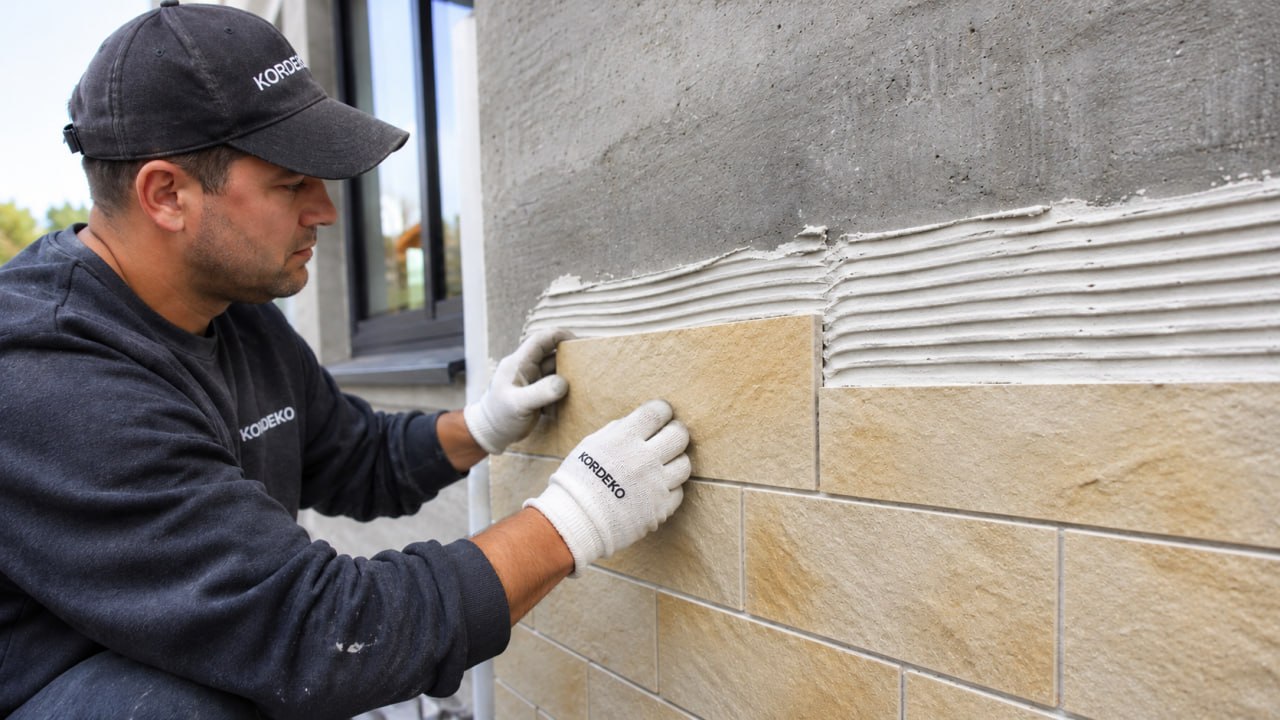
Concrete may seem like an ideal substrate for facade cladding: it is strong, stable, and capable of supporting significant loads. But can flexible tile be bonded directly to a concrete wall without plastering or additional preparation? We explain when this type of installation is acceptable, which primer to choose, and which mistakes can lead to cladding delamination.
Can Flexible Tile Be Installed Directly on Concrete?
Flexible tile can be installed directly on a concrete substrate if the surface is sufficiently strong, flat, dry, and properly prepared. Additional plastering is not always required, especially when the surface has no major irregularities or defects.
However, it is important to distinguish between installation without plastering and installation without preparation. Even a concrete wall that appears smooth and strong may have characteristics that prevent reliable adhesion.
Before cladding, the condition of the surface, its absorbency, and the presence of contaminants should be assessed.
When Does Concrete Require Additional Preparation?
Not every concrete substrate is suitable for direct installation of facade tile. Particular attention should be paid to the following situations.
1. Smooth Cast Concrete
Concrete surfaces formed against shuttering are often very dense and have low absorbency. A standard deep-penetrating primer may not always provide the required preparation. In such cases, a compatible quartz-filled bonding primer may be necessary.
2. Concrete with Cement Laitance
A weak surface layer can sometimes form on concrete and may separate easily from the underlying material. This layer should be removed mechanically before cladding.
3. Dusty or Contaminated Concrete
Dust, form-release oil residues, and construction contamination can prevent the adhesive from bonding properly to the substrate. The surface must be cleaned thoroughly.
4. Concrete with Cracks or Irregularities
Flexible tile follows the geometry of the substrate but does not correct its defects. Uneven areas should be leveled, and the causes of cracks should be addressed before installation begins.
5. Fresh or Damp Concrete
Concrete that has not cured and dried sufficiently continues to change during the hardening process. Installation should only begin once the substrate has reached the required condition, taking into account the requirements of the adhesive and cladding system.
Which Primer Should Be Used on a Concrete Facade?
Primer selection depends primarily on the structure and absorbency of the surface.
For porous and absorbent concrete, a suitable deep-penetrating primer can be used. It helps prepare the substrate for adhesive application.
For dense, smooth, and very low-absorbency concrete, a compatible quartz-filled bonding primer can be used to create a rough contact surface.
However, primer does not replace cleaning or mechanical preparation of a weak substrate.
How Should KORDEKO Flexible Tile Be Installed on Concrete?
KORDEKO PletaFlex Flexible Tile can be used on properly prepared concrete surfaces. Its low thickness and flexibility make it suitable for a variety of architectural elements.
The correct installation sequence includes several stages:
- Check the strength, flatness, and dryness of the concrete.
- Remove dust, contaminants, and weak areas.
- Level the surface where necessary.
- Apply the appropriate primer and allow it to dry as required.
- Prepare a high-quality frost-resistant cement-based tile adhesive according to the manufacturer’s instructions.
- Apply the adhesive evenly and install the flexible tile in accordance with KORDEKO installation technology.
Reliable contact between the tile and the adhesive layer should be ensured, without leaving voids.
Which Mistakes Are Most Common When Installing on Concrete?
One common mistake is bonding tile to smooth concrete without checking its absorbency.
Another problem is attempting to compensate for major irregularities with an excessively thick layer of tile adhesive instead of leveling the substrate beforehand.
Structural and movement joints should also never be ignored. The flexibility of the cladding does not mean that it can safely bridge any movement in the concrete substrate.
An insulated facade is a separate case. There the tile is bonded not to the concrete but to the reinforcement layer of the insulation system: Facade Insulation follows the ETICS requirements set out in the European assessment documents published by EOTA.
See also: deep-penetrating primer or concrete contact primer; why tile must not go on a dusty wall; cladding columns, arches and curved walls.
Conclusion
Flexible tile can be bonded directly to concrete and, in many cases, without an additional plaster layer. The main requirement is a strong, flat, dry, and properly primed substrate.
The quality of concrete preparation directly affects adhesion reliability and the long-term durability of the facade cladding.
Frequently asked questions
Can flexible tile be bonded to concrete without primer?
Does concrete need to be plastered before installing flexible tile?
Is flexible tile suitable for concrete columns?
Need advice on your facade?
- Get a free consultation for your project
- Find out which material suits your facade
- We'll answer all your questions and help you choose