


How to use flexible panels in the bathroom and the kitchen
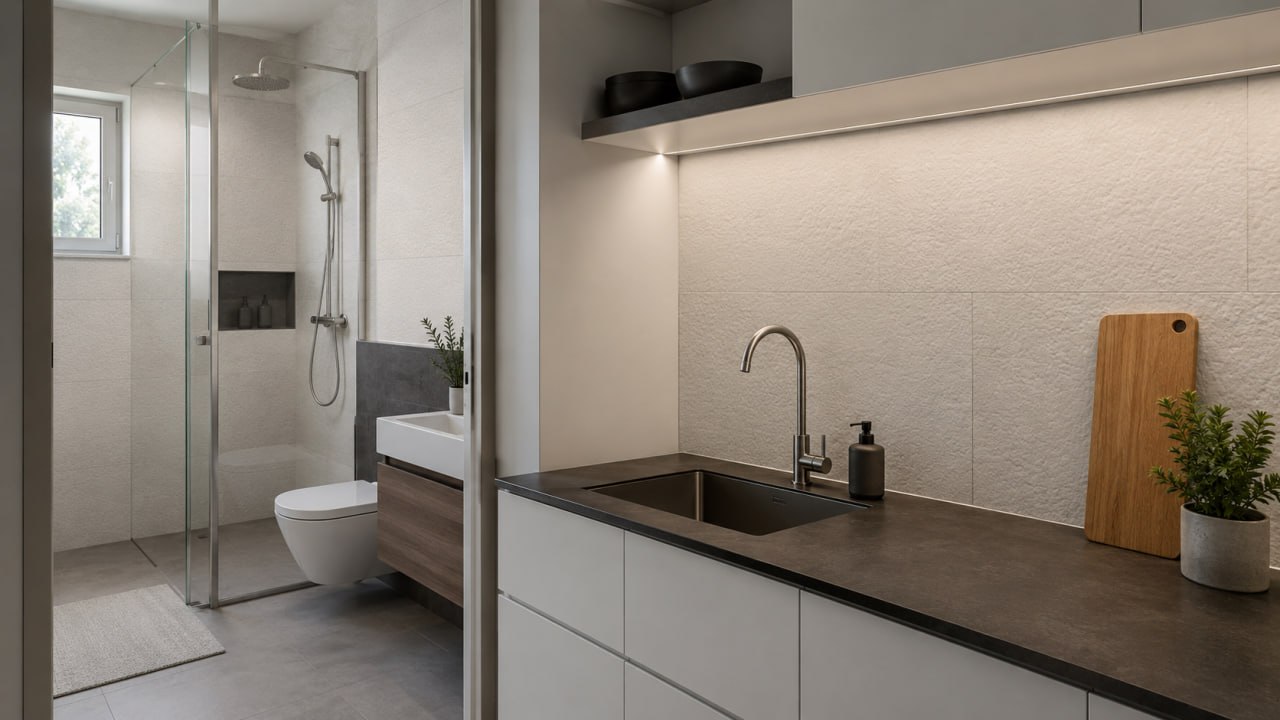
The bathroom and the kitchen demand a finish that resists moisture, cleans easily and stays hygienic. Where flexible panels can be used, which zones need waterproofing and how to pick the right texture.
The bathroom and the kitchen are rooms where finishes face daily moisture, steam, grease, frequent cleaning and temperature swings. So the material has to be not just beautiful but practical: resistant to water, easy to clean, and able to keep a tidy look without complicated upkeep.
Flexible panels are increasingly used not only on facades but indoors too — especially where a stone texture is wanted without heavy cladding and complicated installation.
Why the bathroom and kitchen need a special approach
In these areas, finishes face tougher conditions than in an ordinary room:
- the bathroom has constant steam and moisture;
- the kitchen brings grease, splashes and cooking residue;
- the walls are washed frequently;
- there's a higher risk of soaking near the sink and shower;
- the material has to be hygienic and not trap dirt.
If the wrong finish is chosen, stains, darkened joints, peeling and the feel of an already "worn" interior can appear over time.
Where flexible panels can be used in the bathroom
In the bathroom, flexible panels suit decorative and functional zones:
- an accent wall;
- the area near the washbasin;
- the wall behind the bathtub;
- niches;
- columns and projecting elements;
- the areas around the mirror;
- decorative panels.
What matters is preparing the base correctly and accounting for the zones with direct water contact. In wet zones, waterproofing, junctions and joint protection have to be planned in advance.
Flexible panels in the kitchen: practical every day
In the kitchen, the finish has to handle frequent cleaning without trouble. That's especially important near the worktop, the stove, the sink and the dining area.
Flexible panels can be used for:
- the kitchen backsplash;
- the wall near the dining zone;
- a decorative wall;
- the area around the cooker hood;
- finishing niches and projecting elements;
- styling an open kitchen-living space in a unified look.
For the kitchen it's especially important that the surface can be cleaned of dust, grease and splashes quickly.
Moisture resistance: why it matters
A moisture-resistant finish has to keep its properties in contact with steam and wet cleaning. For the bathroom and kitchen this is one of the main criteria.
KORDEKO flexible panels (PletaFlex) suit spaces where a decorative stone look, practicality and resistance to damp environments matter. They make an expressive interior possible without loading the walls with heavy materials.
Hygiene and upkeep: what to consider
A good finish for the bathroom and kitchen has to be easy to maintain:
- wipe clean easily;
- not collect dirt in very deep relief;
- not require complicated chemicals;
- keep its look after regular cleaning;
- withstand wiping with a damp cloth and normal household care.
For the kitchen, it's best to choose textures and shades on which drops, dust and cooking marks aren't very visible. For the bathroom — colours that harmonize with the sanitary ware, mirrors and lighting.
Where not to cut corners
Even a good material needs correct base preparation. In the bathroom and kitchen it's especially important to:
- level the base;
- remove dust and weak areas;
- use the right adhesive;
- protect the zones directly exposed to water;
- execute the junctions correctly;
- leave no open edges in water-contact zones.
If the surface is prepared incorrectly, the problem won't be the material but the base and the installation — which is why it's worth studying the flexible-panel installation technology in advance.
How flexible panels differ from ordinary ceramics
Ceramic tile is a classic solution, but it isn't always convenient, especially when complex zones, large walls or decorative elements need finishing.
Flexible panels are lighter, simpler to use on details, and give a more natural, less rigid stone look. They're practical wherever you want not just a "tiled" surface but an interior texture: an accent wall, a niche, a backsplash, the area around the mirror or a decorative element. A detailed comparison with rigid claddings is in the article on the differences between flexible panels, porcelain tile and panels.
If the kitchen or bathroom sits against an exterior wall
In private houses, wet rooms sometimes sit against the exterior walls. In that case, it's important that the wall is properly protected against cold and condensation. When facade insulation is done, the exterior wall behaves more stably, and the interior finish is less exposed to cold surfaces and temperature swings. The general principles of these systems are described by the European ETICS Association.
In other words, a good interior finish starts not only with choosing a beautiful material, but also with a correctly built wall.
Practical shades for the bathroom and kitchen
For the kitchen, these work well:
- warm grey;
- beige stone;
- sandy;
- a graphite accent;
- a delicate grey-brown.
For the bathroom, frequent choices are:
- light stone;
- creamy milk-white;
- greige;
- a calm concrete shade;
- natural sand tones.
It's better to avoid overloaded combinations. The bathroom and kitchen already hold many elements: furniture, appliances, sanitary ware, mirrors and light fixtures. So the texture should complement the interior, not compete with it. The texture section for designers helps with choosing the combination.
Mini-checklist before choosing the finish
- Where will there be direct contact with water?
- Does the base need waterproofing?
- How often will the surface be washed?
- Is there a stove, sink or shower zone nearby?
- Is the texture easy to maintain?
- Does the colour match the furniture, sanitary ware and lighting?
- Can the corners, niches and junctions be finished cleanly?
Conclusion
Flexible panels for the bathroom and kitchen are a moisture-resistant finish with the look of stone that helps create an expressive, practical interior. They suit accent walls, backsplashes, niches, washbasin areas, dining zones and decorative surfaces.
What matters is preparing the base correctly, protecting the wet zones, and choosing a texture that's easy to look after every day.
Frequently asked questions
Can flexible panels be used in the bathroom?
Are they suitable for the kitchen backsplash?
How is this kind of finish maintained?
Need advice on your facade?
- Get a free consultation for your project
- Find out which material suits your facade
- We'll answer all your questions and help you choose