


KORDEKO flexible tile: large or small format — how size changes the perception of a house
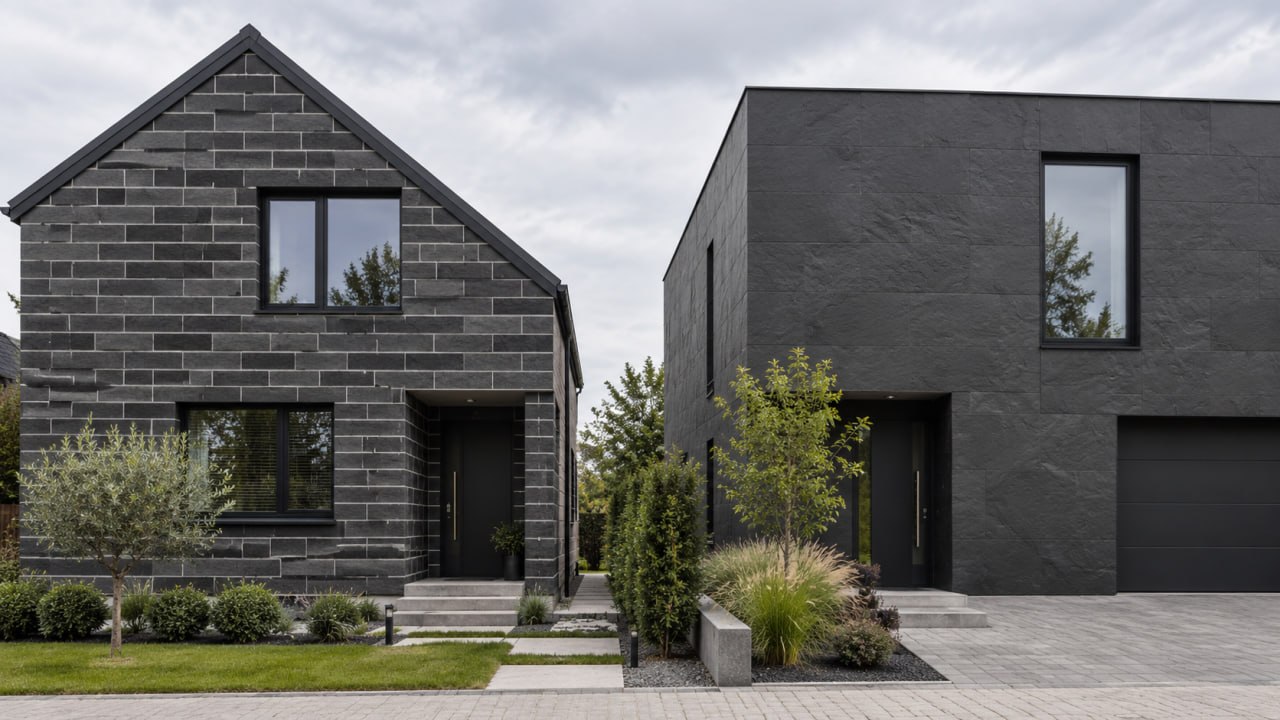
The size of facade cladding elements can noticeably change the appearance of the same house. The same architecture can look massive and modern with a large stone texture, while a smaller format can make it appear more detailed and traditional.
That is why, when choosing flexible tile, it is important to consider not only color and texture, but also the scale of the pattern in relation to the house itself.
Large Formats Make the Facade Look Calmer
Large elements create fewer lines and joints across the same surface area. As a result, the facade appears more unified and visually calm.
A large format works well when you want to:
- emphasize simple architectural geometry;
- make the facade look cleaner and calmer;
- highlight large wall surfaces;
- create a modern architectural appearance;
- avoid overloading the building with too many details.
Large textures are especially effective on broad, flat walls where a very small pattern could create too much visual noise.
Small Formats Add Rhythm to the Facade
The smaller the elements, the more of them appear within the same area. This creates more horizontal and vertical lines and makes the surface visually more active.
A small format can help:
- emphasize the scale of the building;
- add detail;
- make the facade more expressive;
- create the impression of traditional stone or brick masonry;
- visually divide large wall surfaces.
However, it is important not to overuse it. If a small pattern covers every wall, the facade may look too busy.
One House — Different Visual Effects
Imagine the same wall.
With a large texture, the eye perceives it as a smaller number of large stone elements. The surface appears calmer and more monolithic.
With a smaller texture, the eye begins to notice many individual elements and joints.
As a result:
- large format → calmness, scale, modernity;
- small format → rhythm, detail, expressiveness.
That is why the size of the cladding should be selected together with the architecture of the house.
A Small House Does Not Always Need Small Tiles
There is a common assumption that a small house should always use small-format cladding, while a large house should use larger elements.
In reality, this is not a strict rule.
A large texture can look very modern on a small house, especially if the architecture is simple and minimalist.
A small format can also work very well on a large house when used as an accent—for example, around the entrance, on the plinth, or on a separate architectural volume.
What matters more than the total size of the house is its proportions, number of windows, number of floors, and overall geometry.
Format Can Visually Change the Proportions of a House
The size and orientation of cladding elements can influence how the height and width of a building are perceived.
For example, pronounced horizontal lines can visually emphasize width. A vertically oriented layout, on the other hand, can strengthen the impression of height.
This means that cladding format can be used as a tool for visually correcting the architecture.
If a house looks too tall, changing the color is not always necessary. Sometimes well-planned horizontal accents are enough.
If the building appears too wide and low, vertical elements can help make it look taller.
Windows Also Affect the Choice of Format
The size and placement of windows should work together with the cladding pattern.
If the facade has large windows and broad, simple openings, an overly small texture may create too many lines around them.
A larger format can preserve a calmer composition.
With smaller windows, however, an excessively large pattern may appear visually disproportionate.
That is why it is useful to consider the relationship:
tile size → window size → wall section width → floor height.
The Plinth Can Be Highlighted with a Different Format
There is no need to use the same cladding size across the entire house.
For example:
- main facade — large texture;
- plinth — smaller format;
- entrance area — accent masonry pattern;
- columns — vertical layout.
This makes it possible to visually divide the building into functional zones without introducing unnecessary colors.
KORDEKO Flexible Tile (PletaFlex) allows different textures and formats to be combined, making it possible to create a more sophisticated architectural composition without using heavy cladding.
Larger Tiles Do Not Always Mean Less Material
At first glance, a large format may seem automatically more economical: fewer elements should mean less work.
However, total material consumption depends on more than size.
Other important factors include:
- facade area;
- number of windows;
- corners;
- reveals;
- complexity of cutting;
- layout;
- number of architectural details.
On a building with complex geometry, a smaller format can sometimes be easier to adapt to individual areas and may reduce the number of difficult cuts.
Small Formats Can Highlight Architectural Details
Smaller elements work well where you want to draw attention to a specific area.
For example:
- entrance;
- plinth;
- columns;
- arches;
- narrow wall sections;
- fireplace area;
- terrace.
However, if the same texture is used on every wall, it may lose its role as an accent.
How to Avoid Overloading the Facade
If the house already has many architectural elements—cornices, decorative bands, columns, large windows, balconies—an overly small texture can add even more visual rhythm.
In that case, a calmer large format may be a better choice.
If the architecture is simple and has few decorative details, a smaller texture can add the expressiveness the facade needs.
Format and Color Work Together
The size of the elements should not be considered separately from their color.
A light-colored large texture usually appears very calm.
A dark small-format texture will look much more visually active because several factors work together:
- contrast;
- large number of joints;
- small element size;
- strong color.
That is why it is better to evaluate three parameters at the same time:
size + color + texture.
We covered matching the shade to the roof, windows and fence in the article on how to choose a facade colour.
How to Choose the Right Format for Your House
Before purchasing, it is useful to ask several questions:
- Is the house architecturally simple or complex?
- Are there large wall surfaces without windows?
- How large are the windows?
- Do you want to visually emphasize width or height?
- Is there a pronounced plinth?
- Are cornices and decorative bands planned?
- Are separate accent areas needed?
- How will the facade look from a distance of 10–20 meters?
The last question is especially important. A facade is usually viewed from a distance, not only up close.
Large and Small Formats Can Be Combined
You do not have to choose only one option.
An interesting result can be achieved by using:
- large format — on the main facade area;
- small format — on the plinth or entrance area;
- a separate texture — on an architectural accent;
- This gives the facade both a calm background and expressive details.
The key is to give each format a clear purpose.
You can compare large and small formats on a house facade in the KORDEKO 3D constructor.
Insulation and Cladding Format
When carrying out Facade Insulation, the tile format should also be considered in advance. Windows, reveals, corners, the plinth, and other details may require different layouts.
The general requirements for external thermal insulation composite systems (ETICS) are set out in the European assessment documents published by EOTA.
It is therefore better to define the architectural composition and transition points first, and only then calculate the required quantity of material.
This helps avoid situations where a large-format texture ends awkwardly with a small random fragment near a window or corner.
Conclusion
Large and small formats are not simply different sizes of the same material. They influence the perception of the entire house in different ways.
Large format makes the facade look calmer, emphasizes scale, and works well on large wall surfaces.
Small format adds rhythm, detail, and can become a strong visual accent.
KORDEKO flexible tile makes it possible to use different textures and sizes depending on the architecture of the building. The key is to choose the format not separately from the house, but together with its windows, number of floors, proportions, plinth, and decorative elements.
Frequently asked questions
Which tile format suits a small house?
Is large-format tile more economical than small?
Can large and small formats be combined on one facade?
Need advice on your facade?
- Get a free consultation for your project
- Find out which material suits your facade
- We'll answer all your questions and help you choose