


KORDEKO flexible tile: why the same facade looks different on a small and a large house
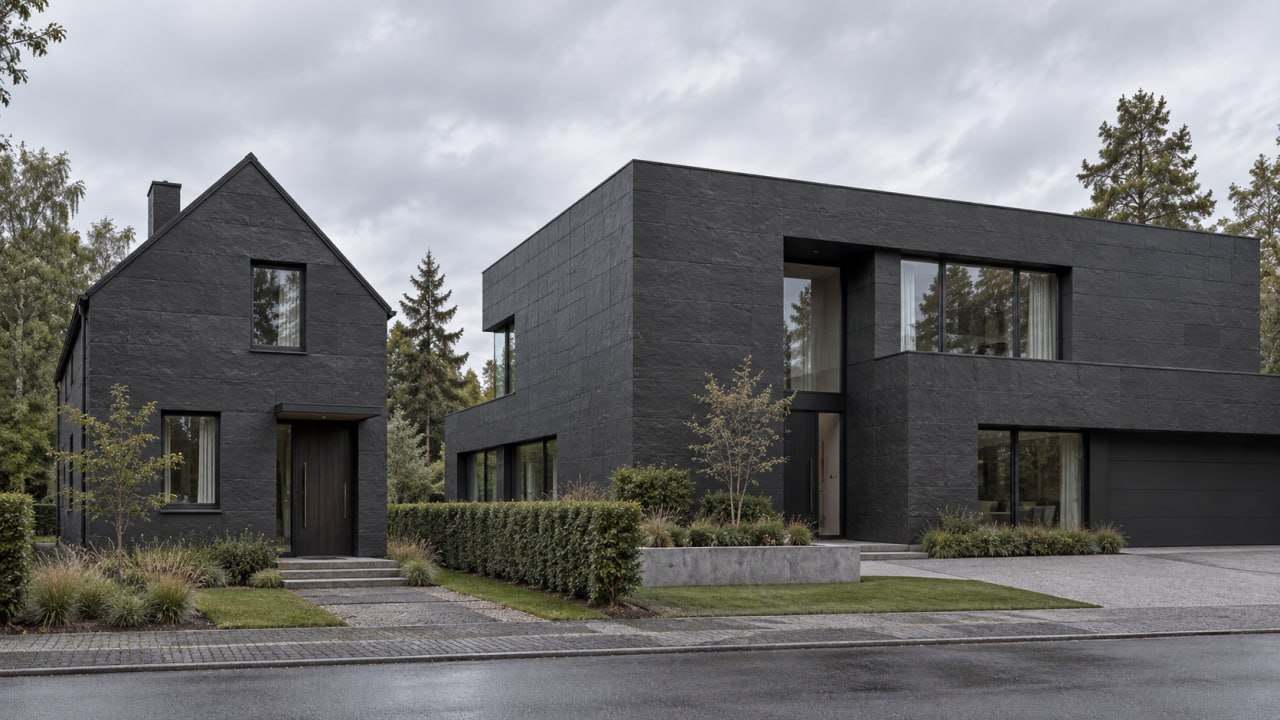
The same facade material can be used on two houses, yet the final result may look completely different. On a small house, a large stone texture may appear bold and massive, while on a larger building it can look calmer and more proportional.
The reason is not that the material changes its properties. What changes is the scale of the architecture, the number of repeated elements, viewing distance, the total cladding area, and the relationship between the texture and windows, doors, and other architectural details.
That is why choosing facade cladding based only on a material sample is not enough. It is important to imagine how it will look on a house of a specific size.
A Small House Makes the Texture Size More Noticeable
On a small house, each facade element occupies a relatively large part of the overall surface.
If a large stone texture is used, individual elements may visually compete with windows, doors, and architectural details.
As a result, the house may appear:
- more massive;
- visually heavier;
- lower;
- more detailed.
However, this does not mean that large formats cannot be used on small houses. With simple architecture, they can create a very modern and cohesive appearance.
On a Large House, Large Textures Look Calmer
On a large surface, large elements are no longer perceived as separate details. They merge into the overall facade composition.
A large wall may look:
- calmer;
- more monumental;
- more modern;
- more visually unified.
That is why large textures often work especially well on broad facade surfaces.
They help prevent a large wall from becoming overloaded with too many small lines and joints.
Small Textures Work in the Opposite Way
On a small house, a small format can add useful detail. It makes the surface more expressive and can create the impression of intricate stone masonry.
On a large building, however, a high number of small elements can create a completely different effect.
If an extensive wall surface is covered with a small pattern, it introduces many:
- joints;
- lines;
- repetitions;
- contrasting transitions.
The facade becomes visually more active.
That is why the same small format can create very different impressions on a small and a large house.
Viewing Distance Matters Just as Much as House Size
A house is rarely viewed from very close range.
People usually see the facade:
- from the road;
- from the gate;
- from the yard;
- from a neighboring property;
- from several dozen meters away.
The farther away the viewer is, the more individual elements merge into a single overall pattern.
That means a material that looks highly detailed in a showroom may appear much calmer and more unified on a large house when viewed from a distance.
Windows Change the Perceived Scale of the Facade
Windows are one of the main visual references people use to understand the scale of a building.
Imagine using the same tile on two different houses.
On a small house, windows may occupy a significant portion of the wall. If a very large pattern is used next to them, the cladding elements may appear disproportionate compared with the openings.
On a larger house, the same windows may look relatively small compared with the total wall area. In that case, a large texture can appear much more natural.
That is why tile size should be compared not only with the house itself, but also with the size of the windows.
The Number of Floors Also Affects Perception
A tall two- or three-storey house has a different visual scale from a compact single-storey building.
On a tall house, an overly small texture can create many horizontal lines and visually break up the facade.
Larger elements, on the other hand, can preserve a sense of architectural unity.
However, if the goal is to visually reduce the perceived height of the building, smaller formats or pronounced horizontal accents can be used deliberately to adjust the proportions.
Color Strengthens the Effect of Scale
The same format can look different depending on its color.
A light-colored large texture usually appears calmer.
A dark large texture can look more massive and emphasize the volume of the building.
A dark small-format pattern can be especially visually active because several factors work together:
- strong color;
- many individual elements;
- visible joints;
- contrast between details.
That is why tile size should never be selected separately from its color.
Texture Can Visually Change the Size of the House
This is an interesting architectural tool.
Large, calm elements can make a facade appear more unified and monumental.
Smaller elements add detail and can visually divide large surfaces.
A horizontal layout can emphasize the width of a building, while a vertical arrangement can enhance the sense of height.
In other words, cladding does more than decorate a house—it can also help control its visual proportions.
Why a Material Can Sometimes Look “Too Expensive” on a Small House
Some textures have a very expressive pattern. On a small house, they can become the dominant architectural feature.
This can be either an advantage or a disadvantage.
If the architecture is simple, an expressive texture can give the building character.
But if the house already has:
- many windows;
- balconies;
- cornices;
- columns;
- decorative bands.
a complex roof,
an additional highly active texture may overload the overall composition.
Large Houses Can Benefit from More Calm Surfaces
A large house does not necessarily need many different materials.
In fact, large-scale architecture often looks better when most of the facade is finished in one calm, consistent texture.
KORDEKO Flexible Tile (PletaFlex) makes it possible to use different sizes and textures depending on the specific area.
For example:
- large format — main walls;
- smaller format — plinth;
- separate texture — entrance area;
- different size — architectural band.
This allows the scale of the cladding to be adapted to the scale of the building.
One Material — Different Layouts
Even when the same texture is used, the final appearance can change significantly depending on the layout.
You can adjust:
- the direction of the elements;
- the width and appearance of joints;
- the size of individual modules;
- where transitions between formats occur;
- the placement of accent areas.
That is why it is important to evaluate not only an individual tile before installation, but also the planned layout of the entire wall.
How to Evaluate the Material Before Buying
It is better not to make a decision based only on a small sample.
A simple visual check can help:
1. View the Material in Natural Light
This gives a more accurate impression of the actual color and relief.
2. Step Several Meters Away
See how the texture merges into an overall pattern.
3. Compare It with the Windows
Evaluate the relationship between the size of the cladding elements and the openings.
4. Look at the Entire Wall
Consider the overall composition rather than just a small fragment.
5. Create a Test Area
This is especially useful for large facades.
You can compare large and small formats on a house facade in the KORDEKO 3D constructor.
If the House Is Already Being Insulated
When carrying out Facade Insulation, the cladding size should ideally be planned before installation begins.
The general requirements for external thermal insulation composite systems (ETICS) are set out in the European assessment documents published by EOTA.
It is important to consider in advance:
- window positions;
- corners;
- reveals;
- plinth;
- cornices;
- decorative bands;
- transition points between textures.
This helps avoid situations where the layout ends awkwardly with a small fragment near a window or where a large element requires inconvenient cutting.
The Main Rule
There is no universal answer such as:
“A small house needs small tiles, while a large house needs large tiles.”
The right choice depends on the combination of:
house size + number of floors + windows + architecture + color + texture + viewing distance.
We covered how large and small formats change the perception of a house in the article on large or small format flexible tile.
Together, these factors determine whether the facade looks harmonious or visually overloaded.
Conclusion
The same facade material can look completely different on a small and a large house because its visual scale changes in relation to the overall architecture.
On a small house, a large texture can become the main visual accent. On a larger building, the same texture usually appears calmer and more monumental. A small texture, on the other hand, can add detail to a compact house but may create an overly active pattern across a very large surface.
That is why KORDEKO Flexible Tile should be selected not only according to color and texture, but also with the size of the specific building in mind. A successful facade is one where the scale of the cladding matches the scale of the architecture.
Frequently asked questions
Does a small house always need small tiles?
How do you assess facade tile before buying?
Why does viewing distance matter?
Need advice on your facade?
- Get a free consultation for your project
- Find out which material suits your facade
- We'll answer all your questions and help you choose