


BRmix 07/09/10: KORDEKO flexible tile — three brick colors for a facade with an industrial character
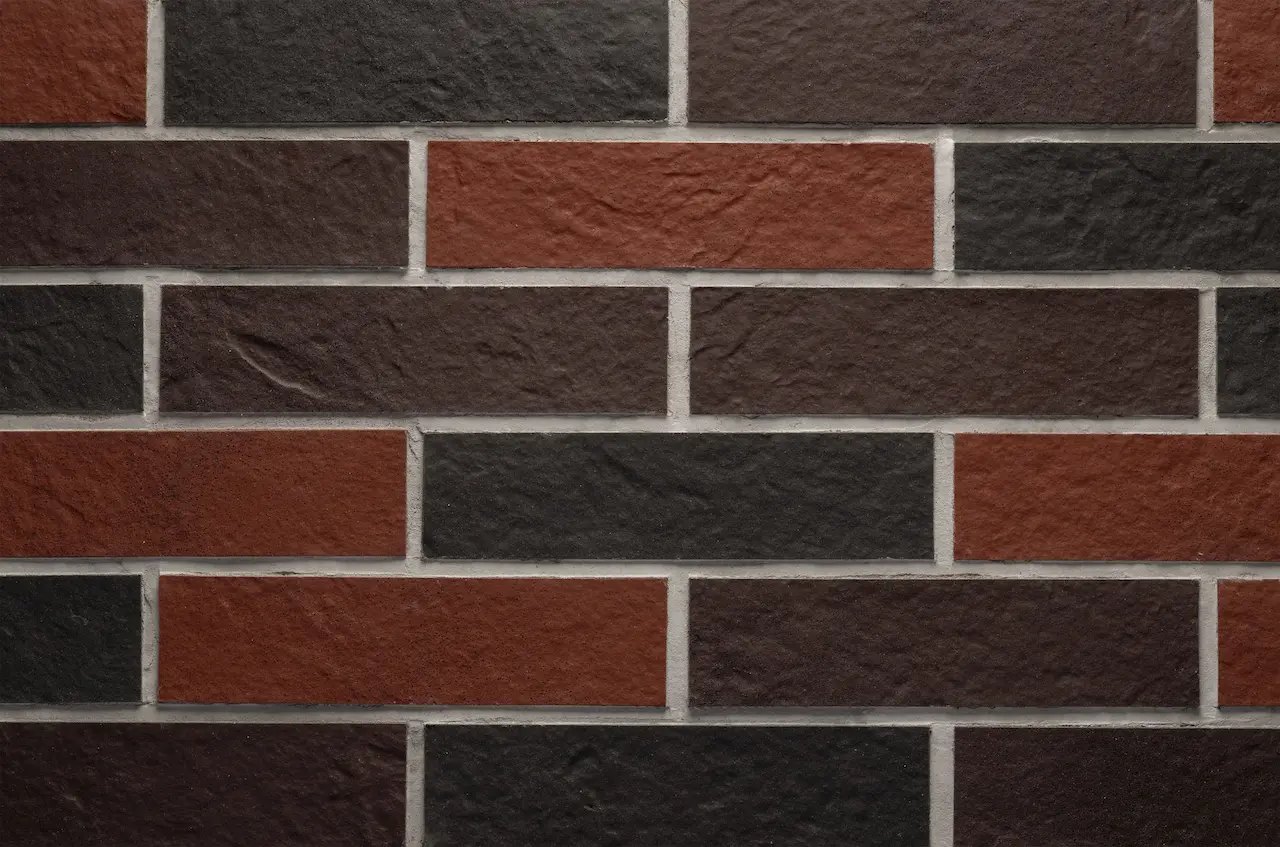
Red-brown brick masonry, deep anthracite, and dark chocolate shades form a combination reminiscent of old European factories, renovated industrial buildings, and modern urban residences. In this architecture, color does more than decorate the facade: it helps create a sense of history, solidity, and individuality.
BRmix 07/09/10 from the ROCK STONE BRICK KORDEKO collection combines three models: Chocolate Rock, Volcanic Anthracite, and Loft Red Clay. Together they create expressive stone masonry in which terracotta elements contrast with nearly black ones, while dark brown modules form a transition between them.
The presented version uses thin, low-contrast joints. This keeps the focus on the colors and textures of the modules themselves.
Three shades that create completely different impressions
The main feature of BRmix 07/09/10 is the combination of three rich colors, each performing its own decorative function.
Chocolate Rock gives the surface a deep brown shade. Volcanic Anthracite forms almost black areas, creating contrast and visual depth. Loft Red Clay adds expressive red-terracotta elements that make the masonry more noticeable.
Unlike combinations of several gray shades, this composition is based on the contrast between warm and cool palettes.
It is particularly interesting on large surfaces, where the individual colors form a complex irregular pattern.
From industrial architecture to the modern residential house
The combination of red, brown, and black brick is often found in architecture inspired by old industrial buildings.
However, this palette is also entirely suitable for modern private homes.
For example, a two-story building with a flat roof, large windows, and BRmix cladding can acquire a pronounced industrial character without additional decorative structures.
Black window frames will echo the anthracite elements of the masonry, while the terracotta modules will add warm natural shades to the architecture.
Another option is to use BRmix only on the ground floor, leaving the upper volume light. This technique emphasizes the base of the building and visually divides it into several parts.
Why thin joints are especially important for this combination
BRmix 07/09/10 already contains strong color contrast within the cladding itself.
Therefore, additional wide light-colored joints could significantly change the character of the surface, making it more graphic.
In the presented sample, the boundaries between modules remain relatively subtle. This allows attention to focus on the alternation of red, brown, and anthracite elements.
The masonry is perceived as more continuous, and the horizontal rows do not compete with the rich color palette.
During installation, it is important to take this effect into account and choose the joint-filling shade in advance. Even a small change in contrast can noticeably affect the appearance of the finished facade.
How to distribute the colors to avoid random patches
Mixed masonry requires careful attention to the placement of individual modules.
This is especially true for BRmix 07/09/10, where the difference between terracotta and anthracite elements is quite noticeable.
If red tiles are concentrated in one part of the wall, a large color patch may form. A similar effect occurs when too many dark elements are grouped in a small area.
Therefore, it is advisable to plan the overall distribution principle before installation.
For a natural pattern, the shades can be alternated without a strict repeating sequence while controlling their placement in each area.
Particular attention should be paid to corners, window openings, and junctions between different architectural volumes.
At the same time, overly regular repetition of colors is also undesirable, as it can make the masonry look artificial.
BRmix for restaurants, hotels, and commercial buildings
This combination is particularly interesting for properties that need a recognizable architectural character.
For example, a restaurant with a BRmix 07/09/10 facade can combine industrial aesthetics with a natural color palette.
The elongated brick modules work well with large display windows, black metal structures, and wooden entrance elements.
We covered combining stone, brick, slate and wood on one facade in the article how to combine textures on a facade.
For small hotels, mixed masonry can be used on the ground floor or around the main entrance.
In office buildings, BRmix is suitable for individual architectural volumes, showroom facades, and public spaces.
Thanks to its rich palette, the material creates a noticeable surface without the use of bright decorative panels.
Stone masonry in the interior: industrial aesthetics with natural shades
Indoors, BRmix 07/09/10 can form the basis of loft-style interiors.
Terracotta elements evoke traditional brick, while dark brown and anthracite modules give the surface a more contemporary character.
In a living room, mixed masonry can be used on a single accent wall. It combines well with natural wood, leather furniture, and metal details.
In restaurants and bars, BRmix can create an expressive backdrop for furniture and other interior elements.
However, when using such a rich texture, lighting and room size should be considered. In small spaces, it is better to use the cladding locally to maintain visual balance.
The effect of massive brick without an additional brick wall
BRmix 07/09/10 belongs to the ROCK STONE BRICK collection, combining three textures in an elongated brick-masonry format.
KORDEKO Flexible Tile (PletaFlex) is made on a mineral-polymer base with a reinforcing membrane. Its low weight makes it possible to reproduce the appearance of traditional stone masonry without constructing an additional massive brick wall.
The material can be used to clad prepared facade and interior surfaces.
For mixed models, it is especially important to control installation uniformity and the distribution of individual shades.
For exterior work, a suitable frost-resistant adhesive must be used and the substrate-preparation requirements must be followed.
BRmix 07/09/10 in a facade insulation system
Mixed brick cladding can be used as a decorative finish in a compatible external thermal insulation system.
The general requirements for external thermal insulation composite systems (ETICS) are set out in the European assessment documents published by EOTA.
Properly installed Facade Insulation provides the required thermal protection for the building, while BRmix creates an expressive appearance combining terracotta, brown, and anthracite stone.
The characteristics of rich dark shades should be considered during design. In direct sunlight, such surfaces can heat up more than lighter ones, so the facade system must be designed for the corresponding thermal loads.
High-quality reinforcement, compatibility of adhesive compounds, and correct execution of junctions are equally important.
BRmix 07/09/10: masonry in which every color matters
This model differs from monochrome versions not only in the number of shades but also in the character of the entire composition.
Chocolate Rock adds depth, Volcanic Anthracite creates contrast, and Loft Red Clay forms warm terracotta accents.
Thanks to the thin joints, the colors merge into a continuous surface while preserving the expressiveness of each individual module.
BRmix 07/09/10 suits architecture inspired by traditional brick masonry, industrial buildings, and modern projects where texture and rich natural shades play the leading role.
Frequently asked questions
Which models make up BRmix 07/09/10?
Why does the joint shade matter for this combination?
How do you distribute three colours to avoid blotches?
Need advice on your facade?
- Get a free consultation for your project
- Find out which material suits your facade
- We'll answer all your questions and help you choose