


BRmix 04/05/09: three shades of gray flexible stone — how to create a facade with the effect of complex brick masonry
Why do some gray facades look monotonous while others attract attention even without bright colors? Often, the secret lies in combining several shades, correctly selected proportions, and the character of the surface itself.
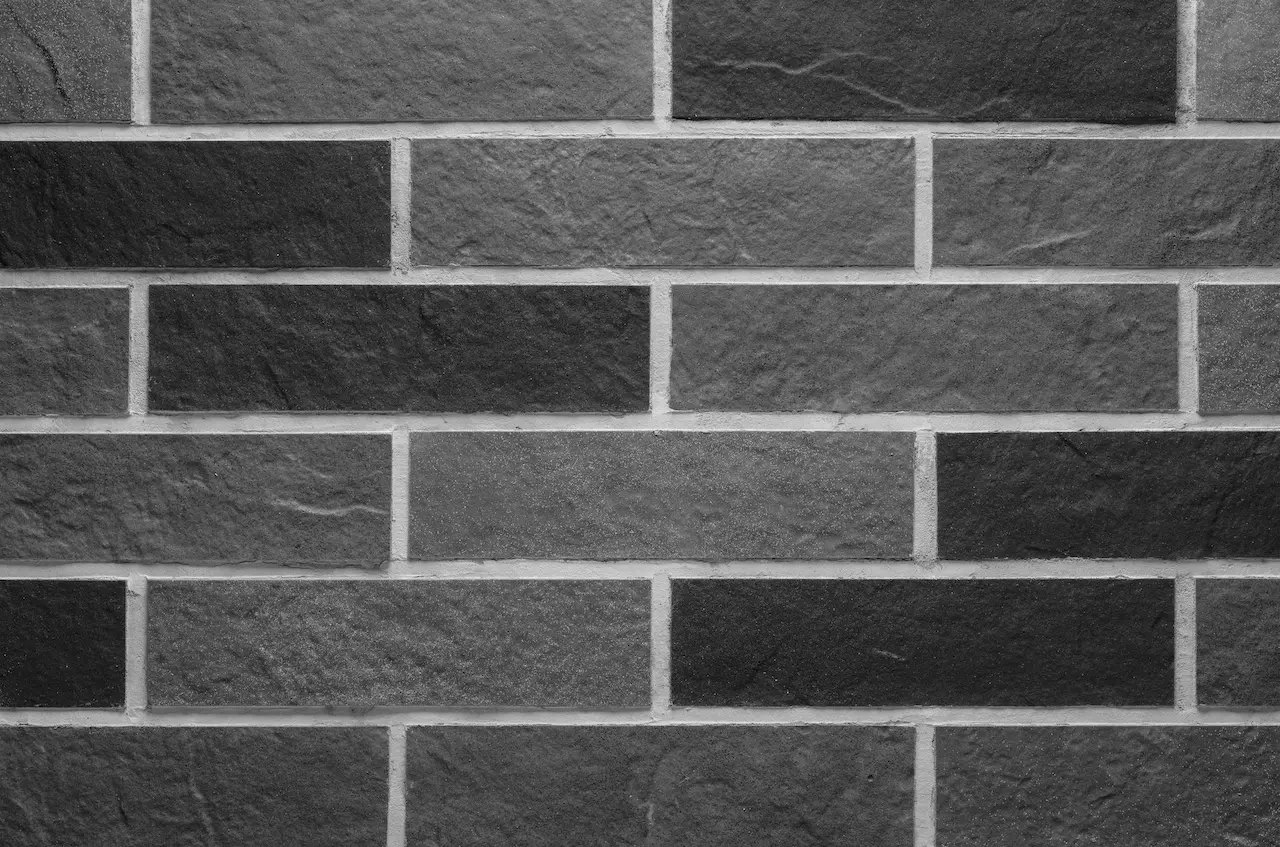
BRmix 04/05/09 from the KORDEKO ROCK STONE BRICK collection combines three textures: Cerro-Torre, Gray Cold Rock, and Volcanic Anthracite. Light gray, medium gray, and almost black elements form non-uniform brick masonry, while light joints emphasize the geometry of the individual modules.
This combination makes it possible to create an expressive facade in a monochrome palette while preserving the natural variety of a stone surface.
Three colors instead of one: what makes BRmix 04/05/09 distinctive
Conventional monochrome cladding creates a uniform field of color. Mixed masonry works differently: neighboring elements can differ significantly in saturation, so the surface pattern is constantly changing.
BRmix 04/05/09 combines three models:
- BR04 Cerro-Torre — gray stone with white mineral granules;
- BR05 Gray Cold Rock — a gray shade with white and black inclusions;
- BR09 Volcanic Anthracite — an almost black surface with black and brown granules.
In the presented sample, light and dark modules are distributed across the entire area without forming large monochrome zones.
Thanks to this combination, the masonry is perceived as a unified surface, while each element retains its own character.
How to distribute three shades correctly across a facade
The main challenge of mixed cladding lies not in the number of colors, but in their arrangement.
If dark elements accidentally become concentrated in one area of the wall, a large anthracite patch may appear. An excessive number of light modules, on the other hand, can disrupt the overall balance of the composition.
Therefore, even before installation begins, it is important to choose an appropriate distribution principle.
For BRmix 04/05/09, a relatively even alternation of all three shades can be used. A strict sequence is not necessary: slight natural irregularity makes the surface look more like natural stone masonry.
It is especially important to consider the position of windows, doors, and architectural corners. Random color transitions become more noticeable in these areas.
Before cladding a large area, it is recommended to lay out several modules on a horizontal surface and assess the future pattern from a distance.
Why mixed gray masonry suits modern architecture
Modern buildings are often designed with a limited color palette. White, gray, anthracite, natural wood, and glass form the basis of many minimalist facades.
We covered combining stone, brick, slate and wood on one facade in the article how to combine textures on a facade.
BRmix 04/05/09 makes it possible to combine several shades from this palette within a single material.
For example, on a two-story house, mixed masonry can be used on the ground floor while the upper part is finished with white plaster. The anthracite tile elements will echo the dark window frames, while the light gray ones will create a transition to the main facade.
Another option is to clad the entire building in BRmix while retaining simple geometry and large glazed surfaces.
In this case, variety is achieved not through additional decoration, but through the alternation of shades within the masonry itself.
Light joints as part of the architectural pattern
In the presented BRmix 04/05/09 version, light gray joints are used and are clearly visible against the anthracite elements.
They are what unite the differently colored modules into orderly brick masonry.
Horizontal lines create visual continuity, while vertical joints form the traditional pattern with offset rows.
This contrast works particularly well on long facade planes and fences.
However, during installation it is important to maintain uniform joint width. On a surface containing three shades at the same time, geometric deviations can further increase the impression of randomness.
BRmix for private houses, fences, and commercial buildings
Mixed gray masonry is suitable for properties that require an expressive surface without saturated decorative colors.
In private architecture, it can be used for main facade walls, the ground floor, the entrance area, or the garage.
BRmix looks particularly interesting in combination with wooden terraces, black metal elements, and panoramic windows.
For site fencing, the combination of three shades creates a more varied surface than monochrome cladding. At the same time, it can be combined with metal gates and other elements in an anthracite palette.
On commercial buildings, BRmix is suitable for entrance areas and the facades of small offices, restaurants, and showrooms.
Non-uniform masonry in the interior
Indoors, BRmix 04/05/09 can become an independent decorative accent.
Thanks to the combination of three gray shades, such a surface works well with modern materials: concrete, glass, metal, and natural wood.
In a living room, mixed masonry can be used on one accent wall. In a home office, it creates a stricter architectural background.
For restaurants and public spaces, finishing individual walls or columns can be an interesting solution.
The size of the room must also be considered. A large amount of contrasting masonry in a small area can visually overload the interior, so the position of the cladding should be planned in advance.
A lightweight alternative to mixed brick masonry
Traditional masonry using bricks of several shades requires preliminary material selection, pattern control, and the construction of an appropriate wall system.
KORDEKO Flexible Tile (PletaFlex) makes it possible to reproduce a similar aesthetic using lightweight mineral-polymer cladding.
The ROCK STONE BRICK collection includes elongated modules in 7.5 × 30 and 10 × 30 cm formats and a mesh-mounted version.
When installing BRmix, it is especially important to control not only the geometry of the rows, but also the distribution of colors.
For dark and mixed shades, a suitable adhesive should be selected, and the final joint color should be agreed upon before the main work begins.
BRmix 04/05/09 in a facade insulation system
Mixed brick cladding can be used as the decorative finish of a compatible external thermal insulation system.
The general requirements for external thermal insulation composite systems (ETICS) are set out in the European assessment documents published by EOTA.
Properly installed Facade Insulation provides the required thermal protection for exterior walls, while BRmix forms an expressive surface with the effect of natural stone masonry.
During design, the compatibility of all components, reinforcement requirements, and thermal loads on the exterior coating must be taken into account.
Because the combination includes anthracite elements, the possible additional heating of dark areas under direct sunlight should be considered.
BRmix 04/05/09: expressive architecture without bright colors
The main advantage of this combination is the variety created within a single color palette.
Three shades of gray make it possible to create a complex stone surface while preserving the restrained character of modern architecture.
Light joints form a clear masonry pattern, while the alternation of textures makes the facade non-uniform and interesting even over a large area.
BRmix 04/05/09 suits projects that aim to combine the expressiveness of natural stone, the geometry of brick, and a calm modern palette.
Frequently asked questions
Which models make up BRmix 04/05/09?
How do you distribute three shades on a facade?
Why does joint width matter in mixed masonry?
Need advice on your facade?
- Get a free consultation for your project
- Find out which material suits your facade
- We'll answer all your questions and help you choose