


KORDEKO flexible tile or a cheap alternative: what the façade looks like a few years on
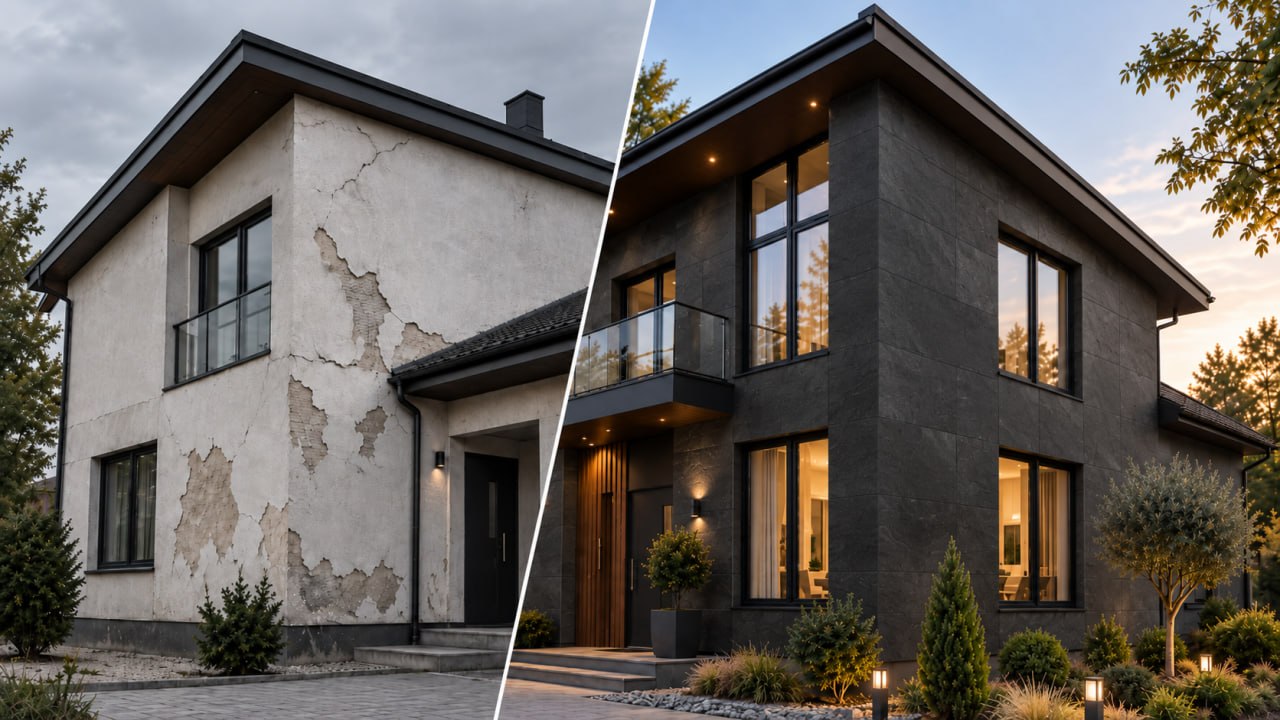
On a small sample two materials look identical. The difference shows up on the wall — after sun, frost and a few seasons: shade variation, cracks, fading and repair costs.
When a client chooses a façade finish, price often looks like the deciding argument. The market offers materials that are „similar in appearance”, „almost the same” or simply „cheaper”. But a façade is not a decoration for one season: it works under sun, rain, frost, wind, dust and temperature swings every day.
That is why it is worth comparing not only the price per square metre, but the whole outcome: how the material looks after years, how it is installed, whether it cracks, whether it fades, how easy it is to maintain and who answers for the quality.
1. Consistent quality, not an unpredictable batch
Cheap alternatives can look attractive on a small sample, but on a large façade the differences become visible. Shade, texture, thickness, flexibility, the edge of the material or its behaviour during installation can all vary.
On the wall you notice immediately:
- shade differences between areas;
- uneven texture;
- weak edges;
- difficult cutting;
- untidy joints;
- differences between batches.
KORDEKO flexible tile (PletaFlex) is produced as a decorative and protective façade finish, so the consistency of the material matters as much as its appearance. The client gets not just „a similar tile”, but a defined product with controlled quality.
2. The façade does not crack and keeps a unified look
One of the main problems with cheap solutions is that they can look good at first but cope poorly with real conditions on a façade. After temperature swings, heat, frost and small substrate movements, cracks, detachment and weak spots appear.
KORDEKO is chosen because flexible tile does not behave like rigid, brittle cladding. It keeps its integrity on the façade and helps avoid the situation where, after one season, areas have to be patched, repainted or redone — covered in detail in the article on the flexible façade that does not crack.
This matters most in the difficult areas:
- house corners;
- window reveals;
- the plinth;
- the entrance area;
- stairs;
- columns;
- junctions and joints.
That is exactly where cheap materials most often show their weaknesses.
3. The colour does not fade, and the façade looks new for longer
A façade is permanently exposed to the sun. If a material is not designed for long outdoor service, the colour can quickly become paler, uneven or „tired” — particularly visible on the sunny sides of a house.
A cheap alternative may look similar on the day of purchase, but after a few seasons the difference becomes obvious: one façade keeps its colour and tidy appearance, the other needs renovating. KORDEKO is built for façade conditions — see how flexible stone holds its colour over time.
4. A correct installation system, not just the material
A façade can be spoiled not only by a poor material but by an incorrect system. Choose the wrong adhesive, skip the primer, prepare the substrate badly or leave corners unreinforced, and even a good finish can be ruined.
When façade insulation is carried out, it is especially important that the finish layer is integrated into the whole system: insulation, reinforcement, mesh, corners, reveals, plinth, drip profiles and water drainage all have to work together. This is the same principle by which the EU Construction Products Regulation treats façade systems — as an assembly assessed together, not as separate products.
The advantage of KORDEKO is that the client gets not just the tile but guidance on applying it: where the material can be used, how to prepare the substrate, which adhesive to choose, and how to avoid mistakes during tile installation.
5. Savings over the long term
A „cheaper” material can save money on the day of purchase but create costs later. If the façade cracks, fades, detaches or gets dirty quickly, additional costs appear:
- repairing damaged areas;
- repainting;
- buying new material;
- paying installers;
- scaffolding and transport;
- lost time;
- a spoiled exterior.
It is more accurate to count not just the starting price but the cost of the façade across its whole service life. If a material lasts longer, holds its appearance better and needs fewer repairs, it often works out cheaper than a low-cost alternative.
Why a „similar material” is not always the same thing
At first glance two samples can look almost identical. But the real test does not happen in a showroom — it happens on the house: under sun, rain and frost, at the plinth, on corners, beside windows and at the entrance.
The difference shows in the details: how the material cuts, how it holds its shape, how it sits on the substrate, how it looks across a large area, how it copes with weather, how it keeps its colour and how it behaves after several seasons.
So when choosing a façade finish, it is worth considering not only price but also the reliability of the manufacturer, the composition of the material, the experience behind it and the technical support available.
Conclusion
Choosing KORDEKO over cheap alternatives pays off for five reasons: consistent quality, resistance to cracking, colour retention, a correct installation system and lower costs over time.
A façade is not the place for accidental savings. It is better to choose a quality flexible tile once, install it correctly and get a tidy appearance for years, than to fix problems later caused by a cheap material. Get in touch and we will help you choose the texture and work out what your house needs.
Frequently asked questions
Why do two tiles that look the same cost different amounts?
Where do problems with a cheap material usually appear first?
Is choosing a good material enough?
Need advice on your facade?
- Get a free consultation for your project
- Find out which material suits your facade
- We'll answer all your questions and help you choose