


KORDEKO flexible panels for public interiors: lobbies, staircases and corridors
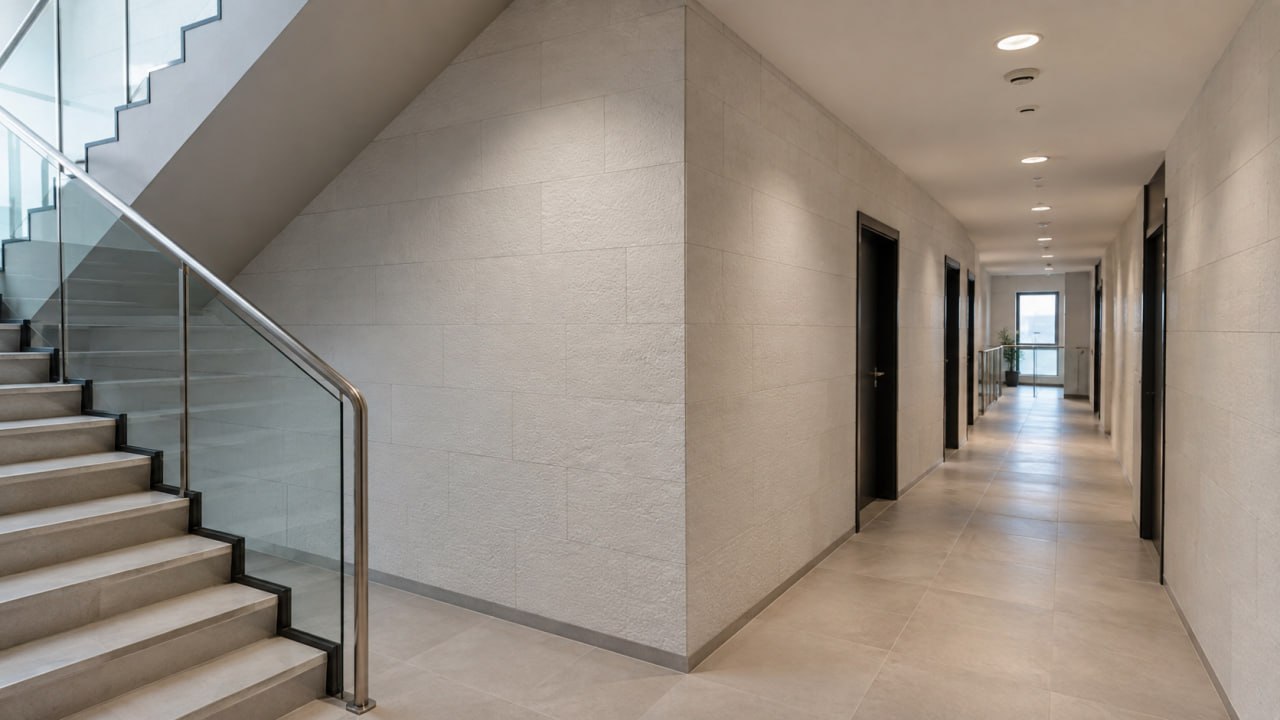
How to choose a practical finish for lobbies, staircases and corridors: wear resistance, easy cleaning and a safe stone texture.
Public spaces are used differently from private interiors. Lobbies, staircases, corridors, entrance zones, office passages, salons, clinics, shops and educational spaces face a constant flow of people every day, along with knocks, frequent cleaning and accidental damage.
That's why the finish can't just be beautiful. It has to be practical, wear-resistant, easy to maintain and safe in its texture.
Why public interiors need a tougher finish
In an ordinary room, walls rarely take serious stress. In a public space, things are different:
- people constantly pass very close to the walls;
- bags, boxes and equipment hit the corners;
- walls near staircases get dirty faster;
- the lower zones are hit by footwear and cleaning equipment;
- surfaces are washed frequently;
- the material has to keep a tidy look for a long time.
If a finish that's too delicate is chosen, wear marks, chips, stains and dirty streaks can appear quickly.
Lobbies: the first impression starts with the walls
The lobby is where a visitor forms an immediate impression of the space. If the walls look bare, cheap or get dirty quickly, the whole interior loses value.
For lobbies, these work well:
- accent walls;
- finishing the reception zone;
- a protective lower wall section;
- cladding the columns;
- textured insertions near the entrance;
- decorative zones with lighting.
KORDEKO flexible panels (PletaFlex) help achieve a stone effect without heavy cladding and suit spaces where style and practicality have to be combined.
Corridors: the main problem is wear and cleaning
The corridor is one of the most stressed zones. Here the walls get dirty most often at the level of hands, bags, trolleys and cleaning equipment.
Ordinary paint quickly shows:
- touch marks;
- rubbed areas;
- stains after wet cleaning;
- damaged corners;
- dirty streaks in the lower part of the wall.
Textured cladding helps increase visual resistance to daily use and makes the corridor more interesting. At the same time, it's important to choose a calm tone, so a long space doesn't feel too heavy.
Staircases: knocks, edges and safety
Stair zones need special attention. Here it's not just the walls that matter, but also the sides, the risers, the landings, the corners and the junctions.
A staircase finish has to withstand:
- knocks from footwear;
- contact with bags and handrails;
- frequent wet cleaning;
- temperature swings near entrance zones;
- dirt brought in from outside.
For staircases it's better to use textures that don't look visually slippery and don't create the feel of a cold, "technical" surface.
A safe texture: attractive, but not excessive
In public interiors, texture has to be chosen carefully. Relief that's too deep can collect more dust and make cleaning harder, while a surface that's too smooth shows marks sooner.
A moderate stone texture is the optimal solution:
- it looks more valuable than ordinary paint;
- it hides small marks of daily use;
- it works well with lighting;
- it doesn't overload the interior;
- it's easy to integrate into lobbies and corridors.
Balance matters especially for public spaces: the material should be expressive but not visually tiring, and shouldn't create unnecessary visual noise.
Frequent cleaning: what to take into account
In public spaces, cleaning happens more often than at home. So the material has to handle regular surface cleaning well.
Before choosing the finish, it's important to be clear about:
- how often the walls will be washed;
- which zones get dirty the most;
- whether there's direct contact with the outdoors;
- whether a staircase or an entrance is nearby;
- whether trolleys, bags or equipment will touch the walls;
- how easily dust and touch marks come off.
A practical finish reduces the need for cosmetic repairs and helps the space keep a fresh look longer.
Where flexible panels fit especially well
Flexible panels can be used selectively or on large surfaces. In public interiors they're especially practical in these zones:
- lobbies and reception areas;
- corridors;
- stairwells;
- walls near lifts;
- entrance zones;
- columns;
- niches;
- decorative panels;
- the protective lower wall section;
- high-traffic retail zones.
Not every wall has to be fully clad. Often it's enough to finish the most visible and stressed zones for the interior to become more practical and more visually valuable. You can see how this looks on real buildings in our projects section.
How to choose a colour for a public space
For lobbies and corridors, it's better to choose shades that don't show dirt right away:
- warm grey;
- greige;
- sandy;
- light stone;
- delicate graphite;
- natural stone shades.
A finish that's too white looks dirty sooner, especially near the entrance and staircases. A very dark one can highlight dust and make the corridor feel narrower. Natural mid-tones are usually more practical.
The interior walls and the building's exterior system
If the public space is inside a private house, an office or a commercial building with exterior insulation, it's important that the interior and exterior finishes don't clash. When facade insulation is done, the overall style can continue indoors: for example, by repeating a stone texture in the lobby, on the staircase or in the entrance zone.
That gives the building a unified look: the facade, the entrance and the interior follow the same visual logic.
Mini-checklist before choosing the finish
- Where is the heaviest flow of people?
- Which walls are touched most often by hands, bags or equipment?
- Does the lower part of the wall need protection?
- How often will wet cleaning be done?
- Are there staircases, corners, columns and niches?
- Won't the texture be too complicated to maintain?
- Does the colour work with the floor, doors, lighting and furniture?
- Is an accent zone a better fit than cladding every wall?
Conclusion
KORDEKO flexible panels for public interiors are a practical solution for lobbies, staircases, corridors and entrance zones. They deliver a tidy stone look, handle intensive use well, simplify maintenance and give the space a more valuable appearance.
For public spaces it's especially important to choose not just a beautiful finish, but a material that handles the flow of people, cleaning, touches and daily stress without problems.
Frequently asked questions
Are flexible panels suitable for walls in public spaces?
What colour should I choose for a lobby or corridor?
Do all the walls need cladding?
Need advice on your facade?
- Get a free consultation for your project
- Find out which material suits your facade
- We'll answer all your questions and help you choose