


How to choose a façade for a house by the sea: salt, wind and humidity
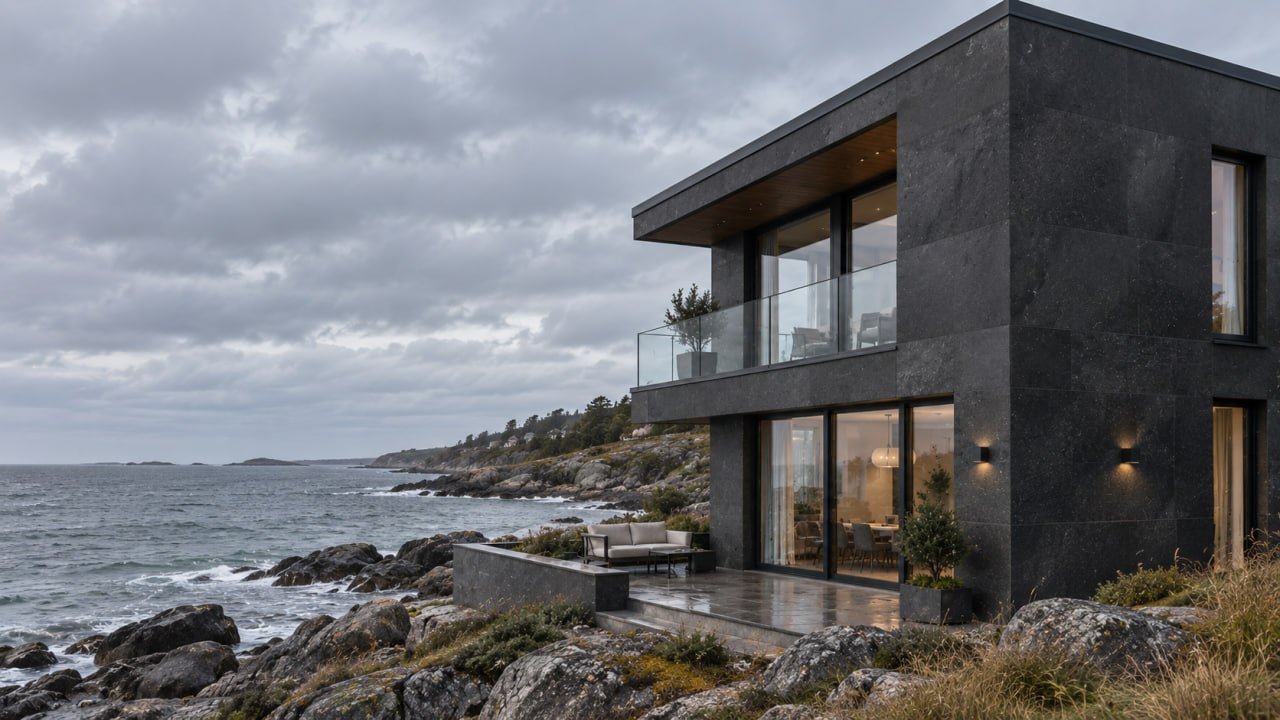
Salt air, humidity and wind load a façade far harder than an inland climate. Which cladding, which plinth colour and which details actually last by the sea.
A coastal climate is one of the hardest environments a façade can face. A house by the sea lives with damp air, wind, salt aerosols, sudden weather changes and strong sun. In those conditions the finish has to be more than good-looking: it has to be durable, practical and designed for long-term outdoor exposure.
If the material is chosen on appearance alone, a few seasons can bring water streaks, stains, fading, cracks, detachment and dirty deposits. Near the sea the whole system matters: the substrate, the insulation, the adhesive, the reinforcement, the final cladding and the protection of the technical details.
Why does a seaside façade age faster?
Salt, moisture and wind work together. Salt aerosols settle on the surface, humidity keeps the dirt in place, and wind constantly drives sand, dust and fine particles against the wall.
The most exposed areas are:
- the plinth and the lower part of the walls;
- the corners of the house;
- open, sun-facing façades;
- areas next to terraces and balconies;
- surfaces under sills and downpipes;
- entrance areas;
- walls with no canopy or protective overhang.
That is exactly where the finish shows its weak points first, if the material is not suited to this kind of load.
Why is salt dangerous for the finish?
Salt can stay on a façade after wind, fog, rain and spells of high humidity. If the surface resists moisture poorly or has vulnerable joints, salt gradually builds up in the sensitive areas.
The result can be whitish deposits, staining, faster soiling, damage to weak joints and the loss of a clean appearance. A seaside façade therefore has to be easy to clean and comfortable with regular contact with a damp environment.
Humidity: the real test for a façade system
In coastal areas a façade does not always dry out completely. Even without heavy rain, damp air acts on the surface constantly, and salt deposits push the load higher still.
Moisture-resistant cladding has to:
- keep its appearance at high humidity;
- not crack on the façade;
- not need constant repainting;
- clean easily of deposits and dust;
- suit the plinth, walls, corners and entrance areas;
- not overload the structure.
In these conditions it is not only the tile that counts, but also the right adhesive, the primer, the reinforcement and the protection of the junctions.
Why does lightweight cladding win?
By the sea a façade needs more frequent maintenance than in a calm climate, and heavy cladding adds difficulties: transport, lifting, installation, cutting, load on the substrate and more complicated spot repairs.
A lightweight finish is more practical because it:
- puts less load on the walls and the insulation;
- installs more easily in awkward areas;
- makes corners, reveals, plinths and terraces simpler to finish;
- suits the renovation of older houses better;
- simplifies logistics and moving material on site;
- lowers the risk of heavy rework during repairs.
KORDEKO flexible tile (PletaFlex) gives a stone appearance without massive cladding, which suits houses that need a practical, lightweight façade finish.
Which plinth colour is practical by the sea?
The plinth takes the heaviest load in a coastal climate: splashes, humidity, dust, salt, sand, shoe marks and dirt from paths. A very light plinth starts to look dirty quickly, while a very dark one shows salt and pale deposits.
Mid-range natural tones are more practical: grey-beige, warm grey, stone sand, soft graphite, brown-grey and natural stone shades. Texture helps hide everyday marks and makes the plinth look more stable over time.
Corners, reveals and junctions: the weak points
Wind and moisture test the quality of the technical details very quickly. If corners are not reinforced, reveals are poorly protected and the junctions to windows and flashings have gaps, the façade will start ageing precisely there.
Before the final cladding goes on, plan for reinforced corners, clean cuts, protected reveals, sealed junctions, correctly fitted sills, drip profiles and drainage that carries water away from the plinth. A coastal façade does not forgive improvised solutions: water and salt find the weak spots fast.
What changes if the house is insulated?
When façade insulation is carried out, the final finish in a coastal climate has to protect the system from moisture, wind and dirt. The reinforcement layer must be strong, the surface primed, and the adhesive suitable for external work.
Insulation and cladding cannot be treated separately. If water gets into weak joints or lingers at the plinth, the façade soils faster and needs repair sooner. The declared performance of construction products used in such a system is regulated across Europe by the Construction Products Regulation.
How do you reduce maintenance on a seaside façade?
Maintenance cannot be removed entirely — salt and dust will settle regardless. It can be made simpler:
- choose moisture-resistant cladding;
- avoid colours that show dirt easily;
- plan correct sills and drip profiles;
- do not allow permanent runs of water down the wall;
- protect the plinth and the entrance area;
- wash off salt deposits and dust periodically;
- keep an eye on gutters and junctions.
Common mistakes when choosing a seaside façade
Choosing on looks alone. A beautiful sample in a showroom does not mean the material will handle humidity, salt and wind.
A plinth that is too white. By the sea, dirt, deposits and water marks show up quickly on a white lower section.
Unprotected top edges. Without drip profiles and proper sills, water runs down the façade and leaves streaks.
Heavy cladding without calculation. The heavier the material, the higher the demands on the substrate, the fixings and the installation.
Skipping regular cleaning. Salt deposits are best not left on the surface for long; periodic washing preserves the look of the façade.
Conclusion
A seaside façade has to resist moisture, salt, wind, sun and frequent soiling. In those conditions lightweight, practical, moisture-resistant cladding has clear advantages: it is simpler to install, to maintain and to use on difficult architectural details.
KORDEKO flexible tile suits a coastal climate thanks to its low weight, its stone appearance and how easily it works on façades, plinths, corners, reveals, terraces and entrance areas. What matters is preparing the substrate correctly, protecting the details against water and choosing a practical colour. We looked at how a façade behaves season by season in our article on flexible façades, insulation and climate.
Frequently asked questions
Does flexible tile hold up in salty sea air?
Which plinth colour is most practical by the sea?
How often should a seaside façade be cleaned?
Need advice on your facade?
- Get a free consultation for your project
- Find out which material suits your facade
- We'll answer all your questions and help you choose